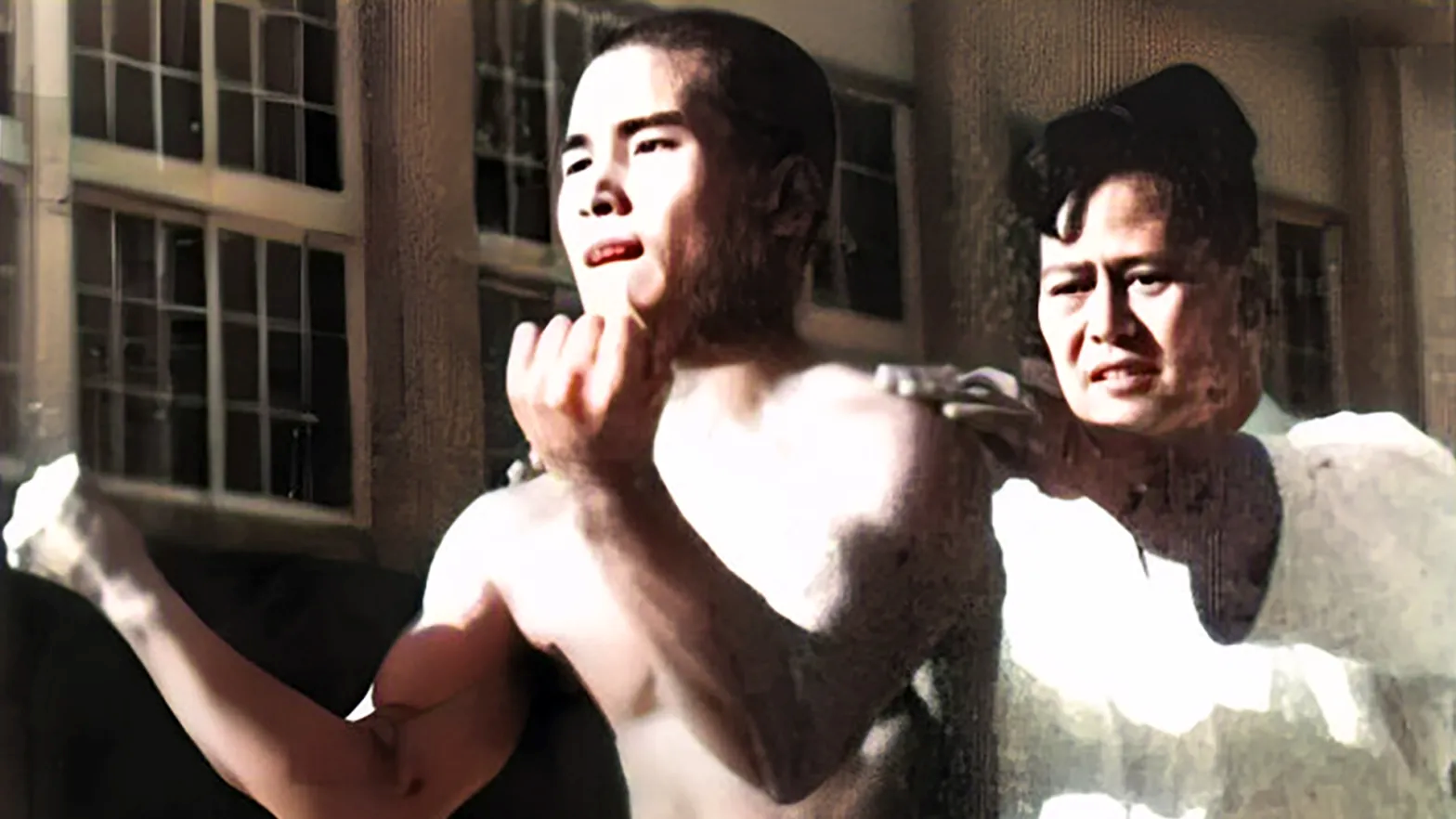
There are kata in Uechi-Ryū Karate that are more dramatic than Sanchin. Seisan gives us more obvious fighting movements, while Sanseiryū asks us to coordinate a larger and more complex vocabulary of technique. The bridging kata introduce combinations, angles, turns, and applications that often feel much closer to what a new student imagines karate is supposed to look like. Sanchin, by comparison, can appear almost painfully simple. We step forward, establish the hands, thrust, turn, breathe, and repeat. There are no spectacular jumps, elaborate combinations, or movements that immediately announce themselves as devastating fighting techniques. And yet Sanchin sits at the very center of Uechi-Ryū. We learn it first, practice it throughout our training, and, if we stay with the art long enough, eventually discover that we never really finish learning it.
Sanchin matters not because it contains every technique we will ever need, nor because endlessly repeating the kata somehow grants mystical abilities. It matters because Sanchin teaches us how to use the body. The techniques of the rest of Uechi-Ryū are built upon principles developed there: stance, posture, breathing, balance, alignment, rooting, tension, relaxation, concentration, awareness, and the ability to connect the entire body into a single action. Sanchin is deliberately simple enough that there are relatively few places for our mistakes to hide. In that sense, it is less a collection of techniques than a laboratory in which we continually examine how we stand, move, breathe, generate force, receive force, and maintain ourselves under pressure. The fascinating thing is that the Sanchin we practice after twenty years is, in a very real sense, not the same Sanchin we practiced after twenty weeks. The kata has barely changed. We have.
Sanchin occupies a special historical place within Uechi-Ryū. When Kanbun Uechi returned from his years of study in China and eventually began teaching the art that would become Uechi-Ryū, the system centered around three principal kata: Sanchin, Seisan, and Sanseiryū. The additional kata familiar to modern Uechi practitioners were developed later as bridges within the curriculum. Sanchin therefore is not merely an introductory exercise created to prepare beginners for the “real” karate that comes afterward. It belongs to the oldest structural core of the system. To practice Sanchin is to practice something very close to the foundation upon which Kanbun Uechi built his teaching.
The word Sanchin is commonly translated as “three battles,” “three conflicts,” or “three challenges,” and generations of martial artists have offered different explanations for what those three conflicts represent. Body, mind, and spirit is perhaps the most familiar interpretation, although others have described relationships among breathing, movement, and awareness, or between internal and external forces. It is probably wise not to become too dogmatic about a single poetic explanation. What matters in practice is the idea of integration. Sanchin begins by asking us to coordinate things that initially feel separate. The feet do one thing, the knees another, the hips another, while the hands, shoulders, breathing, posture, and eyes all demand attention. Over time those separate pieces begin to function together.
A beginner naturally moves as a collection of parts. The arm strikes, the leg steps, the shoulders tense, and the torso follows afterward. We may intellectually understand that the whole body should participate in a technique, but knowing that and actually doing it are very different things. An experienced practitioner begins to move as a connected structure. The floor, feet, legs, hips, torso, shoulder, arm, and hand participate in the same action. Force is no longer produced by an isolated limb but transmitted through an organized body. Sanchin is where that process begins, although understanding it fully may occupy an entire lifetime of practice.
When we first learn Sanchin, most of our attention is necessarily external. We are concerned with where the feet go, how wide the stance should be, how the toes and knees should be positioned, where the elbows belong, whether the shoulders are down, where the fingertips should point, how the turns are performed, and when and how we are supposed to breathe. The instructor adjusts a foot, presses a knee into position, lowers an elbow, straightens the spine, or tells us for the fiftieth time to relax our shoulders. At this stage Sanchin is largely an exercise in learning the physical architecture of Uechi-Ryū.
The Sanchin stance introduces a distinctive way of organizing the lower body. We seek stability without planting ourselves so rigidly that we cannot move. The feet and knees help organize and protect the centerline, while the pelvis, spine, shoulders, and head are arranged into a posture from which force can be delivered and received. The arms establish the characteristic Sanchin position that appears again and again throughout the system. None of this is particularly glamorous, but it is enormously important because poor structure eventually limits everything built upon it. Poor posture reduces power, raised shoulders interfere with efficient movement, collapsed structure makes receiving force more difficult, excessive tension slows technique, and a weak relationship with the ground turns punches and thrusts into isolated movements of the arms rather than actions of the whole body.
This early stage should never be dismissed as merely superficial. Form matters. We need a reasonably stable physical structure before we can begin investigating the more subtle principles hidden within it. At the same time, there is a danger in becoming too attached to outward appearance. A student can begin to believe that looking like Sanchin is the same thing as understanding Sanchin. It is not. The shape provides the container, but eventually we have to discover what is happening inside that shape.
As the sequence becomes familiar and the student no longer has to consciously remember every step and movement, attention begins turning inward. One of the first major questions is tension. How much muscular tension should there be? This is one of the great ongoing conversations in Sanchin practice. Beginners frequently need muscular engagement simply to understand structure. The abdomen needs to support posture, the legs need to maintain the stance, the back needs organization, and the arms cannot simply hang without intent. Traditional conditioning and Sanchin checking can further reinforce the idea that the body must possess structural integrity. The danger comes when structural integrity becomes confused with maximum muscular contraction.
It is entirely possible to perform an impressive-looking Sanchin while being so tense that the body has become inefficient. The shoulders rise, the muscles harden, breathing becomes forced, movement slows, and the practitioner appears powerful largely because every visible muscle is working at once. Yet that kind of tension often sacrifices speed, sensitivity, adaptability, and endurance. One of the important transitions in Sanchin training occurs when the student begins distinguishing useful tension from unnecessary tension. The legs can be engaged without being frozen. The abdomen can support the torso without remaining in a permanent crunch. The arms can possess structure without every muscle being contracted at maximum effort. Strength and relaxation gradually stop seeming like opposites.
This realization becomes increasingly important throughout karate because real movement is a continual interplay between relaxation and contraction. A strike that begins rigidly is generally slower than one that travels with relative relaxation and becomes organized at the moment force is delivered. A body that remains permanently tense has difficulty changing direction, sensing pressure, or adapting to an opponent. Sanchin gradually teaches us something that sounds contradictory when we first hear it: we can become stronger by learning where not to be strong. The goal is not maximum tension. The goal is appropriate tension.
Breathing undergoes a similar transformation. Beginners are often extremely conscious of Sanchin breathing because they are trying to remember it alongside everything else. This can make the breath seem artificial at first. We think about every inhalation and exhalation while simultaneously worrying about our stance, hands, shoulders, posture, thrusts, and turns. With practice, breathing becomes less of an additional task and more an integrated part of movement. It influences tension, endurance, posture, concentration, and emotional state, and it prevents the common tendency to unconsciously hold the breath during effort.
The exact expression of Sanchin breathing varies somewhat among teachers and lineages, and students are generally best served by learning the method taught within their dojo rather than attempting to manufacture something exotic. The deeper lesson is broader than any particular breathing pattern. Breathing should support karate rather than interfere with it. Eventually the practitioner should be able to move, receive pressure, exert force, and remain mentally composed without the breath becoming either forgotten or exaggerated. What began as something we had to consciously remember gradually becomes part of how the body organizes itself.
After several years, Sanchin begins serving another purpose. It becomes a diagnostic tool. Complex kata can sometimes conceal weaknesses because so much is happening. Speed can hide poor balance. Large movements can hide weak alignment. Familiar combinations can carry us from one position to another without requiring us to examine the transitions closely. Sanchin offers fewer hiding places. If the shoulders continually rise, Sanchin reveals it. If the stance collapses under pressure, Sanchin reveals it. If we hold our breath, lose balance in a turn, move our hands independently of our body, or accumulate unnecessary tension, Sanchin reveals those things as well.
This is one reason returning to Sanchin after learning the more advanced kata can be so productive. Seisan and Sanseiryū teach lessons about movement, distance, timing, power, application, and body mechanics that we eventually bring backward into Sanchin. A movement we have performed thousands of times suddenly feels different because we understand something we did not understand before. The curriculum appears to move forward, but understanding frequently moves backward. We encounter a principle somewhere later in our training only to discover that it had been sitting quietly inside Sanchin from the beginning.
Traditional Sanchin checking, commonly called shime, can become part of this process of discovery. An instructor may examine stance, posture, muscular engagement, breathing, concentration, and structural stability while the student performs the kata. Depending upon the teacher and training tradition, this can involve pressure, pushes, pulls, and controlled contact to different parts of the body. Properly understood, the purpose is not to demonstrate how much punishment a student can endure. It is feedback. If pressure on the shoulder collapses the stance, there is something to learn. If a push causes the practitioner to lean backward instead of transmitting pressure through the structure into the floor, there is something to learn. If merely anticipating contact causes someone to stop breathing and tense every muscle, that also teaches us something.
Good Sanchin checking is therefore a conversation between the instructor and the student’s structure. The question is not simply, “Can you take a hit?” The questions are whether you can remain organized, whether you can receive pressure without losing posture, whether you can breathe under stress, and whether you can remain mentally present without becoming frightened or rigid. More force does not automatically create more understanding. Age, health, experience, injuries, body type, and individual anatomy all matter. The purpose of testing should always be development rather than toughness for toughness’s sake. Good Sanchin checking should make the student’s Sanchin better, not merely demonstrate that the instructor can hit hard.
Something particularly interesting often begins happening after years of practice: Sanchin gets smaller. The movements have not necessarily changed very much, but the visible effort begins disappearing. Beginners frequently try very hard to perform Sanchin. Every movement is emphasized, every contraction becomes visible, and every thrust seems intended to demonstrate effort. Experienced practitioners often begin doing the opposite. They remove things. The shoulders become quieter, the breathing becomes less conspicuous, the stance feels stable without appearing forced, and the hands travel without unnecessary movement. The body settles naturally rather than being held rigidly in position. Instead of continually adding effort, the practitioner begins subtracting everything that is not needed.
This is one of the great lessons of long-term martial arts practice. Expertise often looks simpler than imitation because the expert has learned what can be removed. That does not mean less is happening internally. In many ways, more is happening, but the pieces are cooperating instead of competing. The floor supports the stance, the legs support the torso, the torso supports the technique, breathing accompanies movement, and awareness remains present without becoming strained. Sanchin stops feeling like a collection of correct positions that must be consciously held and begins feeling like a continuously connected body moving through space.
After still more years, Sanchin can stop feeling primarily like a kata about techniques and become a kata about principles. The thrust is no longer simply a Sanchin thrust; it becomes an opportunity to investigate how force travels through the body. A step is no longer merely the method of moving forward; it becomes an examination of whether structure can be preserved while the base changes. A turn becomes an exploration of balance, center, and coordinated rotation. Posture becomes an investigation into how little muscular effort is required to maintain useful strength. Breathing becomes an expression of calm while working. Even the eyes become part of the exercise, developing awareness rather than merely looking straight ahead.
At this stage, Sanchin begins appearing everywhere else in the system. A wauke contains Sanchin. A strike contains Sanchin. A grab, kick, turn, entry, and movement through resistance can all contain Sanchin. This does not mean that every technique should literally resemble the movements of the kata or that a practitioner should try to fight while frozen in a formal Sanchin stance. Quite the opposite. The purpose is for the principles developed in formal Sanchin practice to remain after the visible form disappears. Structure, connection, balance, breathing, and efficient use of tension become transferable qualities rather than positions we consciously assume.
One of the great paradoxes of advanced Sanchin is that it may begin to feel softer at the same time that it becomes structurally stronger. This is difficult to appreciate early in training because we naturally equate visible muscular tension with strength. If one practitioner is shaking with exertion while another appears comparatively relaxed, the first person seems to be working harder. But karate is not a contest to determine who can contract the greatest number of muscles at once. Efficient movement depends upon sequencing. Some muscles stabilize while others move. Some areas remain relatively relaxed until the moment they are needed. Force passes through aligned structures rather than being created solely by isolated muscular contraction. The result is a body that can be both stable and mobile.
The distinction is the difference between rigidity and connection. A rigid structure can resist force, but its options are limited. A connected structure can receive, redirect, reorganize, and respond. This does not mean becoming limp or abandoning muscular strength. It means learning to create structure without becoming trapped inside it. For many practitioners, this may be one of the deepest lessons of Sanchin and one that takes decades rather than months to fully appreciate.
Sanchin also has something particularly valuable to offer as we grow older. Youth allows us to compensate for technical errors with strength, speed, flexibility, endurance, and athleticism. Age gradually removes some of those advantages, which can be frustrating, but it can also make our karate more honest. Someone practicing Sanchin in their sixties or seventies should not necessarily attempt to reproduce exactly what their body did at twenty. Bodies change. Injuries accumulate, joints become less tolerant of unnecessary strain, recovery takes longer, balance requires greater attention, and medical or cardiovascular considerations may become important.
The principles of Sanchin, however, do not become less useful with age. They may become more useful. An older practitioner may care less about producing maximum muscular tension and more about alignment, economy, balance, and efficiency. Sanchin checking may become less about demonstrating how much impact can be endured and more about maintaining structure under intelligent, controlled pressure. The stance may need to accommodate the realities of an individual’s hips, knees, or ankles while preserving the principles that make the stance function. None of this represents watering down the kata. It represents understanding what the kata is actually trying to teach. A martial art intended for lifelong study must be capable of growing older with the people who practice it.
This is why it is misleading to think of kata simply as levels that we graduate through. We often imagine that we learn the beginner kata, move on to intermediate kata, eventually reach the advanced material, and leave the early lessons behind. Sanchin refuses to fit neatly into that model. We learn it first and then spend the rest of our training discovering what it means. The white belt’s Sanchin may be about remembering where the feet go. The green belt’s Sanchin may be about posture and tension. The brown belt may be concentrating on breathing and connection. For the new black belt, Sanchin may become an examination of body mechanics. Ten years later it may be about efficiency, and twenty years later it may be about softness, awareness, timing, or structural changes so subtle that someone standing across the dojo cannot see them at all.
Then, perhaps after decades of training, an instructor says something almost identical to what your first teacher told you during your first month of karate: “Relax your shoulders.” The words have not changed, but suddenly they mean something completely different. That is one of the peculiar pleasures of serious martial arts practice. The lessons themselves do not necessarily become more complicated. We simply become capable of understanding them more deeply.
That is ultimately why Sanchin matters. It gives Uechi-Ryū a common language shared across generations and levels of experience. Beginners practice Sanchin, black belts practice Sanchin, teachers practice Sanchin, and senior instructors who have spent most of their lives in karate still return to it. Two people can stand beside one another performing exactly the same kata while working on entirely different things. One may be trying to remember the sequence, another learning to maintain structure, another discovering where to relax, and another investigating something so subtle that it is almost invisible from the outside.
There is something beautiful in that continuity because Sanchin reminds us that fundamentals are not the things we leave behind when we become advanced. Understanding the fundamentals more deeply is what becoming advanced means. We return year after year to the same stance, the same steps, the same turns, the same thrusts, and the same breathing. On the surface, remarkably little changes. Underneath, almost everything does.
Perhaps that is the real secret of Sanchin. The kata does not change very much. We do.