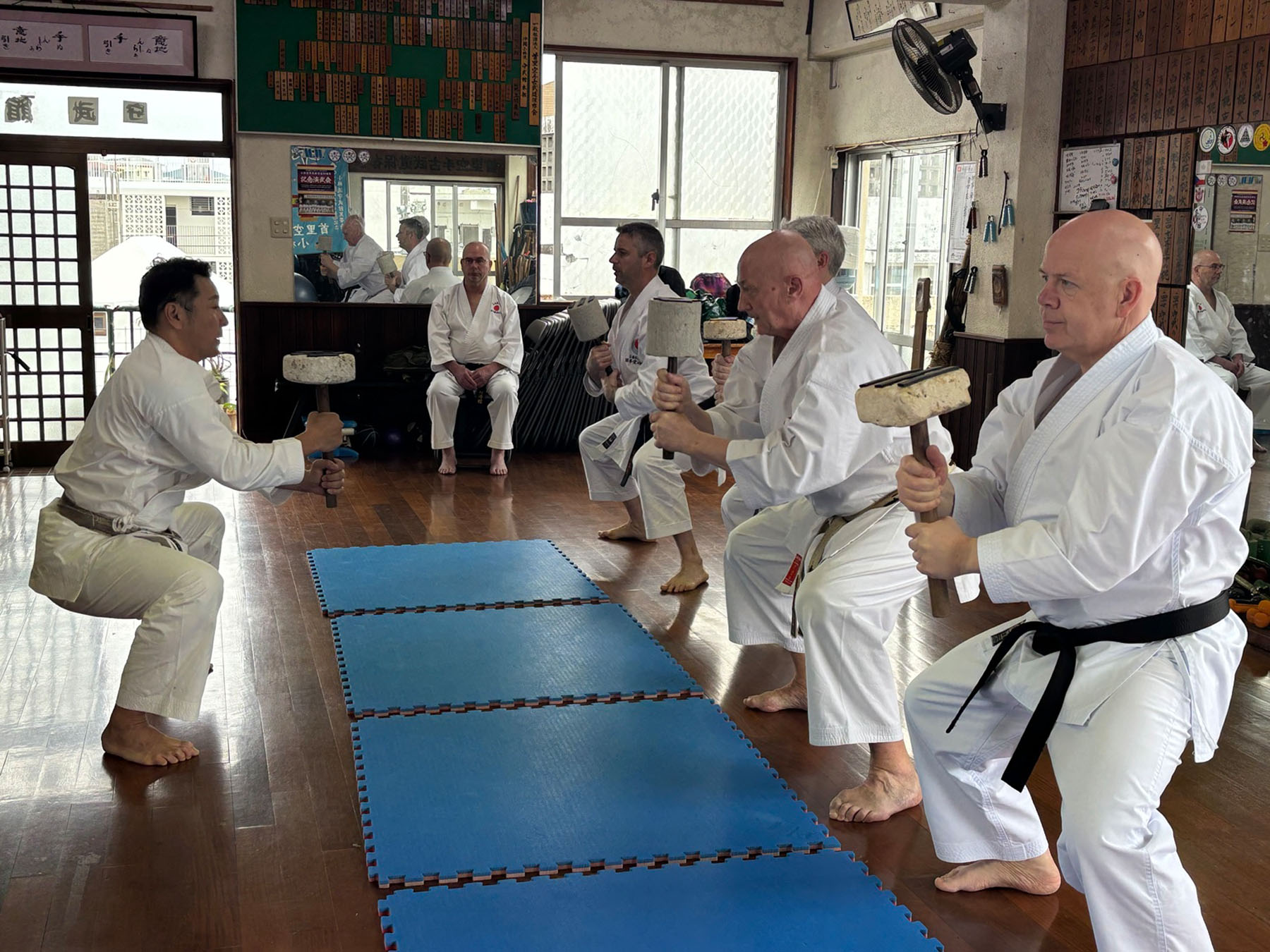
Walk into an old-fashioned Okinawan karate dojo and you may notice that some of the most important training equipment looks as though it belongs in a farmyard or workshop rather than a modern gym. There may be ceramic jars sitting along a wall, stones mounted on wooden handles, a flexible wooden striking post wrapped with rope, an awkward oval of heavy iron, or buckets filled with sand. None of it is particularly sophisticated. There are no electronic displays, carefully engineered machines, or chrome-plated weight stacks. Yet these simple implements represent one of the most distinctive aspects of traditional Okinawan karate: hojo undo, the supplementary training used to build a body capable of expressing karate properly.
The Japanese term hojo undo (補助運動) is usually translated as “supplementary exercises” or “supplementary training.” That translation is accurate, but it can make the practice sound optional, as though it were something added to karate after the important work had already been done. Traditionally, however, hojo undo was often understood as part of the process through which the karate practitioner physically developed the qualities necessary to make kata and technique functional. In traditional Gōjū-ryū curricula, for example, hojo undo is explicitly placed alongside preparatory exercises, fundamental kata, advanced kata, and kumite as part of the training method.
This is an important point because traditional Okinawan karate was never simply a collection of movements to be memorized. Kata provided the technical vocabulary, but the practitioner still had to construct the body capable of using that vocabulary. A punch performed in the air does not teach everything about striking resistance. A gripping motion in kata does not automatically produce a powerful grip. A stance does not become rooted merely because one knows where the feet are supposed to be placed. The body must be strengthened, conditioned, coordinated, and educated. Hojo undo was one of the principal ways this was accomplished.
More Than Strength Training
It is tempting to describe hojo undo simply as the Okinawan version of weight training, but that misses much of its purpose. A modern strength program usually asks how much weight a person can lift, how many repetitions can be completed, or how effectively a particular muscle group can be developed. Hojo undo asks a somewhat different question: What kind of body does karate require?
The answer is not merely a stronger body. Karate requires strength that can be connected from the ground through the legs, hips, torso, shoulder, arm, and hand. It requires the ability to maintain posture while applying force, to grip and pull while moving, to rotate the forearms without losing structural integrity, to strike something solid without collapsing the wrist, and to alternate between tension and relaxation. Traditional equipment therefore tends to place the practitioner in positions and movement patterns that resemble the mechanics found in kata.
This explains why many hojo undo implements seem deliberately awkward. A perfectly balanced dumbbell is designed to be easy to control. A chiishi, with its heavy stone or concrete weight mounted at the end of a wooden shaft, is intentionally unbalanced. As the weight moves away from the body, leverage magnifies its effect. The wrist, forearm, elbow, shoulder, back, abdomen, and legs must cooperate to control it. The exercise becomes less about isolating a muscle and more about organizing the entire body.
Traditional Okinawan hojo undo therefore develops what might reasonably be called a karate body. It is not necessarily the largest or most muscular body. It is a body whose strength has been shaped around the demands of the art.
The Chiishi: Strength Through Leverage
Among the implements most closely associated with Okinawan hojo undo is the chiishi, traditionally a stone weight fixed to the end of a wooden handle. Modern versions are often made by pouring concrete into a mold around a wooden shaft. Its construction is extraordinarily simple, but that simplicity conceals a remarkably versatile training device.
Because the weight is concentrated at the far end of the handle, the chiishi places substantial demands upon the fingers, hand, wrist, and forearm. Exercises commonly involve circles, presses, extensions, rotations, lifting motions, and movements resembling blocks or controlling techniques. The practitioner must prevent the wrist from collapsing while simultaneously stabilizing the shoulder and torso. Traditional Gōjū-ryū sources specifically associate chiishi work with developing the grip, wrists, shoulders, and forearms and with strengthening mechanics found in karate techniques.
The value of the chiishi becomes particularly obvious when one stops thinking of karate blocks as merely defensive collisions between forearms. Movements such as hiki-uke, circular receiving motions, hooking actions, and many of the rotations found throughout Okinawan kata can also represent grabbing, pulling, controlling, twisting, and disrupting an opponent. The chiishi builds precisely the kind of connected wrist and forearm strength such applications require.
Heavy chiishi are impressive, but excessive weight can actually defeat the purpose. If the practitioner must distort posture, shrug the shoulders, abandon proper breathing, or use momentum simply to move the implement, he may be training around the karate rather than through it. As with much traditional training, correct structure should determine the load rather than ego determining it.
Nigiri Game: The Gripping Jars
Another iconic piece of Okinawan training equipment is the nigiri game, or gripping jar. These are ceramic jars traditionally grasped around their rims with the fingertips. Sand, water, stones, or other material can be added gradually to increase the weight.
At first glance the exercise seems almost primitive: pick up the jars and walk. Yet it develops something that modern gym training frequently neglects—the strength of the fingers themselves. Rather than wrapping the entire hand comfortably around a bar, the practitioner must maintain pressure through the fingertips while keeping the wrist and forearm structurally aligned.
Nigiri-game training is especially associated with Gōjū-ryū and with the physical qualities cultivated through Sanchin. The practitioner may walk in Sanchin stance while carrying the jars, maintaining posture, controlled breathing, shoulder position, abdominal engagement, and continuous gripping pressure. The result is not simply stronger hands. The exercise connects the fingers to the forearms, shoulders, torso, stance, and breath.
This matters because Okinawan kata contain an extraordinary number of grabbing movements. Hands seize wrists, clothing, arms, necks, and limbs. Techniques pull an opponent off balance before striking. Open-hand formations are used not merely for dramatic appearance but for controlling and attacking. Strong fingers and hands therefore have an obvious combative purpose.
Ishi Sashi: The Stone Padlock
The ishi sashi resembles a large stone or iron padlock with a handle incorporated into its shape. Used singly or in pairs, it can be swung, raised, rotated, pressed, and manipulated through movements resembling those found in karate.
In modern terms one might compare the ishi sashi loosely to a kettlebell, although the shape and traditional exercises make the comparison imperfect. Its displaced center of gravity forces the practitioner to control the weight dynamically. The shoulders, elbows, wrists, trunk, and legs must work together.
As with the chiishi, the objective is not merely to lift the object. The practitioner learns to move weight without allowing the body to become disconnected. The stance supports the torso, the torso supports the shoulder, and the shoulder supports the arm. When performed correctly, the same concept should appear when striking, blocking, pulling, or throwing.
This whole-body connection is one of the recurring themes of hojo undo. The hand may be the visible end of a technique, but the hand is not supposed to work alone.
The Kongoken: Learning to Move a Body
Perhaps the strangest-looking piece of traditional Okinawan training equipment is the kongoken, a large elongated oval of heavy metal. Unlike the compact chiishi or gripping jars, the kongoken can approximate the scale of another human body. It can be lifted, pushed, pulled, rolled, carried, turned, and manipulated from numerous angles.
The implement became particularly associated with Gōjū-ryū under Chōjun Miyagi. A widely repeated tradition holds that Miyagi encountered a similar device used in physical or wrestling training during his travels and incorporated it into his karate training. Whatever the precise route by which it entered the system, it became one of the characteristic tools of Okinawan Gōjū-ryū hojo undo.
Its value becomes clearer when karate is understood at close range. Kata contains more than punching and kicking. There are movements that can be interpreted as clinching, turning, off-balancing, twisting, controlling the head and arms, disrupting posture, and throwing. The kongoken provides resistance against which those whole-body mechanics can be developed. Traditional descriptions of the implement emphasize this connection between its human-sized proportions and the manipulation of another body.
A barbell is designed primarily to be lifted. The kongoken can be wrestled with. That difference says something important about the purpose of traditional karate conditioning.
The Makiwara: Teaching the Strike
No piece of equipment is more strongly associated with traditional karate than the makiwara, the flexible striking post. Unfortunately, it is also one of the most misunderstood.
Makiwara training is sometimes portrayed as an exercise in hardening the knuckles until the hands become nearly indestructible. Conditioning does occur, particularly with sustained training, but treating that as the primary purpose reduces a sophisticated training tool to little more than a test of toughness.
The real value of the makiwara is feedback.
When punching the air, considerable structural error can go unnoticed. The wrist may be slightly misaligned. The elbow may drift outward. The shoulder may rise. The hips may stop before the hand reaches the target. The practitioner may lean, reach, or tense at the wrong moment. Air does not complain.
The makiwara does.
A properly constructed traditional makiwara flexes when struck. That resistance travels back through the fist and into the body, immediately revealing whether the structure of the technique can withstand impact. The practitioner learns how to align the wrist, elbow, shoulder, torso, hips, knees, and feet behind the strike. He learns that a punch does not begin at the fist. It begins with the organization of the entire body.
The makiwara can also be used for open-hand strikes, elbows and other techniques depending upon the tradition. The essential principle remains the same: learning to transmit force into resistance while maintaining correct structure.
The Tan and the Okinawan Barbell
Long before modern barbells became common training equipment, Okinawan practitioners used the tan, a weighted bar traditionally constructed with stone or other heavy material at each end. Exercises could include lifting, pressing, squatting, turning, and movements intended to strengthen the legs, hips, back, shoulders, and arms.
The resemblance to modern weightlifting should not obscure the karate-specific intention. Squatting under resistance strengthens the legs, certainly, but the practitioner is also developing the ability to keep the torso organized over the stance. Rotational exercises can strengthen the connection between hips and upper body. Pressing and carrying cultivate stability under load.
Modern barbells can reproduce many of these benefits, and there is nothing magical about using stones simply because earlier generations did so. The traditional implement is valuable because the exercises surrounding it were developed within a karate context. The important thing is not nostalgia for old equipment but preservation of the training principle.
Tetsu Geta, Makiage Kigu, and Jari Bako
Traditional hojo undo contains numerous other implements, some of which are encountered less frequently today. Tetsu geta, or iron sandals, add weight to the feet and legs. They were used carefully to strengthen the lower body and develop control through leg movements. The goal was not to perform wild, heavy kicks but to strengthen the musculature involved in raising and controlling the leg.
The makiage kigu is essentially a traditional wrist roller. A weight hangs from a rope attached to a handle, and the practitioner winds and unwinds the rope by rotating the handle. The resulting fatigue in the fingers, wrists, and forearms quickly demonstrates why such a simple device survived as part of traditional training.
The jari bako is a container filled with sand, gravel, beans, or similar material into which the hands and fingers are repeatedly thrust, opened, closed, twisted, or driven. It develops the hands and fingers for gripping and certain open-hand techniques. Traditional lists of Okinawan hojo undo equipment commonly include these implements alongside chiishi, nigiri game, makiwara, tan, and other devices.
There were also bundles of bamboo or other materials that could be squeezed, twisted, struck, or manipulated, as well as countless locally improvised tools. Okinawan karate developed in a culture where practitioners often constructed training equipment themselves from whatever suitable materials were available. The simplicity of the equipment is therefore part of the tradition rather than a deficiency.
Body Conditioning Is Hojo Undo Too
Hojo undo should not be reduced exclusively to objects. Partner conditioning has long occupied an important place in Okinawan karate as well. Forearms may be struck against one another progressively. The legs, abdomen, shoulders, or torso may receive controlled impact. Exercises commonly described as kote kitae, ude kitae, or ashi kitae strengthen and condition the body while teaching the practitioner how to receive force without panic or structural collapse.
As with makiwara practice, intelligent conditioning is progressive. The objective is adaptation, not injury. Bruising oneself until sensation disappears is not evidence of advanced karate. Proper conditioning develops gradually while preserving healthy joints, nerves, bones, and connective tissue.
This is particularly important today because the mythology surrounding old karate can sometimes encourage people to imitate extreme practices without understanding their purpose. Traditional does not mean reckless. A method that permanently damages the hands or joints eventually makes karate worse, not better.
Hojo Undo in Uechi-Ryū
The term deserves special clarification when discussing Uechi-ryū, because Uechi practitioners often use hojo undo somewhat differently from Gōjū-ryū practitioners.
Within Uechi-ryū, hojo undo commonly refers to a defined series of supplementary technique exercises practiced as part of the curriculum. These drills isolate and repeat important movements from the system so they can be developed before being fully expressed in kata, bunkai, or partner practice. Uechi-ryu.com describes the exercises as sequences drawn from important parts of the Uechi system rather than merely general conditioning drills.
This does not make the Uechi usage incompatible with the broader Okinawan meaning. In fact, it reveals the underlying idea of the term. Hojo undo is supplementary training—training designed to build qualities that support the central art. In one dojo that may mean chiishi and gripping jars. In another it may mean repeated striking and blocking combinations. In still another it may include body conditioning, partner exercises, makiwara work, or all of these together.
Uechi-ryū also retains an especially strong tradition of body conditioning and Sanchin-based physical development. The system’s characteristic use of the fingertips, toe kicks, forearms, palms, and close-range techniques makes progressive conditioning particularly relevant. The important lesson is that hojo undo should never become detached from the karate it is intended to support.
The Relationship Between Hojo Undo and Kata
This is perhaps the central principle of traditional hojo undo: the equipment serves the kata; the kata does not serve the equipment.
It is possible to become extremely proficient at swinging a chiishi without improving one’s karate. It is possible to lift enormous weights without understanding how to connect the body during a strike. It is possible to develop thick calluses on the knuckles while continuing to punch with poor structure.
The purpose of hojo undo is therefore not simply accomplishment within the exercise itself. The practitioner should continually ask what quality the exercise is developing and where that quality appears in karate.
When gripping jars, where does that grip appear in kata?
When rotating a chiishi, what receiving, pulling, or controlling action does the movement resemble?
When manipulating a kongoken, what does it teach about controlling another person’s center of gravity?
When striking a makiwara, can the same body connection be felt during kata?
When performing body conditioning, can posture and breathing be maintained under pressure?
Once those questions are asked, hojo undo ceases to be an eccentric collection of old Okinawan exercises. It becomes a laboratory for understanding karate.
Sanchin and the Construction of the Body
Nowhere is this relationship clearer than in the connection between hojo undo and Sanchin.
Sanchin is sometimes described simply as a breathing kata or a tension kata, but those descriptions are incomplete. In Okinawan systems that preserve it, Sanchin teaches fundamental principles of posture, stance, breathing, muscular organization, rooting, tension and relaxation, and whole-body connection. Traditional Gōjū-ryū curricula explicitly treat Sanchin and Tensho as fundamental kata through which breathing, tension, relaxation, physical development, and martial attitude are cultivated.
Hojo undo places additional resistance against those same principles. Carry the gripping jars while walking Sanchin and weakness in the posture becomes obvious. Manipulate a chiishi while maintaining the stance and the relationship between the hand and center becomes tangible. Receive controlled impact while preserving Sanchin structure and the kata becomes something experienced rather than merely performed.
The equipment provides resistance. Sanchin provides organization.
Together they help create the characteristic connected body found in traditional Okinawan karate.
Old Equipment and Modern Training
None of this requires rejecting modern exercise science. A modern karateka can benefit enormously from barbells, dumbbells, kettlebells, resistance bands, medicine balls, and intelligently designed strength programs. There is no virtue in using a stone simply because it is a stone.
What traditional hojo undo offers is specificity.
A kettlebell can substitute reasonably well for certain ishi-sashi exercises. A modern wrist roller can perform the function of a makiage kigu. Weighted carries can reproduce some aspects of nigiri-game work, although ordinary handles will not challenge the fingertips in quite the same way. Resistance bands can strengthen movements resembling particular karate techniques.
The question should therefore not be whether the equipment is ancient or modern. The question should be whether the exercise preserves the qualities we are trying to develop.
Traditional Okinawan karate has always been practical. If an inexpensive bucket of sand develops the hands effectively, there is little reason to replace it with an expensive machine merely because the machine looks more advanced.
Training Without Destroying the Body
There is also a lesson here for contemporary practitioners who romanticize the severity of old training. Hojo undo should strengthen karateka, not cripple them.
Weights should increase progressively. Makiwara resistance should be appropriate to the practitioner’s experience. Finger conditioning should proceed slowly. Joint alignment matters. Partner conditioning should be cooperative rather than competitive. Pain that signals injury is not something to be conquered through character.
This is especially important for students who hope to practice karate throughout their lives. The ultimate test of a conditioning system is not what it allows someone to endure at twenty-five, but whether it helps that person continue training effectively at fifty, sixty, seventy, and beyond.
Traditional karate is a lifetime discipline. Its conditioning methods should support that goal.
The Lesson of the Stone and the Jar
There is something deeply Okinawan about hojo undo. Karate itself emerged from Okinawa’s distinctive history and cultural environment and remains recognized there as an important traditional cultural inheritance. The Okinawa Karate Kaikan today explicitly describes its mission in terms of preserving, transmitting, and developing Okinawan karate as a unique cultural heritage. Hojo undo belongs to that inheritance because it preserves not merely old equipment but an older way of thinking about martial training.
The lesson is one of simplicity. You do not need elaborate equipment to become strong. You need intelligent resistance, consistent practice, correct movement, and time.
A stone on a stick can teach the wrist.
A pair of jars can teach the hands.
A wooden post can teach the punch.
A heavy iron frame can teach you how to move another body.
A kata can teach the pattern.
But only practice can build the person capable of using it.
That is ultimately what hojo undo contributes to traditional Okinawan karate. It occupies the space between knowing a technique and possessing it. Kata teaches what the body should do; hojo undo patiently transforms the body so that it can actually do it.
The implements themselves are almost embarrassingly simple. Stone, wood, iron, clay, rope, sand. Yet generations of Okinawan karateka understood something that modern practitioners can easily forget: sophisticated martial skill does not necessarily require sophisticated technology.
Sometimes all that is required is a heavy stone, a wooden handle, good instruction, and a willingness to repeat the movement thousands of times until the lesson is no longer contained in the equipment.
It is contained in the body.