There is a peculiar kind of insecurity that sometimes follows us into art museums. We may enter a gallery perfectly confident in what we find beautiful, only to begin questioning ourselves when we notice which paintings receive the largest crowds, which artists appear most prominently in the catalog, or which works are accompanied by long explanations telling us why they are important. We stand before a canvas covered with fractured shapes, an enormous field of color, or an installation assembled from ordinary objects and wonder whether there is something we are supposed to be seeing that we simply do not understand. Then, almost inevitably, comes the uncomfortable question: Am I allowed to say that I don’t like this?
Of course you are.
There is no requirement that an educated person admire every important work of art. There is no entrance examination for cultural sophistication requiring us to prefer abstraction over realism, conceptual art over landscape painting, or the avant-garde over the traditional. You are perfectly free to walk through a museum filled with celebrated twentieth-century masterpieces and discover that what you really want to look at is a beautifully rendered portrait, a luminous landscape, a Renaissance altarpiece, or a Victorian painting filled with medieval knights and tragic heroines. Your preferences do not require the approval of a critic, curator, professor, collector, or fashionable acquaintance.
The art you love needs no apology.
Personally, I generally prefer representational art. I am drawn to paintings in which I can recognize the world—or at least some imagined version of it. I love portraiture. I love landscapes. I admire the extraordinary ability of an artist to capture the expression of a face, the texture of fabric, the particular character of sunlight, the atmosphere of a distant horizon, or the personality of a person who has been dead for hundreds of years. There is something almost miraculous about standing before a great portrait and realizing that pigment applied to a flat surface has somehow become a human presence.
I am particularly fond of the Pre-Raphaelites. Give me John Everett Millais, Dante Gabriel Rossetti, William Holman Hunt, or Edward Burne-Jones and I can happily remain in the gallery for a very long time. I love the brilliant colors, obsessive details, literary subjects, medieval fantasies, beautiful faces, elaborate costumes, flowers, landscapes, symbolism, romance, melancholy, and occasional excess of it all.
And excess there certainly is.
The Pre-Raphaelites have never enjoyed universal critical approval. In fact, it is worth remembering that they began as rebels rather than defenders of artistic conservatism. Founded in 1848 by Millais, Rossetti, Hunt, and their companions, the Pre-Raphaelite Brotherhood rejected many conventions promoted by Britain’s academic art establishment. Their intense colors, minute observation of nature, unconventional religious imagery, literary subjects, and refusal to idealize everything they depicted could be genuinely shocking to Victorian audiences. Tate today describes their early work in terms of rebellion against academic convention, while exhibitions have increasingly reconsidered them as part of the Victorian avant-garde rather than merely makers of pretty romantic pictures.
That history contains a useful lesson. What one generation dismisses as strange, offensive, sentimental, ugly, backward-looking, or unserious can be reconsidered by another. Artistic reputations change. Critical fashion changes. The boundaries between radical and traditional are themselves unstable. The Pre-Raphaelites whom someone might now dismiss as hopelessly romantic were once young artists challenging an establishment.
But even if none of that were true, I would still be permitted to love their paintings.
That distinction matters because we sometimes confuse two very different questions: Is this work important? and Do I like it?
They are not the same question.
A painting can be enormously important to the history of art without giving me any particular pleasure. An artist can change how generations of later artists understand color, space, perspective, materials, representation, or the very definition of art, and I can acknowledge that achievement while having no desire whatsoever to hang the artist’s work in my home. Conversely, I can love a painting that occupies only a footnote in the standard history of art. I can adore an obscure nineteenth-century landscape that never altered the course of Western civilization. I can encounter an unknown artist at a local exhibition and find myself returning to one particular canvas again and again.
Historical importance is not the same thing as personal affection.
There is another complication, however. Sometimes the art we love refuses to obey our own supposed preferences.
I love Jackson Pollock’s One: Number 31, 1950.
That statement makes remarkably little sense according to the rules I have just established for myself. Pollock’s enormous painting contains no beautiful woman gazing from a Renaissance palace, no windswept English countryside, no carefully rendered hands, no biblical episode, no medieval legend. There is no conventional subject at all. It is an immense field of poured and dripped paint, more than seventeen feet across, created during the period when Pollock’s distinctive approach helped redefine what painting could be. It now hangs at the Museum of Modern Art in New York.
And I love it.
Why?
I really cannot give you a satisfactory answer.
I could probably construct one. I could talk about rhythm and movement. I could discuss the accumulation of lines, the relationship between control and chance, the extraordinary scale of the canvas, or the way the eye moves continuously through the composition without settling comfortably upon a central subject. I could talk about Pollock’s physical process of working around a canvas rather than simply standing before an easel. All of those things might contribute to my response.
But none of them adequately explains it.
I simply like the painting.
That should be allowed too.
One of the unfortunate consequences of intellectualizing art too aggressively is that we sometimes begin to believe that aesthetic pleasure requires an argument. We think we should be able to defend our preferences as though participating in a debate. We feel obligated to produce reasons. If someone asks why we love a particular painting, perhaps we think an educated response should involve composition, iconography, technique, historical context, formal innovation, or philosophical meaning.
Sometimes the most truthful response is simply, I don’t know. Something about it moves me.
That is not ignorance. It is one of the reasons art exists.
Art can communicate before language arrives to explain the communication. Color can affect us. Scale can overwhelm us. A face can disturb us. A landscape can create longing for somewhere we have never been. A painting can make us feel melancholy without our knowing precisely why. Another can make us inexplicably joyful. There are works we encounter once and remember for decades even though we cannot explain what separated them from the thousand other objects we passed that afternoon.
Art is not merely something we understand. It is something we experience.
Yet there is an important danger on the other side of this argument. If nobody should dictate our taste, neither should our personal taste become an excuse for refusing to learn.
There is a difference between saying, I don’t particularly like Picasso, and saying, Picasso couldn’t paint.
The first is taste. The second is ignorance.
You do not need to love Cubism to understand why Cubism matters. Picasso and Georges Braque began developing the movement in Paris during the first decade of the twentieth century, deliberately challenging the long Western tradition of treating a painting as an illusionistic window through which we look at a three-dimensional world. Cubist painters fractured objects, flattened pictorial space, and presented multiple viewpoints within a single image. They were not simply failing to paint realistically; they were questioning whether realism was the only—or even the most truthful—way painting could represent what we perceive. Their experiments profoundly affected the direction of twentieth-century art.
Knowing that may not make you love a Picasso.
It shouldn’t have to.
But perhaps the next time you encounter one, instead of asking, Why couldn’t he just paint the person normally?, you can ask a more interesting question: What problem was Picasso trying to solve?
That single change in question can transform the experience of looking at art.
The same principle applies to Mark Rothko. You may stand before one of his enormous canvases and see little more than rectangles of color with blurred edges. Someone else may stand beside you and be profoundly affected. Neither response is fraudulent. Rothko gradually abandoned conventional representation in favor of large arrangements of color and form that sought a different kind of emotional encounter between painting and viewer. His mature work became one of the defining achievements associated with postwar American abstraction.
You may learn all of that, spend twenty minutes looking at a Rothko, and ultimately conclude, I understand this better now, but I still don’t particularly like it.
Wonderful.
You have accomplished something far more valuable than pretending admiration.
You have learned to distinguish appreciation from affection.
Perhaps nowhere is this distinction more useful than when encountering conceptual and installation art, because these works can seem deliberately designed to provoke the response, But how is that art?
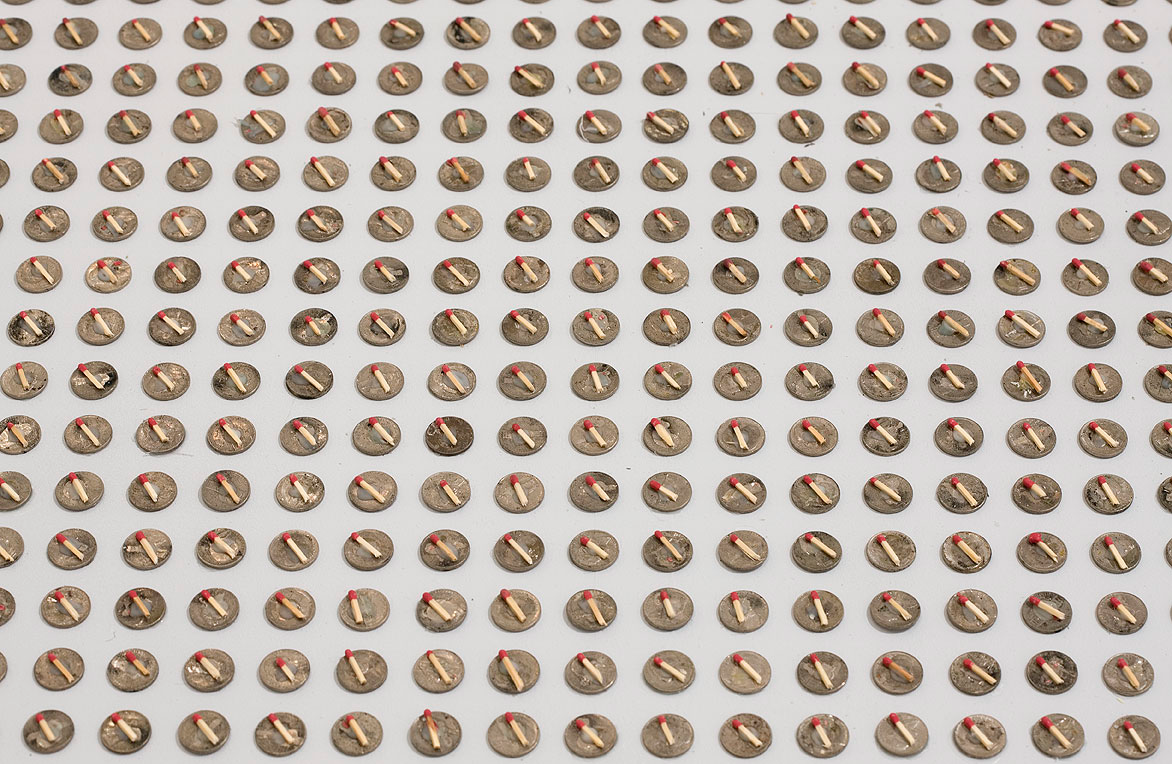
Consider Chris Burden’s The Reason for the Neutron Bomb from 1979. At first glance, its materials sound almost ridiculous: 50,000 nickels and 50,000 matchsticks arranged with painstaking precision. Yet each nickel-and-matchstick combination represented a Soviet tank, transforming a mass of cheap, ordinary objects into a visualization of Cold War military power and the arguments being made for nuclear weapons. Suddenly the materials are not arbitrary. Money and potential fire become miniature machines of war. Repetition becomes military accumulation. An incomprehensibly large number becomes something physically present before us.
You might still prefer a landscape by John Constable.
So might I.
But understanding what Burden was doing makes the encounter more interesting. The question is no longer merely whether arranging nickels and matchsticks requires the technical skill needed to paint a portrait. That is the wrong test because Burden was not attempting to paint a portrait. He was using objects, numbers, scale, repetition, metaphor, and physical space to communicate an idea.
We do not have to judge every artist by whether they successfully accomplished something they were never attempting to do.
This is where learning about art becomes so valuable. Art history does not—or at least should not—exist to tell us what we are required to like. It gives us a vocabulary for understanding what artists were trying to accomplish.
Why did Renaissance painters become fascinated with linear perspective? Why did the Impressionists loosen the brushstroke and become obsessed with changing light? Why did Cézanne begin breaking the visible world into underlying forms? Why did Picasso and Braque fracture those forms further? Why did Kandinsky move toward abstraction? Why did Pollock put canvases on the floor? Why did Rothko reduce painting to immense fields of color? Why did Duchamp place an ordinary manufactured object in an exhibition and ask us to reconsider what makes something art? Why did conceptual artists eventually decide that sometimes the idea itself could matter as much as the crafted object?
Those are fascinating questions even when the answers do not change our preferences.
Indeed, learning about art can sometimes make dislike more interesting.
There are paintings I respect more after studying them even though I still do not enjoy looking at them. There are movements whose historical importance I understand while knowing that they will never become personal favorites. There are artists whose ideas fascinate me much more than their finished works. And there are probably artists I have dismissed too quickly whose work I will encounter differently ten years from now.
Taste is allowed to change.
That is another reason we should resist turning preferences into identities. Saying that you generally prefer traditional or representational art does not require you to join a team called Traditional Art and spend the rest of your life defending it against Team Modern Art. You do not betray Rembrandt by enjoying Pollock. Loving Vermeer does not prohibit you from being moved by Rothko. Admiring Michelangelo does not require you to hate Duchamp. Appreciating the Pre-Raphaelites does not prevent you from walking into a contemporary gallery tomorrow and discovering some strange installation that unexpectedly stops you in your tracks.
Art is much too large for tribal loyalty.
And museums are much more enjoyable when we stop treating them as examinations.
Walk into a gallery and look.
Really look.
Read the label if you want to. Learn who the artist was. Learn when the work was made. Ask what was happening historically. Ask what the artist was responding to. Ask why the materials were chosen. Ask what conventions were being followed and which were being rejected. Ask what the artist might have wanted you to notice.
Then look again.
Maybe the work will suddenly open itself to you.
Maybe it won’t.
Perhaps you will stand before something that critics have written books about and feel absolutely nothing. That is fine. Perhaps you will turn the corner and encounter a modest little landscape by an artist whose name you have never heard and be completely captivated. That is fine too.
And perhaps once in a while you will encounter something that violates nearly everything you thought you liked. You will find yourself standing before a Pollock, staring into an enormous web of paint, unable to explain why you cannot walk away.
That is one of the great pleasures of looking at art.
The goal of art education should never be to replace your taste with somebody else’s. It should enlarge the world in which your taste operates. It should give you more things to see, more questions to ask, more histories to understand, more experiments to consider, and more opportunities to be surprised.
We should learn enough about Picasso to understand why he painted as he did. We should understand what Rothko was attempting to communicate through color. We should know why Pollock’s methods mattered. We should be willing to discover how 50,000 nickels and matchsticks can become a meditation on war. We should understand why the Pre-Raphaelites were once considered radicals even if their work now looks traditional beside much contemporary art.
But after all that learning, we should retain the courage to say two remarkably simple things.
I like this.
I don’t like that.
Neither statement requires an apology.
The only thing we should perhaps be reluctant to say is, I don’t understand this, therefore it has no value.
Curiosity asks more of us than that.
Good art education teaches humility because it reminds us that our preferences are not universal laws. Something that leaves me cold may bring another person to tears. Something I find overwhelmingly beautiful may strike someone else as sentimental or dull. Neither of us needs to surrender our judgment. We merely need enough generosity to recognize that another person may see something we do not.
That generosity should extend to artists as well. Every serious work of art represents, in some fashion, an attempt to communicate a vision of the world. Sometimes that vision is expressed through breathtaking technical mastery. Sometimes it arrives through distorted figures, fields of color, splattered paint, industrial materials, discarded objects, photography, performance, video, or fifty thousand matchsticks.
We can try to understand what the artist is saying without promising to love the language in which they chose to say it.
And perhaps that is the healthiest relationship we can have with art: curiosity without submission, knowledge without pretension, openness without dishonesty.
Learn everything you can.
Look at everything you can.
Give unfamiliar art a chance.
Allow yourself to be challenged.
Allow yourself to change your mind.
But never permit someone else’s idea of sophistication to shame you out of loving what you love.
Stand in front of the Renaissance portrait. Wander through the landscape gallery. Lose yourself in a Pre-Raphaelite fantasy. Spend an inexplicably long time staring at a Jackson Pollock. Walk away unmoved from the masterpiece everyone else seems to adore. Come back years later and see whether anything has changed.
Your taste belongs to you.
The art you love needs no apology.