Modern karate is often spoken of as though it were a single Japanese martial art with a common origin and a relatively uniform method. Historically, however, karate is better understood as an Okinawan fighting tradition that was substantially reorganized after it reached mainland Japan. The karate practiced today in Shotokan, Wado-ryu, Shito-ryu, Goju-ryu, and the many systems descended from them certainly preserves Okinawan material, but its Japanese development changed how that material was practiced, taught, classified, explained, and ultimately understood. Some changes were deliberate attempts to make karate suitable for Japanese schools and universities. Others reflected the influence of Japanese budo, changing social expectations, military culture, competition, and the practical necessity of teaching large numbers of students.
Understanding this transformation is especially important for practitioners of traditional Okinawan karate. It helps explain why two arts that contain apparently similar punches, blocks, stances, and kata can nevertheless feel remarkably different. The distinction is not simply that Okinawan karate is “older” while Japanese karate is “newer.” Both continued to evolve. Rather, they developed in different cultural environments and increasingly emphasized different ways of training the human body and transmitting martial knowledge.
Before Karate Was Japanese
Karate developed in the Ryukyu Kingdom, centered on Okinawa, which historically occupied a cultural crossroads between China, Japan, Korea, and Southeast Asia. Indigenous Okinawan fighting traditions, commonly associated with te or ti, interacted over generations with Chinese martial practices introduced through trade, diplomatic exchange, immigration, and personal study. The precise genealogy of individual techniques is often difficult to reconstruct, and romantic stories about secret masters and forbidden weapons should be treated cautiously, but Chinese influence on Okinawan karate is unmistakable.
Different centers of practice eventually became associated with traditions retrospectively called Shuri-te, Naha-te, and Tomari-te. These should not necessarily be imagined as rigidly organized “styles” in the modern sense. They were overlapping networks of teachers, methods, kata, and personal approaches. Shuri became associated with figures such as Sokon Matsumura and later Anko Itosu; Naha with Kanryo Higaonna and his student Chojun Miyagi; Tomari with teachers such as Kosaku Matsumora and others whose influence crossed into neighboring traditions.
Training was often comparatively personal. A teacher might have only a few serious students, and a student could spend years working on a very limited body of material. Kata was central, but kata was not simply a performance to be memorized for promotion. It functioned as a repository of combative principles. Techniques could involve striking, kicking, seizing, pulling, controlling limbs, unbalancing, throwing, attacking vulnerable anatomical targets, and manipulating an opponent at close range.
This older Okinawan environment is one of the keys to understanding what happened later. Karate was not originally designed as a standardized curriculum for hundreds of students standing in rows in a gymnasium. Nor was it originally constructed as a competitive sport. It was transmitted primarily as a fighting method through kata, conditioning, partner training, and direct instruction.
Karate Enters the Schools
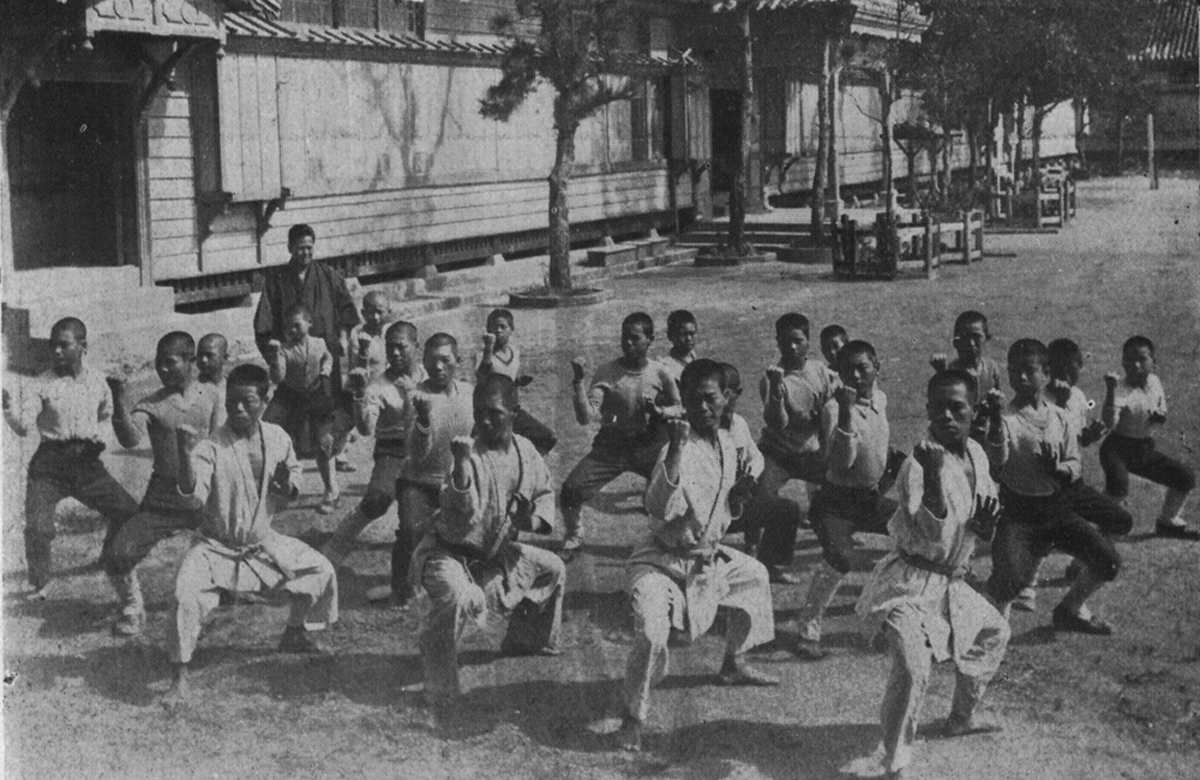
One of the first great transformations actually occurred on Okinawa itself before karate became established in mainland Japan. Anko Itosu played a particularly important role in introducing karate into the Okinawan school system during the early twentieth century. To make karate appropriate for children and group instruction, training necessarily became more systematic and somewhat less explicitly combative.
Itosu’s creation or development of the Pinan kata illustrates this transition. Rather than beginning students immediately with more difficult classical forms, instructors could now use a progressive series through which fundamental movements, postures, coordination, and discipline could be taught. Karate was beginning to become not only a fighting art but also a system of physical education.
This distinction matters because it prevents us from imagining that Japanese instructors alone “watered down” an otherwise unchanged Okinawan art. The process of modernization had already begun in Okinawa. What happened in mainland Japan greatly accelerated and redirected it.
Funakoshi and the Introduction of Karate to Japan
Gichin Funakoshi is the figure most closely associated with introducing Okinawan karate to mainland Japan, particularly following his demonstrations there in the early 1920s. Funakoshi had studied primarily under Anko Asato and Anko Itosu and represented an Okinawan Shuri-based tradition. His teaching eventually became the foundation of what would be known as Shotokan.
Funakoshi entered a martial culture already dominated by established Japanese budo. Judo had been systematized by Jigoro Kano. Kendo had emerged from older sword traditions into a modern educational discipline. Japanese martial institutions possessed ranks, uniforms, formal etiquette, organized curricula, and national organizations. If karate was going to survive and prosper within this environment, it had to become recognizable as a Japanese budo.
This produced changes extending far beyond technique.
Even the name changed. Karate had commonly been written with characters meaning “Chinese hand” (Tode or Karate), openly acknowledging its Chinese associations. During the Japanese development of the art, the characters were changed so that karate came to mean “empty hand.” Funakoshi supported this interpretation and connected it with broader philosophical ideas concerning emptiness, character, and self-development. The change was linguistically elegant, but it also helped detach karate from an explicitly Chinese identity at a time when Japanese nationalism and Sino-Japanese political tensions made Chinese associations increasingly uncomfortable.
The art was becoming culturally Japanese.
From Jutsu Toward Do
An equally significant transformation concerned the purpose of training. Okinawan karate had certainly always contained moral and educational dimensions; it would be misleading to portray the old masters as interested only in violence. Nevertheless, the mainland Japanese environment increasingly framed karate as karate-do—the “way of the empty hand.”
The distinction between jutsu, practical technique, and do, a lifelong path of cultivation, should not be exaggerated into an absolute historical division. Japanese martial arts had long contained ethical dimensions, and Okinawan teachers valued character. Yet the language of budo placed increasing emphasis on discipline, perseverance, etiquette, character development, and spiritual or psychological refinement.
Funakoshi famously taught that there is no first attack in karate—karate ni sente nashi. Whatever its precise tactical interpretation, the maxim illustrates the moral identity karate was developing. Karate was being presented not merely as something one used to defeat another person but as a discipline through which one learned to govern oneself.
That philosophical development became one of Japanese karate’s greatest contributions. At the same time, it subtly altered the relationship between karate and its original combative purpose.
The Japanese Transformation of Technique
The technical differences that developed between many Japanese and Okinawan systems are immediately visible.
Japanese karate, particularly as Shotokan developed under Funakoshi’s son Yoshitaka and subsequent generations, increasingly favored long, deep stances and large, powerful movements. Zenkutsu-dachi became longer and lower. Techniques were performed with pronounced hip rotation and strong linear acceleration. Kicks became higher and more varied. Training encouraged athleticism, speed, extension, and powerful movement across distance.
Many Okinawan systems retained comparatively shorter and more natural stances. Their movement frequently reflects the assumption that fighting takes place at close range rather than at the extended distance characteristic of much modern kumite. The Okinawan practitioner may strike while simultaneously controlling an opponent’s arm, seize clothing or limbs, disrupt posture, attack at an angle, and follow a strike with a takedown or another close-range technique.
Neither approach is inherently superior. They reflect different training environments and increasingly different tactical assumptions.
This distinction can be seen particularly clearly in Uechi-Ryu. Its Sanchin stance is compact and structurally protective rather than long and deeply rooted in the manner of many Japanese front stances. Its characteristic open-hand techniques, circular movements, toe kicks, body conditioning, and close-range methods preserve a visibly different martial vocabulary from the long linear techniques that many people have come to associate with “karate.” Goju-ryu similarly preserves Sanchin training, close-range methods, breathing practices, conditioning, and substantial evidence of its southern Chinese ancestry.
What Happened to Kata?
Kata survived the transition to Japan, but its role gradually changed.
In traditional Okinawan karate, kata could function as a compressed encyclopedia of fighting principles. A movement conventionally described as a “block” might instead—or additionally—represent a strike, limb control, release from a grip, entry, off-balancing action, or component of a throw. The distinction between offense and defense was frequently less clear than elementary terminology suggests.
As karate entered schools, universities, and large group classes, movements needed standardized names and explanations. It is much easier to teach thirty students that age-uke is an upper-level block than to teach each student several possible applications involving positioning, limb control, striking, and close-range manipulation.
This helped produce the familiar model of karate basics: uke, tsuki, and geri—blocks, punches, and kicks.
The terminology is useful pedagogically, but it can narrow interpretation. If a movement is taught from the beginning exclusively as a block, generations of students may eventually forget that it can perform other functions.
Japanese karate also increasingly emphasized the visual and technical standardization of kata. Stances, angles, timing, posture, and movement became highly defined. This produced extraordinary technical precision. Japanese kata could be powerful, athletic, aesthetically disciplined, and remarkably consistent across large organizations.
Yet something could be lost when the external shape of kata became more important than exploring the combative questions hidden within it.
Bunkai and the Question of Application
This difference becomes especially apparent in bunkai, the analysis and application of kata.
Okinawan karate traditionally retained a strong relationship between kata and practical application, although claims that every old Okinawan teacher possessed a complete secret bunkai curriculum should be treated skeptically. Transmission varied considerably between teachers. Nevertheless, close-range interpretation is strongly compatible with the movements preserved in many older kata.
In much twentieth-century Japanese karate, application was increasingly separated from kata. Kata became one branch of training, kihon another, and kumite another. A student could become technically proficient in kata without necessarily understanding how all of its movements might function against resistance.
This separation is one of the most consequential developments in modern karate.
A traditional kata may contain a movement designed for a confrontation occurring at arm’s length, while competition kumite trains the karateka to fight from several feet away. Both are legitimate training activities, but they are solving different problems.
This helps explain why some movements in kata appear mysterious when interpreted exclusively through the assumptions of modern sparring. The kata may not be describing that kind of fight at all.
The Rise of Kihon
Japanese karate also contributed enormously to the formal development of kihon, systematic fundamental training.
Basic techniques certainly existed in Okinawa, but Japanese karate organized them with extraordinary precision. Students could practice hundreds of repetitions of punches, blocks, kicks, stances, and combinations while moving up and down the dojo floor. Instructors could correct posture, alignment, hip movement, balance, timing, and power generation in a highly controlled environment.
This was extremely effective for mass instruction.
It also transformed karate pedagogy. Instead of learning primarily through kata and application, the student could first learn an idealized technique in isolation, then place it into kata, and finally use related movements in kumite.
The familiar tripartite structure of kihon, kata, and kumite became one of the defining characteristics of modern Japanese karate.
Okinawan training frequently presents less rigid boundaries between these categories. Kata, conditioning, partner drills, and application may overlap much more naturally.
The Influence of Japanese Budo
Karate also adopted much of the institutional culture of Japanese martial arts.
The white dogi, colored belts, dan and kyu ranks, formalized dojo etiquette, standardized testing, and organizational hierarchy were not ancient features of Okinawan karate. Much of this framework was influenced directly or indirectly by Jigoro Kano’s modernization of judo and the broader Japanese budo movement.
These innovations proved extraordinarily useful.
Rank systems provided students with measurable progress. Uniforms diminished visible social distinctions. Standardized curricula allowed instructors to teach large numbers of people. Organizations could certify instructors and establish branches. Karate could now be exported internationally in a form that could reproduce itself.
This institutionalization is one of the principal reasons karate became a global martial art.
But institutionalization inevitably changes an art. Once advancement requires examinations, examinations require standards. Standards require standardized technique. Standardized technique encourages the idea that there is one officially correct way to perform a movement.
Older karate was often more individual.
A teacher’s karate might differ noticeably from his teacher’s karate because bodies, experiences, and tactical preferences differed. Modern organizations naturally tend toward conformity because an organization cannot easily evaluate thousands of students according to entirely individualized standards.
Kumite Changes the Art
Perhaps no development changed Japanese karate more dramatically than organized sparring and eventually competition.
Early karate did not possess modern tournament kumite in its current form. As Japanese university karate clubs experimented with free sparring, systems of controlled engagement gradually developed. After the Second World War, competitive karate expanded rapidly.
Competition produced tremendous benefits. It created pressure testing. It developed timing, distance, courage, speed, reflexes, tactical intelligence, and the ability to perform against an unwilling opponent. It also made karate exciting for spectators and helped it spread internationally.
But competition inevitably rewards what the rules measure.
If victory is determined by successfully striking an opponent under rules designed to protect participants, practitioners adapt to those rules. Techniques too dangerous for routine competition disappear from regular sparring. Grabbing may be restricted. Joint manipulation becomes less important. Throws may be limited. Attacks to vulnerable targets are prohibited. Protective distance becomes advantageous. Footwork becomes faster and lighter.
Gradually, tournament karate can become very different from the fighting environment assumed by older kata.
This does not mean sport karate is ineffective. An accomplished competitive karateka may possess exceptional timing, speed, distance management, and striking ability. It simply means that sport is a specialized expression of karate rather than a perfect reconstruction of the older Okinawan art.
Conditioning: Another Major Difference
Traditional Okinawan karate also tends to preserve a stronger emphasis on physical conditioning methods that became less central in many Japanese schools.
Hojo undo, or supplementary training, could involve implements such as chi-ishi, nigiri-game, ishi-sashi, makiage kigu, and the makiwara. These practices developed grip strength, posture, connective strength, striking mechanics, and the ability to transfer force through the body.
Body conditioning was especially prominent in systems such as Uechi-Ryu and Goju-Ryu. Sanchin testing and kote kitae, or forearm conditioning, cultivated the ability to maintain structure and composure under physical contact.
Japanese karate certainly retained conditioning—the makiwara became particularly important in some traditions—but the general trend favored kihon, kata, and kumite as the central training categories. As karate entered schools and universities, specialized Okinawan conditioning practices were less convenient to reproduce than exercises requiring only an open floor.
Once again, practical circumstances helped shape martial philosophy.
Breathing, Tension, and Sanchin
The contrast is particularly fascinating when examining Sanchin.
Sanchin occupies a foundational position in both Goju-Ryu and Uechi-Ryu and reveals their strong connection with southern Chinese martial traditions. The kata trains posture, breathing, rooting, structural alignment, concentration, tension and relaxation, and the coordination of the body as an integrated unit.
For the beginner, Sanchin may appear almost absurdly simple. There are relatively few movements and little of the athletic spectacle associated with advanced Japanese kata. Yet Sanchin illustrates an important Okinawan idea: sophistication does not necessarily mean accumulating more techniques.
The practitioner returns to the same kata repeatedly because the kata changes as the practitioner changes.
This represents a somewhat different educational philosophy from the large curriculum approach that became common in many Japanese systems. Advancement does not necessarily mean moving away from elementary material. It can mean discovering increasingly sophisticated principles inside material one has practiced for decades.
A senior Uechi-Ryu practitioner still practices Sanchin not because he has failed to progress beyond it, but because there is no point at which he has completely exhausted it.
Japanese Karate Was Not Simply “Watered Down”
It is tempting for advocates of Okinawan karate to tell this history as a story of decline: Okinawa possessed the “real” fighting art, Japan simplified it, sport weakened it, and modern karate lost the original secrets.
History is more complicated and more interesting than that.
Japanese karate gained things as well as lost them.
Japanese instructors developed extraordinary standards of technical precision. They refined pedagogy, organized curricula, expanded kumite, developed sophisticated methods of distance and timing, and transformed a relatively small regional fighting tradition into an international martial discipline. Without this transformation, karate might never have become one of the world’s major martial arts.
Furthermore, Okinawan karate did not remain frozen in the nineteenth century. Chojun Miyagi deliberately organized and named Goju-Ryu. Kanbun Uechi transmitted a system learned in China that was subsequently expanded and systematized by Kanei Uechi and other Okinawan teachers. New kata were created. Curricula were reorganized. Teaching methods changed. Ranking systems were adopted. Okinawan karate also entered the modern world.
The distinction, therefore, is not between authentic ancient karate and artificial modern karate.
It is between different branches of the same evolving martial family.
Okinawan Karate and Japanese Karate Today
The differences today are tendencies rather than absolute rules. Some Japanese dojo teach sophisticated practical bunkai and close-range fighting. Some Okinawan dojo participate enthusiastically in tournaments. Some Japanese karateka practice extensive conditioning, while some Okinawan schools teach highly standardized curricula. Globalization has caused the traditions to influence one another continually.
Nevertheless, broad distinctions remain recognizable.
Okinawan karate generally favors comparatively natural stances, close-range engagement, conditioning, kata-centered instruction, body development, gripping and controlling methods, and a relatively direct approach to self-defense. Japanese karate generally displays stronger influence from modern budo: formalized kihon, longer and often deeper stances, large technically precise movements, systematic rank structures, highly standardized kata, greater emphasis on long-range movement, and historically a much stronger relationship with competitive kumite.
Perhaps the deepest difference, however, is not visible in stance length or technique.
It is a difference in what karate gradually became for.
Okinawan karate emerged primarily as a method of personal combat and physical cultivation transmitted through relationships between teachers and relatively small groups of students. Japanese karate became a modern budo capable of educating schoolchildren, university students, soldiers, police, and eventually millions of practitioners around the world. Later, competitive karate developed yet another purpose: testing skill against other trained karateka under controlled conditions.
Each purpose changed the art.
What This Means for the Modern Karateka
For modern practitioners, understanding this history should not become an excuse for arguing over which tradition possesses “real karate.” A better question is to ask what each method is trying to teach.
A deep front stance may be an excellent training device even if one would never deliberately assume it before a street confrontation. Sport kumite may teach superb timing even though its rules prohibit many classical techniques. Hojo undo may develop physical qualities that cannot be learned through kata alone. Sanchin may teach structural principles invisible to someone who sees it merely as a sequence of movements. Kata may preserve close-range methods that make little sense until one stops interpreting every uke as a literal block against a distant punch.
Once we understand why karate changed, apparent contradictions begin to disappear.
Karate was transformed because it crossed cultures. It moved from the Ryukyu Kingdom into modern Japan, from private instruction into public schools, from small training groups into universities, from a fighting method into budo, from Okinawa into military and postwar society, and eventually from Japan into the world. At every stage, teachers modified karate to meet the needs of new students and new circumstances.
The remarkable thing is not that karate changed.
The remarkable thing is how much survived.
Inside the modern dojo, beneath the belts, ranks, tournaments, standardized terminology, and institutional structures, we can still find movements transmitted from Okinawan teachers who inherited an art shaped by centuries of exchange between the Ryukyus and China. When we practice kata seriously, investigate its applications, condition the body, work with partners, and return continually to fundamentals, we are participating in that history.
For an Okinawan karateka, this perspective gives practices such as Sanchin an even deeper significance. Sanchin is not merely another kata among many. It represents an older conception of what kata can be: not simply a sequence to memorize, not a performance to perfect for examination, and not something abandoned once a more advanced form has been learned. It is a method of studying the body, the mind, and the principles of combat over an entire lifetime.
Japanese karate demonstrated how successfully karate could change.
Okinawan karate reminds us why some things are worth preserving.