At the turn of the twentieth century, the United States was becoming an unmistakably modern nation. Cities were expanding, factories were multiplying, railroads and electric lines were changing the geography of everyday life, and mass-produced goods were filling American homes. The transformation brought enormous prosperity and technological progress, but it also produced a certain uneasiness. Something seemed to be disappearing amid the machines. Furniture could be manufactured more quickly and cheaply than ever before, yet much of it appeared artificial, covered with machine-cut ornament pretending to be hand carving. Houses could be built in endless variations of fashionable historical styles, yet many seemed disconnected from their materials, their landscapes, and the people who actually lived in them. Against this background emerged the American Arts and Crafts movement, a broad artistic and social response that called for honesty in materials, dignity in craftsmanship, simplicity in design, and beauty rooted in usefulness.
In America, one of the most recognizable expressions of this philosophy became what we now commonly call Mission style. Heavy oak furniture, broad horizontal lines, exposed joinery, simple construction, leather upholstery, hammered copper fixtures, warm earth tones, and houses shaped around wood, stone, fireplaces, porches, and gardens all came to represent an alternative to the elaborate ornamentation of the Victorian age. Mission style was never the whole of the American Arts and Crafts movement, nor was the term always historically precise. Yet it became one of the movement’s most enduring visual languages. To understand Mission style is therefore to understand something larger: an American search for an architecture and decorative art that felt genuine, democratic, useful, and appropriate to modern life.
From Britain to America
The intellectual origins of the Arts and Crafts movement lie primarily in nineteenth-century Britain. Industrialization had transformed British manufacturing, but critics worried about what mechanization was doing to workers, objects, cities, and culture. Among the most influential voices was the critic and social thinker John Ruskin, who argued that great art and architecture emerged when craftspeople possessed dignity, freedom, and meaningful participation in their labor. Ruskin admired medieval craftsmanship because he believed the slight irregularities of handmade objects revealed the humanity of the person who created them. Perfection produced by machinery could therefore be aesthetically impressive while still representing, in his view, an impoverishment of human labor.
William Morris turned many of Ruskin’s ideas into a practical artistic movement. Morris was a designer, craftsman, writer, printer, businessman, socialist, and one of the defining figures of nineteenth-century decorative art. Through Morris & Co., he promoted furniture, textiles, wallpaper, stained glass, books, and interior decoration emphasizing traditional craftsmanship and natural forms. Morris famously insisted that useful objects should also be beautiful. The home, in this conception, was not merely a place to accumulate possessions. It could become a unified work of art in which architecture, furniture, textiles, metalwork, ceramics, and gardens participated in a coherent aesthetic whole.
There was an irony at the heart of the British movement. Beautiful handmade goods required skilled labor, and skilled labor was expensive. Objects intended to restore dignity and beauty to ordinary life frequently became affordable mainly to prosperous customers. American designers inherited this contradiction, but they also approached it with the optimism of a country fascinated by both craftsmanship and modern production. The American Arts and Crafts movement would consequently be less hostile to machinery than some of its British predecessors. The question increasingly became not whether machines should exist, but whether they could be used intelligently without allowing industrial production to dictate design.
An American Arts and Crafts Identity
By the 1890s and early 1900s, Arts and Crafts societies, workshops, magazines, schools, architects, and furniture makers had appeared throughout the United States. The movement was never governed by a single style. American Arts and Crafts design could be rustic or sophisticated, urban or rural, austere or richly decorative. It encompassed architecture, furniture, ceramics, stained glass, metalwork, textiles, bookmaking, graphic design, landscape design, and interior decoration.
What unified these different expressions was less a strict visual formula than a philosophy. Materials should look like what they actually were. Wood should be allowed to look like wood rather than being disguised beneath layers of gilding and imitation carving. Structural elements could be visible rather than hidden. Ornament should emerge from construction, material, or natural form rather than being applied merely to impress. Rooms should be comfortable and livable. Houses should relate naturally to their sites. Craftspeople should be respected as creative participants rather than treated simply as anonymous laborers.
There was also a moral dimension to the movement. Arts and Crafts advocates frequently believed that good design encouraged good living. A thoughtfully designed home could promote family life, hospitality, simplicity, contemplation, and contact with nature. The fireplace became especially important, both practically and symbolically. It was the traditional hearth around which the family gathered, a reminder of domestic stability in an increasingly industrial and mobile society.
This idealism helps explain why Arts and Crafts design can sometimes feel almost philosophical. A wooden chair was not simply a chair. Its exposed joints could make a statement about honesty. A hand-hammered copper lamp could represent resistance to anonymous mass production. A house built around local stone and timber could suggest harmony between human life and the surrounding landscape.
The Rise of Mission Style
The term Mission furniture became popular in the United States around the beginning of the twentieth century. Its connection to the historic Spanish missions of California was often more romantic than literal. Genuine furnishings from Spanish colonial missions were generally much more varied than the standardized oak furniture later marketed under the Mission name. Nevertheless, the missions provided Americans with an appealing historical image: thick walls, heavy timbers, simple wooden furniture, craftsmanship, regional history, and a seemingly unpretentious way of life.
The Mission Revival in architecture was already popular in California, where architects and developers borrowed forms associated with the Spanish colonial missions—stucco walls, red tile roofs, arches, courtyards, bell towers, and broad shaded arcades. Furniture makers adopted the word “Mission” for sturdy, rectilinear furniture that appeared similarly simple and substantial.
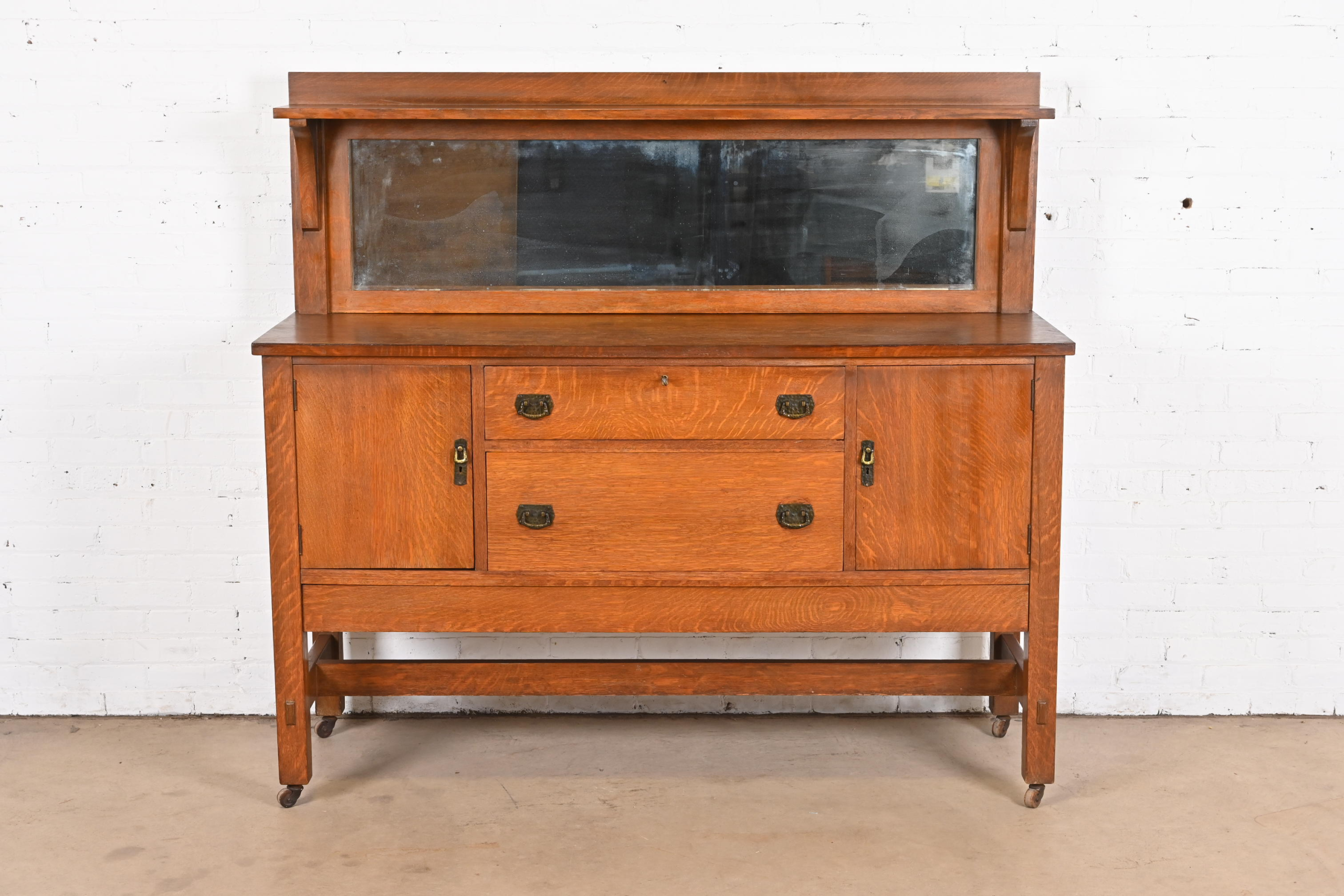
Mission furniture generally rejected the curving profiles, elaborate veneers, decorative carving, and historical ornament common in much nineteenth-century furniture. Instead, it emphasized straight lines, broad boards, visible joints, and a sense of structural weight. Oak became particularly associated with the style, frequently stained to emphasize the grain. Mortise-and-tenon joinery, pegs, exposed construction, leather seats, and slatted backs made furniture look as though its method of construction had nothing to hide.
A Mission chair could therefore possess an almost architectural quality. Its arms, legs, stretchers, and back rails formed a visible framework. Decoration was often minimal because the structure itself supplied the visual interest. This was precisely the point. Beauty was supposed to arise from proportion, material, and craftsmanship rather than from ornament added afterward.
Gustav Stickley and the Craftsman Ideal
No individual became more closely associated with American Mission furniture than Gustav Stickley. Born in Wisconsin in 1858 to German immigrant parents, Stickley eventually became a furniture manufacturer, designer, publisher, and one of the leading advocates of the American Arts and Crafts movement.
Stickley preferred the term Craftsman for his own work. His furniture emphasized solid construction, straight lines, oak, visible joinery, and limited ornament. He wanted objects to express their materials and methods of construction openly. A joint could be visible because there was no reason to disguise it. Hammer marks on metalwork could remain because they documented the hand of the maker. Wood grain was treated as decoration in itself.
In 1901, Stickley began publishing The Craftsman, a highly influential magazine devoted not simply to furniture but to an entire philosophy of living. Its pages discussed architecture, interiors, gardens, social reform, craftsmanship, education, and the decorative arts. Through the magazine, Stickley helped transform Arts and Crafts from a design preference into a recognizable American lifestyle.
The Craftsman house became one of the movement’s most important architectural expressions. These homes emphasized broad rooflines, deep porches, exposed rafters and beams, built-in cabinetry, fireplaces, natural materials, and interiors designed as coherent wholes rather than collections of unrelated decorated rooms. The house was intended to feel grounded, comfortable, and human in scale.
Stickley’s great experimental project was Craftsman Farms in New Jersey, where he attempted to create a model environment reflecting Arts and Crafts principles. The project expressed the movement’s dream of integrating work, family, architecture, craftsmanship, landscape, and moral life. Financial difficulties eventually undermined Stickley’s business empire, but his influence on American furniture and domestic architecture survived.
The American Bungalow
If Mission furniture carried Arts and Crafts ideas into the interior, the bungalow carried them across the American landscape. Few house types are more closely associated with the movement.
The bungalow originated in South Asia, where the British adapted the Bengali bangla house into a low, informal dwelling suited to warm climates. The form traveled through the British Empire and eventually into American architecture. In California, particularly during the early twentieth century, the bungalow became extraordinarily popular.
Its appeal was easy to understand. The typical American Craftsman bungalow was relatively small, practical, welcoming, and visually grounded. It often featured a low-pitched roof, wide eaves, exposed rafters, a large front porch, tapered columns, natural woodwork, built-in furniture, and a prominent fireplace. Rooms flowed into one another more freely than in many Victorian houses, reflecting a less formal domestic culture.
The bungalow also seemed democratic. It offered many middle-class Americans access to some of the aesthetic principles promoted by elite Arts and Crafts designers. House plans circulated through magazines, pattern books, and mail-order catalogs. Entire neighborhoods of Craftsman and Mission-inspired bungalows appeared across California and throughout the country.
Here again we encounter the productive contradiction of the American movement. A philosophy inspired partly by opposition to industrial mass production became enormously successful precisely because modern printing, transportation, standardization, and manufacturing allowed Arts and Crafts designs to reach a mass audience.
Rather than destroying the movement, this tension helped make it distinctly American.
Greene and Greene: The Bungalow Becomes Art
Among the most extraordinary American Arts and Crafts architects were the brothers Charles Sumner Greene and Henry Mather Greene, whose work in Pasadena and Southern California elevated the bungalow into something approaching a total work of art.
The Greenes were influenced by the English Arts and Crafts movement, traditional Japanese architecture, California’s climate and landscape, and their own deep appreciation of wood craftsmanship. Their houses combined broad horizontal forms with extraordinary attention to detail. Structural elements were not merely functional but expressive. Beams extended beyond walls, joints became decorative features, wood surfaces were carefully shaped and finished, and furniture was frequently designed specifically for the room in which it would stand.
Their masterpiece, the Gamble House in Pasadena, completed in 1908 for David and Mary Gamble of the Procter & Gamble family, remains one of the great achievements of American domestic architecture. The building seems simultaneously massive and delicate. Broad rooflines anchor it to the earth, while balconies, terraces, stained glass, carved wood, and carefully articulated joinery create extraordinary refinement.
The Japanese influence is especially important. Japanese architecture had attracted considerable attention among Western artists and designers during the late nineteenth century because of its emphasis on craftsmanship, natural materials, asymmetry, spatial flexibility, and the relationship between architecture and landscape. Greene and Greene absorbed these ideas without simply copying Japanese buildings. Their houses developed a distinctive Southern California vocabulary in which gardens, sleeping porches, terraces, woodwork, stained glass, furniture, and architecture became part of a unified environment.
Mission style could sometimes become heavy and austere. Greene and Greene demonstrated how Arts and Crafts principles could instead become sensual, elegant, and extraordinarily sophisticated.
California and the Romance of the Mission
California gave the American Arts and Crafts movement a distinctive regional identity. The state’s Spanish colonial history, mild climate, dramatic landscape, expanding cities, and relative distance from the architectural traditions of the East encouraged experimentation.
The rediscovery—and sometimes romantic reinvention—of California’s Spanish missions became especially influential. Mission Revival architecture transformed elements of Franciscan mission buildings into a modern regional style. Stucco surfaces, red tile roofs, arcades, courtyards, bell forms, and heavy wooden doors came to signify an idealized California past.
This nostalgia was complicated. The romantic image of peaceful missions and pastoral California frequently ignored the experiences of Indigenous peoples whose lives were profoundly disrupted by the Spanish mission system. Like many revival styles, Mission Revival architecture created a selective version of history. It transformed a complex colonial past into a picturesque visual language.
Nevertheless, the style became enormously influential in American architecture. Railroad stations, hotels, schools, commercial buildings, houses, and civic structures adopted Mission Revival forms. The architecture seemed perfectly suited to California’s light and climate, and tourists came to associate it strongly with the region.
Within Arts and Crafts interiors, Mission furniture complemented this architecture. Heavy oak chairs, leather upholstery, copper lamps, pottery, Native American textiles, and simple wooden tables could be assembled into interiors intended to evoke regional authenticity.
Roycroft and the Community of Craftsmen
Another major center of American Arts and Crafts activity developed far from California in East Aurora, New York. There, entrepreneur and writer Elbert Hubbard established the Roycroft community during the 1890s.
Inspired partly by William Morris and the English Arts and Crafts movement, Roycroft began with printing and bookmaking but expanded into furniture, metalwork, leather goods, and other decorative arts. The community cultivated an image of independent craftspeople working together in an environment that valued creativity and skilled labor.
Roycroft objects are especially associated with beautifully printed books, hand-hammered copper, leatherwork, and substantial wooden furniture. The distinctive Roycroft mark became a recognizable symbol of quality craftsmanship.
Hubbard was also a gifted promoter. He understood that Americans were not merely buying objects; they were buying an idea about authenticity, individuality, craftsmanship, and resistance to anonymous industrial culture. In this respect Roycroft anticipated a phenomenon familiar today: the desire to know who made an object, where it was made, and whether its maker possessed a meaningful relationship with the work.
The Roycroft experiment also reveals how successfully Arts and Crafts ideals could themselves become commercial brands. What began as a critique of industrial consumer culture could become part of consumer culture—although one that encouraged buyers to value craftsmanship, durability, and design.
Frank Lloyd Wright and the Prairie School
The American Arts and Crafts movement also intersected with the emerging Prairie School, most famously represented by Frank Lloyd Wright. Wright cannot simply be classified as a Mission designer, and his architectural philosophy developed in directions very different from Stickley’s. Yet both belonged to the broader search for a genuinely modern American architecture.
Wright rejected the idea that American houses should imitate European historical styles. He advocated what he called organic architecture, in which buildings grew from their sites, materials, purposes, and internal spatial relationships. His Prairie houses emphasized long horizontal lines, low roofs, broad overhangs, open interiors, central hearths, built-in furniture, art glass, and carefully coordinated decoration.
Like Arts and Crafts designers, Wright believed architecture and interiors should form a unified composition. Furniture was designed for particular rooms. Windows, carpets, lighting, cabinetry, murals, and architectural forms were conceived together.
The connection is particularly evident in the importance both traditions gave to the hearth and domestic life. The fireplace often became the psychological center of the home. Yet Wright pushed beyond the rustic medievalism that sometimes characterized British Arts and Crafts design. His work pointed toward modernism, abstraction, open-plan architecture, and the twentieth-century rejection of historical imitation.
The American Arts and Crafts movement therefore stands at an important crossroads. It looked backward toward preindustrial craftsmanship while simultaneously helping create modern design.
Furniture as Architecture
One of the most appealing qualities of Mission furniture is its clarity. A Mission-style table generally looks like a table constructed from wood rather than a wooden object attempting to imitate something more elaborate. Legs remain substantial. Stretchers are visible. Joints may be emphasized. The grain of quarter-sawn oak becomes part of the aesthetic experience.
This straightforwardness produced furniture that could feel almost architectural. Chairs resemble miniature timber structures. Sideboards and bookcases possess strong horizontal and vertical rhythms. Slats create repeating patterns. Broad surfaces emphasize the beauty of wood.
Quarter-sawn white oak became especially prized because the cutting technique exposes striking ray-fleck patterns within the grain. Fuming and staining could deepen the color, producing the rich browns commonly associated with Craftsman furniture.
Leather, copper, iron, stained glass, pottery, and textiles complemented the wood. Lamps frequently featured hammered metal bases with mica or stained-glass shades. Pottery was often matte rather than glossy, emphasizing earthy surfaces and natural colors. Decorative motifs included flowers, trees, leaves, landscapes, geometric patterns, and simplified natural forms.
The result could be remarkably harmonious. Rather than filling a room with unrelated decorative objects, Arts and Crafts interiors attempted to create visual unity.
The Craftswoman and the American Arts and Crafts Movement
Although many famous names associated with the movement are male architects and furniture makers, women played an enormous role in American Arts and Crafts culture. The movement opened opportunities in ceramics, textiles, jewelry, metalwork, book arts, interior decoration, education, and design at a moment when the professional art world often limited women’s participation.
Arts and Crafts societies and schools offered women ways to transform activities traditionally categorized as domestic handicrafts into respected artistic work. Pottery became especially important. American art pottery flourished in the late nineteenth and early twentieth centuries, producing some of the most distinctive decorative art of the period.
Women participated in or led influential workshops and enterprises, including pottery studios, textile operations, metalworking shops, and design schools. Their contributions remind us that the Arts and Crafts movement was not simply a history of famous architects and furniture makers. It was also a vast network of craftspeople who blurred the traditional boundary between “fine art” and “decorative art.”
That distinction itself was something Arts and Crafts philosophy questioned. Why should a painting displayed in a museum automatically be considered more artistic than an exquisitely designed bowl, chair, lamp, textile, or book? If beauty belongs in daily life, then useful objects can also become serious works of art.
Native American Art and the Complications of “American” Design
The movement’s desire to create a distinctly American aesthetic also brought designers into contact with Native American artistic traditions. Southwestern pottery, baskets, blankets, textiles, and geometric patterns attracted enormous attention among collectors and designers during the Arts and Crafts era.
This influence produced both admiration and appropriation. Some Arts and Crafts advocates recognized Indigenous works as sophisticated artistic traditions worthy of preservation at a time when American institutions had often dismissed them merely as ethnographic curiosities. Yet Anglo-American designers and retailers also removed patterns and objects from their cultural contexts, marketed them as decorative symbols of an imagined primitive authenticity, and profited from romantic images of Native life while Indigenous communities continued to experience displacement and assimilation policies.
The history therefore requires nuance. The American Arts and Crafts movement helped broaden appreciation for Indigenous art, but it also participated in the contradictions of the society in which it developed.
Understanding those tensions does not diminish the artistic achievements of the movement. It allows us to see them more completely.
The Arts and Crafts Home
The ideal Arts and Crafts interior was intended to feel warm rather than ostentatious. Walls often featured muted natural colors. Wood trim remained visible rather than painted. Furniture was substantial but restrained. Built-in bookshelves, window seats, sideboards, cabinets, and benches integrated furniture into the architecture.
The dining room became especially important. A heavy oak table beneath a copper or stained-glass fixture suggested durability and communal life. Meals, conversation, reading, music, and family gatherings were activities around which the house was designed.
There was an almost ethical rejection of the Victorian parlor—the formal room filled with ornamental objects that might rarely be used. Arts and Crafts advocates preferred rooms that served genuine purposes. Comfort was valued. Books should be within reach. Chairs should invite sitting. Windows should connect rooms to gardens. Porches should encourage life outdoors.
In California, this relationship between interior and exterior became particularly important. Sleeping porches, terraces, pergolas, courtyards, and gardens blurred the boundary between house and landscape. The architecture acknowledged climate rather than treating the house as an isolated decorative object.
This emphasis feels strikingly contemporary. Many ideas now associated with modern residential architecture—open plans, natural materials, indoor-outdoor living, built-in storage, functional simplicity, regional design, and attention to craftsmanship—have important precedents in the Arts and Crafts movement.
Why Mission Style Fell Out of Fashion
By the 1910s and 1920s, Mission and Craftsman design had become enormously popular. Popularity, however, created the very problem the movement had originally attempted to resist. Factories began producing inexpensive “Mission-style” furniture in enormous quantities. Simplified construction made the furniture well suited to industrial production.
Before long, heavy oak furniture had become so common that younger designers associated it not with artistic rebellion but with their parents’ houses.
Changing tastes also favored lighter and more cosmopolitan styles. Colonial Revival, Mediterranean Revival, Art Deco, European modernism, and eventually International Style architecture competed with or displaced Arts and Crafts aesthetics.
By the middle decades of the twentieth century, Victorian furniture once considered old-fashioned was being rediscovered by collectors while Craftsman furniture was often discarded. Pieces by Stickley and other manufacturers could sometimes be found cheaply in used furniture shops and estate sales.
Then came another reversal.
Beginning particularly in the later twentieth century, collectors, historians, architects, and homeowners rediscovered the quality of American Arts and Crafts design. Original Stickley furniture became highly collectible. Greene and Greene houses were recognized as masterpieces. Craftsman bungalows were restored rather than demolished. Architectural salvage companies began preserving doors, lighting, hardware, tile, and woodwork that previous generations had casually removed.
What had once seemed merely old-fashioned became historic.
The Continuing Appeal of Mission Style
Mission and Craftsman design endure because their central principles continue to answer anxieties created by modern life. We still live in a world of mass production. We still fill our homes with inexpensive objects designed to be replaced rather than repaired. We still confront the tension between technological efficiency and the human desire for things that feel personal, durable, tactile, and real.
An Arts and Crafts chair speaks differently from a disposable object. Its appeal does not depend upon lavish decoration. It comes from weight, proportion, joinery, grain, and material. A well-made oak table can collect scratches and wear without becoming useless; the evidence of life can actually deepen its character.
This is one reason contemporary interest in woodworking, ceramics, handmade furniture, artisan metalwork, local crafts, and restoration feels so closely related to the ideals of the movement. The vocabulary has changed—we might now speak about sustainability, local production, slow design, handmade goods, or responsible consumption—but many of the concerns would have been immediately recognizable to Morris or Stickley.
Even today’s renewed fascination with Craftsman bungalows reflects something deeper than nostalgia. People respond to porches because porches encourage interaction. They respond to fireplaces because fireplaces create centers. They respond to built-in woodwork because it gives a room permanence. They respond to natural materials because those materials possess textures and irregularities that manufactured surfaces often lack.
More Than a Style
It is tempting to reduce the American Arts and Crafts movement to an inventory of recognizable features: oak furniture, hammered copper lamps, exposed beams, stained glass, pottery, fireplaces, bungalows, and broad front porches. These things are certainly part of its visual identity, but concentrating only on them misses the movement’s deeper significance.
Arts and Crafts was fundamentally an argument about the relationship between human beings and the things they create.
Who made this object?
How was it made?
What material was used?
Does its structure make sense?
Will it endure?
Does it serve a genuine purpose?
Is it beautiful because it is honest, or merely decorated to appear expensive?
And perhaps most importantly: Does the environment we create around ourselves make everyday life better?
Those questions remain remarkably relevant.
The American Arts and Crafts movement never succeeded in reversing industrialization, nor could it. Mission furniture itself eventually became a mass-produced commodity. Yet the movement changed American architecture and design because it insisted that modernity did not have to mean abandoning craftsmanship, beauty, regional identity, or human scale.
Its greatest achievement may therefore be neither a particular chair nor even a particular house. It was the restoration of dignity to the ordinary object.
A table could be beautiful because it was a good table. A house could be meaningful because it served the people living inside it. A craftsman’s hand did not need to disappear behind unnecessary ornament. Wood could remain wood, stone could remain stone, and construction could become part of decoration.
In Mission and Craftsman design, simplicity was never supposed to mean emptiness. It meant removing what was unnecessary so that material, structure, craftsmanship, and human life could become visible again.
That idea—beauty through honesty—is what gave America’s Arts and Crafts movement its distinctive character, and it is why, more than a century later, a quiet bungalow beneath broad eaves or a solid quarter-sawn oak chair can still feel surprisingly modern.