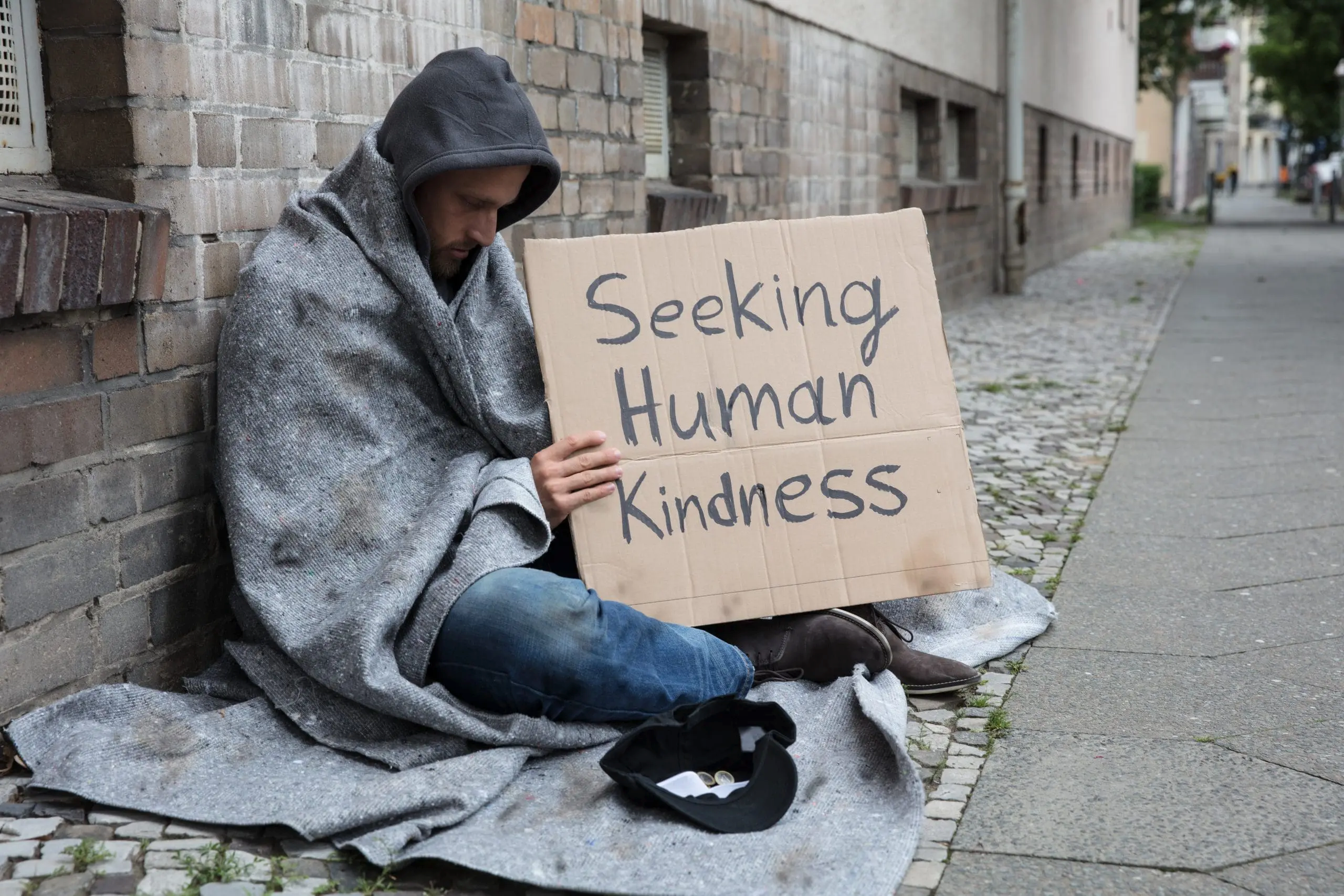
Homelessness is an uncomfortable subject. Most of us, I hope, want to help. We do not want people sleeping beneath overpasses, living in tents beside highways, wandering through emergency rooms because they have nowhere else to go, or trying to survive another cold night on a sidewalk. We recognize, at least intellectually, that something is terribly wrong when human beings are living this way in communities surrounded by extraordinary wealth. Yet wanting to help and knowing how to help are two very different things. Faced with a problem that seems impossibly complicated, it becomes easier to look away.
And so we do.
We drive past the tent encampment. We avoid eye contact with the man standing outside the grocery store. We complain about the trash along the sidewalk, the shopping carts beneath the bridge, the person sleeping in the park, or the uncomfortable encounter outside a restaurant. We talk about property values, public safety, tourism, and neighborhood cleanliness. Those concerns are not necessarily illegitimate. People should be able to walk safely through their communities, businesses should be able to operate, parks should remain usable, and public spaces should belong to everyone. But somewhere in the conversation it becomes dangerously easy to stop seeing homeless people as people. They become the homeless, an abstraction, a nuisance, a statistic, a political issue, or simply something that needs to be moved somewhere else.
That is where we begin to lose our humanity.
I work in a hospital, and that means I get to see homelessness closer than many people do. What I see does not fit comfortably into the simple explanations offered by either side of our political arguments. In my experience, many of the homeless people coming through the hospital are struggling with serious problems involving drugs, alcohol, mental illness, or some combination of them. Others have been hit by economic catastrophe, family breakdown, disability, unemployment, abuse, or simply a series of bad circumstances from which they were never able to recover. Sometimes several of these problems exist at once. Human lives are complicated, and homelessness is usually complicated with them.
That is why slogans are not going to solve this.
It is tempting to believe that homelessness is simply a housing problem and that if we build enough inexpensive apartments the problem will disappear. Housing is unquestionably part of the solution. A person cannot stop being homeless without eventually having someplace safe and stable to live. Communities with severe housing shortages and crushing rents are naturally going to push vulnerable people closer to the edge. Affordable housing matters. But housing alone cannot treat schizophrenia. It cannot cure addiction. It cannot repair a shattered family. It cannot teach someone who has spent years surviving on the street how to suddenly navigate appointments, medications, employment, bills, relationships, transportation, and all the other ordinary structures of daily life.
Putting someone inside four walls without addressing the conditions that helped put that person on the street may change his address without changing his life.
The same is true of simply clearing encampments. A city can remove tents from a particular sidewalk, power-wash the pavement, erect fences, and announce that the neighborhood has been cleaned up. Perhaps the immediate area really does improve. But unless the people who lived there have somewhere meaningful to go, homelessness has not been solved. It has merely been moved. The tents reappear beneath another overpass, behind another shopping center, alongside another riverbed, or in another neighborhood. We should be honest enough to admit the difference between solving a problem and relocating it where we do not have to look at it.
Government certainly has a role to play. There are problems of this scale that individuals and charities simply cannot address by themselves. We need competent mental-health services, addiction treatment, shelters that are actually safe, transitional housing, affordable housing, veteran services, employment programs, crisis intervention, and effective policing when genuine criminal behavior occurs. We need institutions capable of dealing compassionately with people whose mental illness has left them incapable of caring for themselves. We need treatment programs with enough space to accept people when they finally become willing to enter them. We need systems that do not require a person living in chaos to navigate seventeen agencies and months of paperwork before receiving help.
But government cannot be our excuse for indifference.
There is something dangerously comforting about saying, “The government should do something.” Once we have said it, responsibility seems to leave our hands. We pay taxes, elect politicians, and assume that somewhere there is an agency responsible for whatever suffering we happen to encounter. Government programs are necessary, but human responsibility cannot be completely outsourced to a bureaucracy. Communities are made of people. Families are made of people. Neighborhoods are made of people. If compassion exists nowhere except in government policy, then we have built a very cold society indeed.
Perhaps the first place to begin is much closer to home.
Before we imagine ourselves solving homelessness nationally, we can make certain that the people immediately around us do not quietly fall through the cracks. Check on the brother who lost his job. Call the friend going through a divorce. Pay attention to the coworker who suddenly seems to be living out of his car. Help an adult child who is struggling before a temporary crisis becomes a permanent collapse. Make sure an elderly relative is not choosing between rent and medication. Help someone find treatment before addiction destroys the last relationships holding his life together. Sometimes preventing homelessness may be far easier than rescuing someone after years on the street.
That does not mean families must tolerate abuse, violence, theft, or destructive behavior indefinitely. Compassion does not require abandoning boundaries or pretending that addiction and mental illness have no consequences. Sometimes the most loving response is refusing to enable someone while continuing to help that person reach treatment. There will also be situations that family and friends simply cannot manage. But there is a great difference between recognizing our limitations and deciding that another person’s suffering is none of our concern.
Beyond our own families, ordinary people can do more than we sometimes imagine. We can volunteer at shelters and food programs. We can contribute money to organizations doing effective work rather than merely complaining about what government is failing to accomplish. We can donate clothing, hygiene supplies, blankets, transportation assistance, and other necessities to organizations that know how to distribute them responsibly. Medical professionals, counselors, attorneys, tradespeople, teachers, business owners, clergy, and countless others possess skills that can become enormously valuable when offered through community organizations. Even a few hours given regularly can matter.
Feeding someone matters too.
A meal does not solve homelessness. Neither does a pair of socks, a bottle of water, or a conversation. But we should be careful about dismissing small acts simply because they do not solve an enormous problem. If someone is hungry today, feeding him today has value. If someone is cold tonight, giving her a blanket tonight has value. Human beings are not policy problems waiting for comprehensive solutions before they are worthy of immediate kindness.
Perhaps just as important, we can refuse to participate in dehumanization.
Language matters. It affects what we allow ourselves to think about other people. When human beings become described exclusively as filth, parasites, junkies, criminals, or blight, it becomes much easier to justify treating them as things to be removed rather than people to be helped. Some homeless people commit crimes. Some behave destructively. Some refuse assistance. Some are addicted. Some are mentally ill. Some can be frightening. Acknowledging those realities is not cruelty; pretending they do not exist helps nobody. But neither addiction nor mental illness nor poverty strips someone of human worth.
There is a difference between condemning destructive behavior and declaring a human being disposable.
We should also become much more willing to ask uncomfortable questions about our community priorities. When a city finds millions of dollars for beautification projects, decorative improvements, entertainment districts, convention centers, or other prestigious developments while shelters remain overcrowded and mental-health services remain inadequate, citizens have every right to ask why. Budgets are moral documents whether politicians want to describe them that way or not. Where we spend our shared resources tells us what we actually value.
That does not mean every beautification project is frivolous or that all public money should be directed toward homelessness. Communities need parks, roads, libraries, art, recreation, economic development, and attractive public spaces too. But priorities deserve scrutiny. Before we spend another fortune making a downtown district prettier, perhaps we should ask whether the psychiatric crisis center has enough beds. Before congratulating ourselves on a revitalized tourist district, perhaps we should ask whether veterans are sleeping in cars a few blocks away. Before approving another initiative intended primarily to move homeless people out of sight, perhaps we should ask where exactly we expect them to go.
Those questions should not belong exclusively to activists or politicians. Ordinary citizens should ask them loudly and repeatedly.
We also have to abandon the fantasy that there is one cause of homelessness and therefore one solution. There isn’t. A woman escaping domestic violence does not need exactly what a man suffering from untreated psychosis needs. A veteran struggling with post-traumatic stress does not need precisely the same intervention as a teenager thrown out by his family. Someone temporarily displaced after losing employment may need short-term rental assistance and help finding work. Someone consumed by a decade-long opioid addiction may need intensive medical treatment, rehabilitation, and years of ongoing support. Someone suffering severe mental illness may need supervised care that goes far beyond a studio apartment and a monthly welfare check.
Human problems require human-scale solutions.
That also means acknowledging a difficult truth about personal responsibility. Compassion does not require us to pretend that every homeless person is simply a helpless victim of forces beyond his control. Human beings make choices, and choices have consequences. Addiction can begin with choices. Relationships can be destroyed by choices. Assistance can be refused. Opportunities can be squandered. Pretending otherwise infantilizes people rather than respecting them. But responsibility and compassion are not opposites. A person can be responsible for terrible decisions and still deserve help making better ones. We do not have to decide that someone is completely innocent before deciding that his life is worth saving.
Humanism demands something more difficult than either condemnation or sentimentalism. It asks us to see the whole person.
That means seeing the frightened residents who want safe neighborhoods and the frightened homeless woman wondering where she can sleep without being assaulted. It means seeing the business owner cleaning human waste from a doorway in the morning and the mentally ill man who has reached a point where he no longer understands where a bathroom is available. It means respecting law, public order, property, and community standards while refusing to forget that the person creating the problem remains a member of the human family.
There are no easy answers here. Anyone promising that homelessness can be solved simply by building apartments, arresting people, clearing encampments, spending more money, spending less money, expanding welfare, cutting welfare, or implementing one particular program is offering something far neater than reality.
I certainly do not have the answers.
But admitting that we do not know exactly how to solve homelessness does not excuse us from doing anything about it. We can prevent suffering where we can. We can support family and friends before they fall. We can volunteer. We can give. We can feed people. We can support serious mental-health and addiction services. We can demand smarter priorities from government. We can insist on both compassion and accountability. We can reject policies that merely move suffering out of sight while pretending the problem has disappeared.
And perhaps most fundamentally, we can look.
We can look at the person sleeping beneath the overpass and see a person. We can look at the woman pushing everything she owns in a shopping cart and remember that she has a name, a history, fears, memories, disappointments, and hopes. We can look at the addict who has relapsed for the fifth time and recognize that helping him may be frustrating and difficult without deciding that he is worthless. We can recognize the dignity of someone whose life has become almost unrecognizable from our own.
Homelessness may be complicated. It may be expensive. It may sometimes be frightening, ugly, frustrating, and resistant to our best efforts. We may never completely eliminate it.
But we can stop looking away.
Because once the tents have been removed, the sidewalk scrubbed, the shopping carts collected, and the problem pushed into somebody else’s neighborhood, the people are still there.
And they are still people.