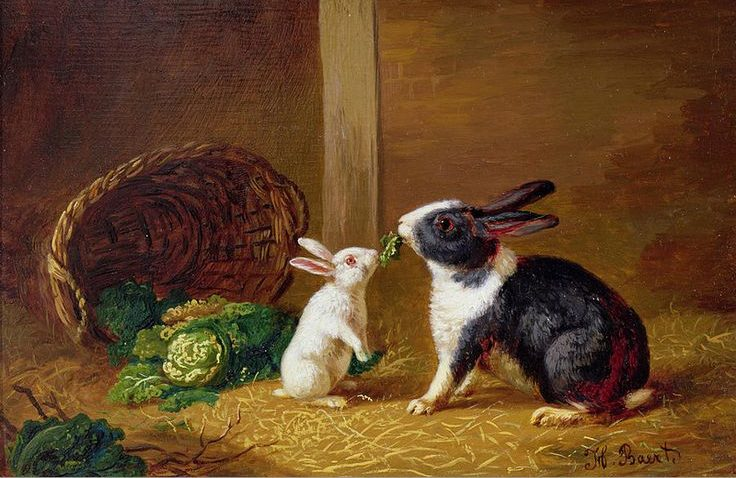
Few animals have moved as easily between the sacred, the comic, the erotic, and the domestic as the rabbit and the hare. Across world art, leporids appear in manuscript margins, Buddhist cave ceilings, Renaissance Madonnas, Chinese moon imagery, Japanese prints, Islamic ceramics, Dutch still lifes, hunting scenes, children’s illustration, modern photography, and contemporary sculpture. Their recurrence is not accidental. Rabbits and hares are visually memorable animals: quick, alert, vulnerable, reproductive, crepuscular, and strongly tied to the seasonal rhythms of spring. Their bodies are small enough to belong to the intimate world of gardens, fields, and households, yet strange enough to attract myth. Their long ears, luminous eyes, sudden motion, underground homes, and nocturnal associations invite symbolic elaboration.
The rabbit and the hare are often treated interchangeably in art-historical writing, though biologically they are not identical. Hares are generally larger, longer-legged, born with fur and open eyes, and associated with open fields; rabbits are smaller, burrowing animals whose young are born helpless. In older sources and iconographic traditions, however, the distinction is often blurred. Artists and patrons usually cared less about zoological precision than symbolic resonance. The “hare” of medieval bestiaries, the “rabbit” of Marian iconography, the “moon hare” of Asia, and the “bunny” of modern illustration often overlap in meaning.
The long history of rabbits and hares in art may be organized around several repeating symbolic fields: fertility and sexuality; the moon, time, and cyclical renewal; vulnerability and sacrificial innocence; cunning, inversion, and satire; purity and virginity; hunting, aristocratic leisure, and mortality; and finally, modernity’s nostalgia for nature, childhood, and the uncanny. Their symbolic power lies precisely in their instability. A rabbit beside the Virgin Mary may signify chastity; a rabbit in a Roman love context may signify erotic desire; a rabbit in a medieval margin may become a sword-bearing rebel; a rabbit in East Asian art may be lunar, immortal, or auspicious. The rabbit is common because it is both familiar and ambiguous.
I. Ancient and Classical Foundations: Fertility, Desire, and the Animal of Love
In ancient Mediterranean cultures, hares were frequently associated with fertility, eroticism, and desire. Their biological reputation for prolific reproduction made them natural symbols of generative abundance. In Greco-Roman visual culture, hares could appear in contexts of courtship, hunting, banqueting, and divine love. The animal was associated with Aphrodite and Eros, and in some classical contexts a hare could function as a love gift. The offering of a hare might signify erotic pursuit, beauty, or desire, particularly in scenes connected to youthful courtship.
This erotic symbolism was not merely abstract. Ancient writers and later medieval compilers repeated claims about the hare’s sexual vitality, reproductive powers, and supposed medicinal uses. These ideas shaped the animal’s later iconographic career. Even when Christianity reinterpreted the hare in moral or spiritual terms, the older association with fertility and lust remained available. This is one reason the rabbit and hare become symbolically double in medieval and Renaissance art: they can represent both uncontrolled sexuality and sanctified fertility.
The visual qualities of the hare also mattered. Unlike larger sacrificial animals such as bulls, goats, or sheep, the hare is delicate and swift. Its fragility makes it suitable as a symbol of desire pursued, beauty captured, or life threatened. In hunting imagery, the hare’s speed and vulnerability dramatize the relationship between predator and prey. In erotic imagery, the same qualities may suggest pursuit, seduction, or the fleeting nature of pleasure.
II. Early Christian and Medieval Art: Ambiguity, Salvation, and the Marginal Rabbit
Christian art inherited the symbolic vocabulary of antiquity but transformed it. The hare’s association with fertility and sexuality did not disappear; rather, it became morally charged. Because rabbits and hares were understood through bestiary traditions, biblical classifications, and popular natural history, they could carry contradictory meanings. They could symbolize lust, fecundity, cowardice, vulnerability, innocence, resurrection, or the soul fleeing danger.
Medieval bestiaries often interpreted animals allegorically. The natural behavior of an animal was read as a moral lesson. A hare might be treated as weak and fearful, an emblem of the soul pursued by sin or demons. Its flight from predators could become an image of the Christian seeking refuge. At the same time, its reproductive reputation made it a convenient sign of lust or uncontrolled bodily appetite. Such contradictions were not necessarily a problem for medieval viewers. Medieval symbolism often depended on context. The same creature could be good, bad, comic, or sacred depending on its placement, companions, and narrative role.
One of the most striking medieval uses of rabbits appears in manuscript marginalia. In the margins of Gothic manuscripts, rabbits sometimes reverse the expected order of the world: they hunt dogs, execute humans, ride armed into battle, or attack knights. These “killer rabbits” are often humorous, but their humor is not trivial. Marginal art frequently plays with inversion. The weak defeat the strong; the hunted becomes hunter; the ridiculous mirrors the serious. In a manuscript culture filled with sacred text, legal commentary, and devotional order, the margins become a controlled space for disorder. The rabbit’s ordinary harmlessness makes the inversion especially funny. A lion attacking a knight would be heroic; a rabbit attacking a knight is absurd.
This marginal rabbit also reveals a broader medieval fascination with boundary creatures. Rabbits live at the edge of field and burrow, domestic and wild, surface and underground. They are edible animals, hunted animals, and symbolic animals. Their place in the margins of manuscripts echoes their place in the imagination: they occupy thresholds.
III. The Three Hares Motif: Silk Roads, Sacred Geometry, and Visual Riddle
Among the most fascinating rabbit or hare images in world art is the “three hares” motif: three hares running in a circle, each appearing to have two ears, though the design contains only three ears total. Each ear is shared by two animals. The result is a visual puzzle, an emblem of motion, interdependence, and threefold symmetry.
The earliest known examples are commonly associated with the Mogao Caves at Dunhuang in China, especially in Buddhist cave-ceiling designs from the Sui and Tang periods. From there, or through wider networks of Silk Road transmission, the motif appears across Central Asia, the Islamic world, and Europe. It is found in Buddhist contexts, Christian churches, Jewish synagogue decoration, and secular ornamental design. This geographic spread has made the three hares one of the most compelling examples of cross-cultural visual migration.
Its meaning is difficult to reduce to a single explanation. In Buddhist and Chinese contexts, the hare’s lunar associations may have contributed to its significance. In Christian Europe, the threefold structure invited Trinitarian interpretation. In Jewish contexts, especially in painted synagogue decoration, the motif could be integrated into broader symbolic programs involving animals, cosmology, and sacred order. In architectural ornament, the circular motion of the hares may suggest eternity, the passage of time, cosmic harmony, or divine mystery.
The motif’s power lies partly in its refusal to settle. It is at once animal image, geometric device, optical illusion, and sacred sign. It does not merely depict hares; it uses hares to think visually about unity and multiplicity. Three bodies share three ears. Each animal is distinct, yet each depends on the others for its completion. As art history, the motif is also a reminder that images travel. Symbols do not belong permanently to one civilization. They move through trade, pilgrimage, conquest, textiles, manuscripts, ceramics, architecture, and memory.
IV. East Asian Traditions: The Moon Rabbit, Immortality, and Seasonal Auspiciousness
In East Asian art, the rabbit is inseparable from the moon. Chinese, Japanese, Korean, and broader Buddhist traditions preserve stories of a rabbit or hare dwelling in the moon. In Chinese mythology, the moon rabbit is often associated with Chang’e, the moon goddess, and with the preparation of an elixir of immortality. In Japanese tradition, the rabbit is frequently imagined pounding mochi on the moon. These myths arise partly from pareidolia: the dark and light patterns of the lunar surface can be perceived as a rabbit-like shape. But the association also rests on deeper symbolic parallels. The moon waxes and wanes; rabbits multiply. Both are linked to cyclical renewal.
Chinese art often presents the rabbit as auspicious. In lunar New Year imagery, zodiac art, textiles, ceramics, and festival objects, the rabbit may signify longevity, elegance, watchfulness, and seasonal blessing. In moon-viewing imagery, the rabbit can evoke autumn, the Mid-Autumn Festival, osmanthus blossoms, and the refined pleasure of contemplating the moon. The animal thus participates in a poetic world of seasonal time. It is not merely a creature but a sign of the calendar.
In Japanese art, rabbits appear in prints, netsuke, lacquer, textiles, and ceramics. They may be shown with waves, grasses, the moon, or pounding implements. The combination of rabbit and waves is especially meaningful because of the moon’s relationship to tides. The rabbit becomes a lunar animal whose motion is linked to water, rhythm, and change. In popular design, rabbits could also be playful, charming, and decorative, making them ideal for small objects and intimate art forms.
The East Asian rabbit is therefore not primarily a symbol of Christian purity or classical eroticism, though fertility remains part of its symbolic field. It is above all lunar. It belongs to night, autumn, medicine, immortality, cyclical time, and refined seasonal awareness.
V. Buddhist and South Asian Contexts: Self-Sacrifice and the Hare in the Moon
The moon-hare tradition is also deeply connected to Buddhist narrative. In one well-known Jataka tale, the Bodhisattva is born as a hare who offers his own body as food to a hungry stranger, who is in fact a deity in disguise. In honor of this act of self-sacrifice, the hare’s image is placed on the moon. This story shifts the animal’s meaning from fertility to compassion. The hare becomes an emblem of generosity, self-offering, and spiritual perfection.
This Buddhist background helps explain why the moon hare could become so enduring across Asia. It was not only a folk explanation for lunar markings; it was also a moral image. The hare’s smallness and vulnerability intensify the ethical force of the story. A powerful animal sacrificing itself might seem noble; a fragile hare doing so becomes sublime.
In visual terms, Buddhist hare imagery often participates in larger cosmological and decorative programs. The animal may appear in ceiling patterns, narrative illustrations, or symbolic designs. Its relationship to the moon links it to time, rebirth, and the cosmic order. Its relationship to self-sacrifice links it to Buddhist virtue. The hare becomes a bridge between natural observation, mythic imagination, and moral teaching.
VI. Islamic Art and the Courtly Hare: Ornament, Hunt, and Pleasure
Rabbits and hares also appear prominently in Islamic art, especially in ceramics, metalwork, textiles, carpets, and manuscript painting. In these contexts they may be associated with courtly leisure, hunting, garden imagery, and ornamental vitality. Islamic art often developed sophisticated animal ornament in which creatures are not always symbolic in the narrow allegorical sense but contribute to a larger aesthetic of abundance, refinement, and paradise-like pleasure.
The hare’s elegance made it well suited to decorative arts. Its curved body, long ears, and leaping form translate beautifully into repeating patterns and circular compositions. In ceramics or textiles, the hare can be part of a lively field of animals, foliage, and arabesque design. It may suggest the hunt, but also the cultivated garden, the princely court, or the pleasures of the natural world ordered by art.
The presence of hares in Islamic visual culture also matters for the history of transmission. Motifs involving hares moved across Eurasia through trade and artistic exchange. The three hares motif, for example, has often been discussed in relation to Silk Road networks and the movement of designs between Buddhist, Islamic, and European contexts. Whether one emphasizes direct transmission or shared ornamental logic, the hare demonstrates the permeability of artistic cultures.
VII. Renaissance Naturalism: Dürer, Observation, and the Dignity of the Small
In European Renaissance art, rabbits and hares retained their symbolic meanings but also became subjects of empirical observation. Albrecht Dürer’s famous Young Hare of 1502 is one of the supreme examples. The work is not a narrative scene, not a saint’s attribute, and not a marginal joke. It is a study of an animal treated with extraordinary attention. Dürer renders the hare’s fur, ears, eyes, whiskers, posture, and alertness with a precision that transforms a humble creature into a monument of observation.
Dürer’s hare belongs to a broader Renaissance interest in nature, optics, collecting, and the artist’s intellectual status. To draw a hare so carefully is to demonstrate mastery over sight itself. The animal becomes a test of artistic knowledge. Its soft fur, varied textures, and tense stillness challenge the artist’s hand and eye. The result is both scientific and devotional in a broad sense: a reverent attention to the created world.
Dürer also used hares in religious contexts, as in The Holy Family with Three Hares. Here the animal returns to Christian symbolism, but the naturalistic study and the sacred image belong to the same artistic universe. The Renaissance did not simply abandon symbolism for observation. Rather, it allowed close looking and inherited meaning to coexist.
VIII. The Rabbit in Marian and Christian Iconography: Virginity, Fertility, and Incarnation
One of the most paradoxical meanings of the rabbit in Western Christian art is its association with both fertility and virginity. This apparent contradiction becomes especially important in images of the Virgin Mary. Because rabbits and hares were believed in some premodern natural histories to reproduce in unusual ways, including the possibility of conceiving while already pregnant, they could be interpreted as symbols of miraculous generation. In Marian art, the white rabbit could therefore signify Mary’s purity and the mystery of the Incarnation.
Titian’s Madonna of the Rabbit is a central example. The painting places a white rabbit near the Virgin and Christ Child, transforming an ordinary animal into a theological sign. Its whiteness suggests purity; its fertility suggests motherhood; its miraculous reproductive associations point toward virgin birth. The rabbit also belongs to the pastoral landscape, grounding the sacred scene in the sensuous world of nature. Titian’s painting does not remove the animal’s older fertility symbolism; it redeems and redirects it.
This is characteristic of Christian iconography more broadly. The same animal that could signify lust in one setting could signify chastity in another. The transformation depends on visual context. Beside Venus, the hare may be erotic; beside Mary, it may be virginal; in a hunting scene, it may be prey; in a bestiary, it may be a moral lesson; in a resurrection context, it may suggest renewal. Christian art did not erase ambiguity. It used ambiguity.
IX. Hunting, Still Life, and Mortality: The Hare as Prey
From the Renaissance through the Baroque and into later European art, hares appear frequently in hunting scenes and still lifes. Dead hares hang from hooks, lie on tables, or appear beside game birds, fruit, vessels, and hunting equipment. These images are often displays of wealth, skill, and abundance, but they also participate in the tradition of vanitas. The dead hare is both food and memento mori. Its limp body reminds the viewer that vitality is temporary.
In aristocratic hunting imagery, the hare represents sport, land ownership, masculinity, discipline, and elite leisure. The pursuit of hares by dogs or falcons demonstrates control over nature. Yet the hare’s vulnerability complicates the image. It is fast, but not fast enough. Its body becomes the point where pleasure and death meet.
In still life, the hare’s fur provided painters with a technical challenge similar to Dürer’s living hare, but with a different emotional register. The living hare is alert; the dead hare is tactile, silent, and heavy. Its softness becomes elegiac. The animal that once signified fertility now signifies mortality. This shift is not a contradiction but a deepening of the same symbolic field: the rabbit and hare belong to life’s abundance, and therefore also to life’s fragility.
X. Modern and Contemporary Art: Childhood, Uncanny Bodies, and Consumer Myth
In modern art and visual culture, rabbits become increasingly associated with childhood, fantasy, domestic affection, and the uncanny. The rabbit of children’s literature—most famously in works such as Alice’s Adventures in Wonderland and later illustrated traditions—becomes a guide into alternative worlds. The White Rabbit is anxious, clothed, verbal, and time-bound: a creature of dream logic and modern nervousness. This anthropomorphic rabbit belongs to a different symbolic order than the medieval hare or the moon rabbit, yet it preserves older themes of liminality and passage. The rabbit leads the child underground, into a burrow-world where ordinary rules fail.
Modern artists have also used rabbits to explore vulnerability, reproduction, death, and the body. In photography, sculpture, and conceptual art, the rabbit may appear as a laboratory animal, a domestic pet, a commodity, a symbol of innocence, or a disturbing reminder of flesh. The modern rabbit is often cute, but cuteness itself can be unstable. A cute animal can comfort, sentimentalize, or unsettle. Contemporary art frequently exploits this instability.
Popular culture has further transformed the rabbit into a commercial and seasonal icon: Easter bunnies, chocolate rabbits, cartoon rabbits, plush toys, advertising mascots, and fantasy characters. These images often flatten older symbolism into cheerfulness, but traces remain. The Easter rabbit still carries themes of spring, fertility, renewal, and resurrection, even when secularized. The cartoon rabbit often preserves cunning and speed. The plush rabbit preserves vulnerability and tenderness. The mythic animal survives inside consumer culture.
XI. Why Rabbits and Hares Are So Common in Art
The recurrence of rabbits and hares in world art can be explained through several overlapping factors.
First, they are biologically memorable. Their fertility, speed, alertness, and seasonal visibility make them natural symbols of life-force. Societies close to agriculture and seasonal cycles would have encountered them often and noticed their reproductive abundance.
Second, they are visually distinctive. Long ears, compact bodies, large eyes, and leaping movement make them easy to stylize. They work well in manuscript margins, textile patterns, ceramics, sculpture, heraldry, and children’s illustration. Few animals are so recognizable with so few lines.
Third, they are symbolically flexible. The rabbit can be sacred or profane, pure or lustful, comic or tragic, lunar or earthly, domestic or wild. This flexibility allows artists to reuse the animal in radically different contexts without exhausting it.
Fourth, they occupy thresholds. Rabbits and hares are active at dawn and dusk; they move between field and burrow; they are hunted yet elusive; they are familiar yet wild. Such threshold creatures are especially useful in myth and art because they help cultures think about boundaries: life and death, surface and underworld, innocence and sexuality, nature and civilization, time and eternity.
Fifth, they connect ordinary life to cosmic imagination. A rabbit in a garden is common; a rabbit in the moon is cosmic. A hare in a field is natural; three hares sharing three ears become metaphysical geometry. This ability to move from the small to the vast gives the animal unusual artistic power.
Conclusion
The history of rabbits and hares in art is not a minor curiosity but a revealing thread in global visual culture. These animals appear wherever human beings have tried to represent fertility, vulnerability, time, renewal, desire, sacrifice, humor, and the mystery of the natural world. In the West, they move from classical erotic symbolism to Christian paradox, from manuscript satire to Renaissance naturalism, from hunting still life to modern childhood fantasy. In the East, they become lunar companions, makers of elixirs or mochi, auspicious signs of longevity and seasonal beauty, and symbols of Buddhist self-sacrifice. Across Eurasia, the three hares motif demonstrates the migration of images through sacred and commercial networks.
The rabbit and the hare endure because they are never only one thing. They are too fertile to be merely innocent, too vulnerable to be merely comic, too lunar to be merely earthly, too ordinary to be merely sacred, and too symbolically charged to be dismissed as decoration. Their art-historical importance lies in this doubleness. They remind us that world art often builds its deepest meanings from the smallest creatures.
Select Bibliography
Baxandall, Michael. Painting and Experience in Fifteenth-Century Italy. Oxford: Oxford University Press, 1972.
Benton, Janetta Rebold. Holy Terrors: Gargoyles on Medieval Buildings. New York: Abbeville Press, 1997.
Camille, Michael. Image on the Edge: The Margins of Medieval Art. Cambridge, MA: Harvard University Press, 1992.
Clark, Kenneth. Animals and Men: Their Relationship as Reflected in Western Art from Prehistory to the Present Day. London: Thames and Hudson, 1977.
Daston, Lorraine, and Gregg Mitman, eds. Thinking with Animals: New Perspectives on Anthropomorphism. New York: Columbia University Press, 2005.
Flores, Nona C., ed. Animals in the Middle Ages: A Book of Essays. New York: Garland, 1996.
George, Wilma, and Brunsdon Yapp. The Naming of the Beasts: Natural History in the Medieval Bestiary. London: Duckworth, 1991.
Harbison, Craig. Jan van Eyck: The Play of Realism. London: Reaktion Books, 1991.
Hearn, Maxwell K. How to Read Chinese Paintings. New York: Metropolitan Museum of Art, 2008.
Lumpkin, Susan, and John Seidensticker. Rabbits: The Animal Answer Guide. Baltimore: Johns Hopkins University Press, 2011.
Miyeko Murase. Bridge of Dreams: The Mary Griggs Burke Collection of Japanese Art. New York: Metropolitan Museum of Art, 2000.
Pastoureau, Michel. Bestiaries of the Middle Ages. Translated by George Holoch. Princeton: Princeton University Press, 2011.
Rowland, Beryl. Animals with Human Faces: A Guide to Animal Symbolism. Knoxville: University of Tennessee Press, 1973.
Stocker, David, and Margarita Stocker. “The Three Hares: A Curiosity Worth Regarding.” Folklore 107 (1996): 15–24.
Valcanover, Francesco. L’opera completa di Tiziano. Milan: Rizzoli, 1969.
Walker-Meikle, Kathleen. Medieval Pets. Woodbridge: Boydell Press, 2012.