Introduction
The Pre-Raphaelite school of art occupies one of the most fascinating positions in nineteenth-century cultural history. It was at once a rebellion and a revival, a critique of modernity and a distinctly modern movement, a return to medieval and early Renaissance sources and a radical challenge to the artistic institutions of Victorian Britain. Founded in London in 1848 by a group of young artists and writers, the Pre-Raphaelite Brotherhood began as a small, semi-secret society opposed to what its members saw as the lifeless formulas of academic painting. Yet the movement quickly grew beyond its original Brotherhood into a broader aesthetic, literary, decorative, and philosophical current that influenced painting, poetry, book design, stained glass, furniture, textile production, illustration, fantasy art, Art Nouveau, Symbolism, Arts and Crafts design, and modern visual culture.
The term “Pre-Raphaelite” refers to the movement’s admiration for art before Raphael, or more precisely before the High Renaissance academic tradition associated with Raphael had become, in the eyes of the Brotherhood, the dominant model for European painting. The Pre-Raphaelites did not reject Raphael simply because they disliked him as an artist. Rather, they objected to the academic worship of Raphael as a fixed standard of beauty, grace, composition, and idealization. To them, the art world of mid-Victorian Britain had become too polished, too theatrical, too dependent on inherited formulas, and too far removed from the direct study of nature, spiritual seriousness, and moral imagination. The Brotherhood believed that art should recover a more sincere relation to the visible world, to literature, to religious and ethical meaning, and to the craft of making.
The Pre-Raphaelite movement is often remembered for its jewel-like colors, intricate surfaces, medieval subjects, biblical narratives, Arthurian romances, Shakespearean heroines, red-haired women, symbolic flowers, and intense visual detail. But this popular image tells only part of the story. The movement began with startling realism and social seriousness. Its earliest works shocked viewers because they presented sacred subjects in contemporary or historically specific terms, painted every leaf and stone with almost scientific attention, and refused the soft brown tones and generalized ideal beauty favored by academic taste. Later Pre-Raphaelitism moved in more decorative, poetic, sensual, and mythic directions, especially through Dante Gabriel Rossetti, Edward Burne-Jones, William Morris, and their circle. The school therefore contains multiple phases: the original Brotherhood of 1848–1853; the wider Pre-Raphaelite circle of the 1850s and 1860s; the later Aesthetic and decorative phase; and the Arts and Crafts legacy that carried many Pre-Raphaelite values into design, architecture, publishing, and the modern home.
To understand the Pre-Raphaelites properly, one must see them not merely as painters of romantic medieval dreams, but as a group wrestling with the deepest tensions of modern life: industry and nature, faith and doubt, sexuality and morality, craft and mass production, historical memory and modern alienation, realism and symbolism, beauty and truth. They were not anti-modern in a simple sense. They used new pigments, engaged with contemporary science, responded to photography, challenged institutional authority, and helped redefine the relationship between fine art and design. Their medievalism was not escapism alone; it was often a critique of industrial capitalism, mechanized labor, and spiritual impoverishment. Their intense naturalism was not merely decorative; it was a discipline of looking. Their interest in women was not merely aesthetic; it reflected changing Victorian anxieties about desire, agency, class, sanctity, and danger. Their legacy remains visible in fantasy illustration, graphic novels, book arts, fashion photography, album covers, cinematic medievalism, gothic aesthetics, and contemporary figurative painting.
This article examines the Pre-Raphaelite school in detail: its historical origins, philosophical principles, artistic techniques, major artists, literary and religious influences, regional centers, relationship to women artists and models, influence on later movements, and continuing role in modern media. It treats Pre-Raphaelitism as both a historical art movement and a living visual language that continues to shape the modern imagination.
I. Historical Background: Victorian Britain and the Birth of Rebellion
The Pre-Raphaelite Brotherhood was founded in 1848, a year of revolutions across Europe. Although Britain avoided the continental upheavals of that year, it was hardly politically or culturally stable. Industrialization had transformed cities, labor, class relations, and the landscape. Railways, factories, coal smoke, urban poverty, and expanding imperial commerce shaped the Victorian world. The art establishment, centered on the Royal Academy in London, seemed to many younger artists to be both powerful and stale. Historical painting remained prestigious, but the formulas of academic composition, idealized anatomy, and conventional subject matter appeared increasingly inadequate to a generation living amid social change, religious questioning, scientific discovery, and political agitation.
The Royal Academy’s teaching was rooted in the study of old masters, classical models, and idealized composition. Sir Joshua Reynolds, the Academy’s first president, had advocated what later critics saw as a “grand style,” a way of painting that generalized from nature and elevated the subject above ordinary life. To the Pre-Raphaelites, this academic ideal had hardened into mannerism. They believed that painters were being trained not to see, but to repeat. Figures were arranged in conventional poses, colors were subdued into brownish harmonies, religious scenes were theatrical rather than spiritual, and history painting often felt artificial. The Brotherhood’s revolt was therefore both aesthetic and ethical. They saw bad art not merely as weak technique, but as a failure of sincerity.
The founding members were Dante Gabriel Rossetti, William Holman Hunt, John Everett Millais, William Michael Rossetti, James Collinson, Frederic George Stephens, and Thomas Woolner. Of these, the central painters of the first phase were Hunt, Millais, and Dante Gabriel Rossetti. The group adopted the initials “P.R.B.” and sometimes placed them on paintings without explaining their meaning, adding to the aura of secrecy. Their chosen name announced a program: to look before Raphael, before the academic idealization of the High Renaissance, toward what they imagined as an earlier art of clarity, detail, spiritual intensity, and truthfulness.
The movement’s early inspirations included Italian quattrocento painting, medieval art, Northern Renaissance detail, manuscript illumination, early Netherlandish painting, and the moral seriousness of religious art before the Renaissance had, in their view, become overly polished and theatrical. Jan van Eyck’s Arnolfini Portrait, visible in the National Gallery, deeply impressed the young artists. Its mirror, minute surfaces, symbolic objects, luminous color, and domestic realism suggested a model of painting in which the material world could carry profound meaning. The Pre-Raphaelites also admired the honesty and vividness they associated with early Italian painters such as Fra Angelico, Giotto, and Botticelli, though their understanding of these artists was shaped by Victorian scholarship and taste.
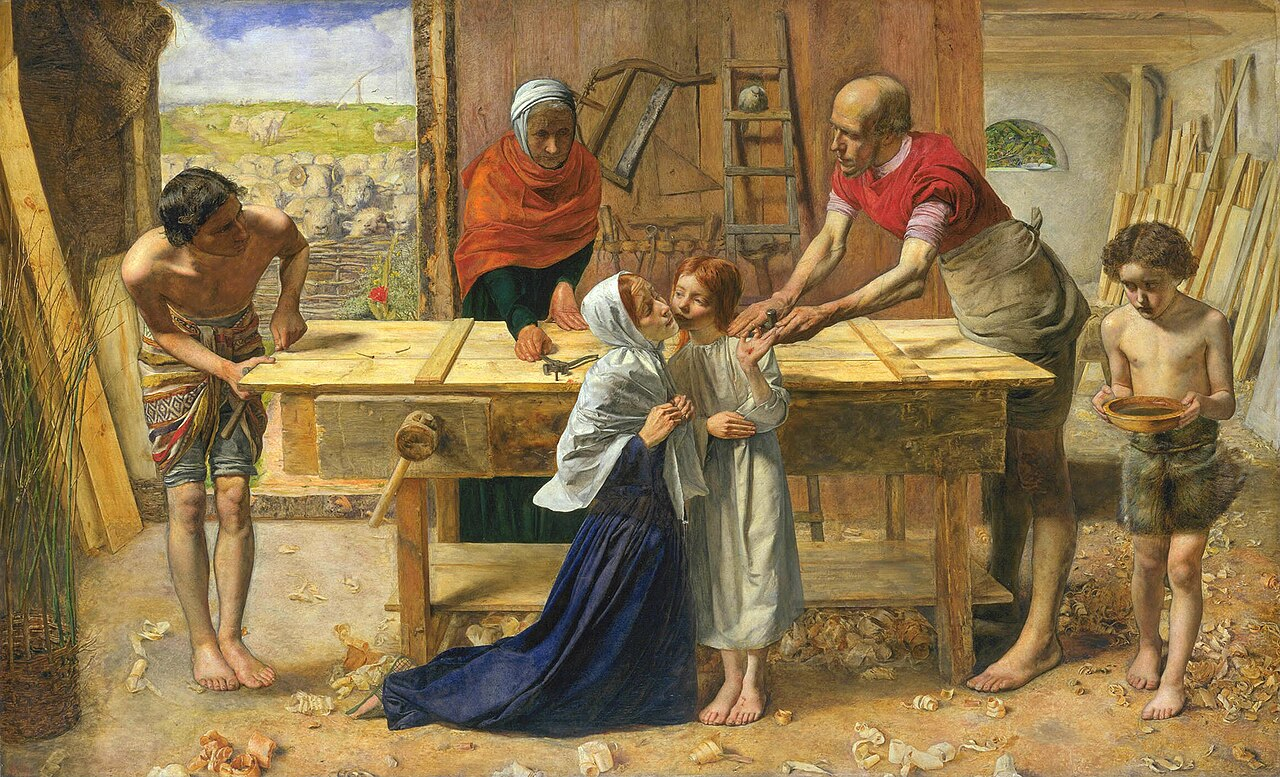
The Brotherhood’s emergence was controversial almost immediately. Their early paintings were criticized for ugliness, stiffness, irreverence, and excessive detail. Charles Dickens famously attacked Millais’s Christ in the House of His Parents, objecting to its realistic depiction of the Holy Family in a carpenter’s workshop. For Dickens and many others, sacred art required idealization; for Millais, Hunt, and Rossetti, sanctity could be made more powerful by being brought into the real world of labor, bodies, wood shavings, dirt, and blood. This clash reveals the radical nature of early Pre-Raphaelitism. The movement’s “return” to earlier art was not conservative in effect. It unsettled the assumptions of its own age.
II. The Principles of the Brotherhood
The Pre-Raphaelite Brotherhood was never a tightly organized school with a formal manifesto in the modern sense. It was a group of friends and collaborators united by shared dissatisfactions and ambitions. Still, William Michael Rossetti later summarized the Brotherhood’s early doctrines in four famous principles: “to have genuine ideas to express”; “to study Nature attentively”; to sympathize with what was “direct and serious and heartfelt” in earlier art rather than what was conventional; and, most importantly, “to produce thoroughly good pictures and statues.” These principles are essential because they show that the movement was not merely stylistic. It was grounded in an ethic of sincerity.
The first principle, having genuine ideas to express, rejected empty virtuosity. For the Pre-Raphaelites, technical skill was not enough. Art required inner necessity, a subject that mattered, and a moral or imaginative purpose. Their paintings are therefore often literary, symbolic, religious, or psychological. Even when the surface is sensuous, the work tends to imply a story, crisis, decision, or revelation.

The second principle, the attentive study of nature, became the most visible feature of early Pre-Raphaelite painting. Leaves, flowers, stones, textiles, hair, skin, water, and light were rendered with extraordinary precision. This was not the generalized “nature” of academic landscape, but particular nature: exact plants, specific weather, sharply observed textures. The artists often painted outdoors or from carefully arranged studies. Millais’s Ophelia, for example, is famous not only for its Shakespearean subject but also for its botanically rich riverbank. The flowers are not merely decorative; they are symbolic, naturalistic, and poetic at once.
The third principle distinguished between earlier art that was “direct and serious and heartfelt” and art that was merely conventional or self-displaying. This is where the term “Pre-Raphaelite” becomes meaningful. The Brotherhood did not advocate a literal return to medieval technique. Rather, they sought a quality they believed had been lost: earnestness. They wanted art to feel spiritually and emotionally necessary, not merely accomplished. This attraction to sincerity helps explain their love of medieval romance, biblical story, Dante, Shakespeare, Keats, and Tennyson. Literature supplied subjects in which moral and emotional intensity could be embodied.
The fourth principle, producing good pictures and statues, sounds simple but is perhaps the most revealing. The Brotherhood did not want theory to replace art. Their rebellion was practical. It demanded labor, discipline, and craft. John Ruskin, who became their most important early defender, had urged artists to “go to Nature in all singleness of heart,” rejecting nothing and scorning nothing. Ruskin’s words became almost a moral commandment for Pre-Raphaelite naturalism. Looking was not passive; it was devotional labor.
The philosophy of the school can therefore be summarized in five overlapping commitments: truth to nature, moral seriousness, historical imagination, artistic sincerity, and craft integrity. These values made Pre-Raphaelitism both a visual style and a broader worldview. It was a way of seeing the world as symbolically charged, morally consequential, and worthy of reverent attention.
III. John Ruskin and the Moral Defense of Pre-Raphaelitism
No account of the Pre-Raphaelite school can ignore John Ruskin. Ruskin was not a member of the Brotherhood, but his criticism helped legitimize them at a crucial moment. His Modern Painters had already argued for truth to nature and against formulaic idealization. When the young Pre-Raphaelites came under attack, Ruskin defended them in letters to The Times and elsewhere, recognizing in their work an attempt to practice principles he himself had advocated.
Ruskin’s support mattered because he was one of the most influential art critics of the Victorian period. His defense did not mean that he approved of everything they did. He had reservations, especially about some aspects of Rossetti’s art and the later sensual direction of the movement. But he recognized that Hunt and Millais were attempting to restore seriousness to painting by rejecting studio conventions and attending to the natural world.
Ruskin’s influence was philosophical as much as practical. He believed that art had moral significance because it reflected how a society saw creation, labor, beauty, and truth. Bad art resulted from bad seeing, and bad seeing resulted from spiritual and social disorder. This view resonated with Pre-Raphaelite practice. Their minute naturalism was not simply optical; it implied that every part of the world deserved attention. A single flower could reveal divine order. A humble workshop could become the setting of sacred history. A woman’s face could become a site of psychological and symbolic depth.
Ruskin also helped connect Pre-Raphaelitism to wider debates about labor and craft. His later writings, especially The Stones of Venice and Unto This Last, influenced William Morris and the Arts and Crafts movement. The Pre-Raphaelite concern with sincerity and handcraft thus became part of a larger critique of industrial capitalism. The issue was not only what art looked like, but how it was made, who made it, and what kind of life its making implied.
IV. Early Pre-Raphaelite Painting: Realism, Religion, and Scandal
The earliest Pre-Raphaelite works are often sharper, stranger, and more socially serious than the later popular image of the movement suggests. They are marked by hard outlines, brilliant color, intense detail, compressed space, and a refusal to soften awkwardness. They often make viewers uncomfortable because they reject the graceful distance expected of historical or religious painting.
John Everett Millais’s Christ in the House of His Parents is a central example. The painting shows the young Christ in Joseph’s carpenter shop after injuring his hand, foreshadowing the Crucifixion. The setting is not a generalized holy space but a working shop, with tools, wood, dust, and ordinary bodies. The Virgin Mary is not an idealized queen but a concerned mother. The sacred enters the mundane. This was precisely what shocked critics. Yet the painting reveals the Brotherhood’s religious seriousness: incarnation means that divinity enters flesh, labor, family, and material history.
William Holman Hunt’s The Hireling Shepherd and The Awakening Conscience likewise demonstrate the moral intensity of early Pre-Raphaelitism. Hunt was perhaps the most consistently religious and moralizing of the original painters. His works are dense with symbolism, often requiring careful reading. The Awakening Conscience, for instance, depicts a kept woman rising from her lover’s lap in a moment of spiritual realization. The painting’s interior details—music, mirror, tangled threads, garden glimpsed outside—function as signs of moral entrapment and possible redemption. Hunt’s art often treats the visible world as a field of spiritual clues.
Millais’s Ophelia, one of the most famous Pre-Raphaelite paintings, combines natural observation, literary tragedy, and symbolic detail. The figure of Ophelia floats in the water, surrounded by plants associated with grief, innocence, memory, and death. The painting’s beauty is inseparable from its horror. Its naturalism intensifies rather than softens tragedy. Ophelia does not disappear into an idealized mist; she is held in a cold, exact, living world.

Rossetti’s early Ecce Ancilla Domini!, also known as The Annunciation, presents the Virgin Mary not as a composed Renaissance maiden but as a startled young woman recoiling on her bed as the angel appears. The white interior, red embroidery, lily, and intense psychological atmosphere make the scene both sacred and intimate. Rossetti’s treatment of Mary emphasizes inward experience rather than public grandeur. The painting points toward his later interest in women as symbolic, psychological, and poetic presences.
These works reveal the early Pre-Raphaelite paradox: the artists wanted to recover older sincerity, yet their paintings looked shockingly new. Their medievalism and biblical subjects did not make them conservative. Their realism, color, and emotional intensity challenged Victorian expectations.
V. The Germ and the Union of Art and Literature
The Pre-Raphaelites were never merely painters. Poetry, criticism, translation, and literary imagination were central from the beginning. Their magazine The Germ, published briefly in 1850, was subtitled in terms that linked nature, poetry, literature, and art. Though it survived only four issues, it provides crucial evidence of the Brotherhood’s ambitions. They wanted an art that crossed boundaries between word and image.
The Germ included poems, essays, reviews, and etchings by members and associates of the group, including Dante Gabriel Rossetti, William Michael Rossetti, Thomas Woolner, James Collinson, Ford Madox Brown, and Christina Rossetti. Its failure in the marketplace should not obscure its historical importance. It anticipated later “little magazines” in which avant-garde groups used small publications to define their aesthetic principles and create networks of sympathetic readers.
Literature was central to Pre-Raphaelite subject matter. Dante, Shakespeare, Keats, Tennyson, Browning, Malory, and medieval romance provided themes of doomed love, spiritual testing, feminine agency, betrayal, death, and visionary longing. The Pre-Raphaelites did not illustrate literature in a merely subordinate sense. They transformed literary moments into symbolic images. A scene from Shakespeare or Dante became a psychological and visual condensation of an entire moral world.
Dante Gabriel Rossetti embodied this union of poetry and painting more than any other member. He was both poet and painter, and his mature art often feels like visual poetry. His paintings are not narrative in the straightforward sense of Hunt’s moral dramas. They are compressed icons of desire, memory, beauty, and fatality. His women often appear as embodiments of states of soul: longing, enchantment, mourning, temptation, spiritualized desire. This poetic symbolism would deeply influence later Aestheticism and Symbolism.
Christina Rossetti’s relationship to the movement is also important. Although not a painter in the same sense as the Brotherhood’s central artists, she contributed poetry to The Germ and became one of the major literary voices associated with the Pre-Raphaelite circle. Her poetry shares with the movement a concern for spiritual intensity, symbolic objects, renunciation, desire, and the unseen meanings of ordinary things.
VI. Major Artists of the Original Brotherhood
Dante Gabriel Rossetti
Dante Gabriel Rossetti was the most charismatic and myth-making figure of the movement. Born into an intellectually rich Italian expatriate family, Rossetti was steeped in Dante, medieval literature, Catholic imagery, and Romantic poetry. His early work helped define the Brotherhood’s anti-academic rebellion, but his later work transformed Pre-Raphaelitism into a more sensual, poetic, and symbolic art.
Rossetti’s early paintings, such as Ecce Ancilla Domini! and The Girlhood of Mary Virgin, are religious and austere. They employ sharp symbolism and psychological intensity. Later, however, Rossetti turned increasingly toward images of women as icons of beauty, desire, and memory. Works such as Bocca Baciata, Lady Lilith, Monna Vanna, Proserpine, and Astarte Syriaca helped create the popular image of the Pre-Raphaelite woman: heavy hair, full lips, elongated neck, intense gaze, and sumptuous surroundings.
Rossetti’s art is often criticized for turning women into aesthetic objects. That criticism is not without force. Yet his women are rarely passive in the simple academic sense. They are powerful, troubling, self-contained, and often dangerous. They look back. They hold symbolic objects. They occupy the image like presences rather than decorations. Rossetti’s female figures helped shape later Symbolist and Decadent art, where beauty is frequently linked to mystery, eroticism, death, and spiritual danger.
Rossetti’s influence extended beyond painting. As a poet, translator, collector, teacher, and cultural magnet, he shaped the second generation of Pre-Raphaelites, including William Morris and Edward Burne-Jones. His studio became a center of aesthetic experiment. His medievalism was less archaeological than dreamlike; it created an atmosphere that later artists could inhabit.
William Holman Hunt
William Holman Hunt was the most doctrinally committed of the original Brotherhood. He maintained the early Pre-Raphaelite emphasis on moral seriousness, religious symbolism, and painstaking naturalism throughout his career. Hunt’s paintings are often didactic, but their didacticism is inseparable from their visual power.
The Light of the World became one of the most widely reproduced religious images of the Victorian era. Christ stands at a closed door, lantern in hand, symbolizing spiritual invitation. The image’s popularity testifies to Hunt’s ability to translate Pre-Raphaelite detail and symbolism into devotional culture. The Scapegoat, painted after Hunt traveled to the Holy Land, is another major work: a desolate animal standing in a salt-encrusted landscape becomes a symbol of sin, exile, and sacrifice.
Hunt’s insistence on historical and geographical accuracy led him to travel in the Middle East to paint biblical subjects from direct observation. This practice reflected the Pre-Raphaelite desire to ground sacred history in material specificity. Yet it also raises questions for modern scholars about Orientalism, empire, and Victorian religious imagination. Hunt’s Holy Land paintings combine sincere religious purpose with the nineteenth-century British tendency to treat the East as a space of biblical authenticity and symbolic possession.
John Everett Millais
John Everett Millais was a prodigy and perhaps the most technically brilliant painter of the original group. His early Pre-Raphaelite works are among the movement’s masterpieces. Christ in the House of His Parents, Mariana, The Woodman’s Daughter, The Order of Release, and Ophelia show his command of figure, color, detail, and emotional atmosphere.
Millais’s career later moved away from strict Pre-Raphaelitism toward a broader and more commercially successful Victorian style. He became a member, then president, of the Royal Academy—the very institution the Brotherhood had once challenged. This has sometimes led critics to treat him as a defector. But such a judgment is too simple. Millais’s early contribution was decisive, and his later career shows how Pre-Raphaelite innovations could be absorbed into mainstream British art.
Millais also demonstrates the tension between avant-garde rebellion and institutional success. The Pre-Raphaelites began as outsiders, but many of their techniques and subjects eventually entered popular taste. Millais’s later fame reflects the movement’s complicated path from scandal to acceptance.
William Michael Rossetti
William Michael Rossetti was not primarily a painter, but he was essential as chronicler, critic, organizer, and theorist. His later accounts of the Brotherhood helped shape how the movement was remembered. He edited The Germ and preserved crucial documents. Without him, the historical record of the Brotherhood would be far poorer. His role reminds us that art movements are not made only by painters; they are also made by writers, editors, critics, collectors, and archivists.
James Collinson, Frederic George Stephens, and Thomas Woolner
The remaining original members are less famous but still important. James Collinson, a painter and devout Catholic convert, contributed to the group’s religious seriousness but eventually withdrew. Frederic George Stephens abandoned painting and became a critic. Thomas Woolner, a sculptor and poet, brought three-dimensional art and literary ambition into the Brotherhood. Their varied careers show that the PRB was from the beginning a mixed artistic and intellectual society rather than a uniform painting school.
VII. Ford Madox Brown and the Wider Circle
Ford Madox Brown was never an official member of the Brotherhood, but he was one of its most important allies and influences. Older than the original members, Brown brought historical ambition, social concern, and technical seriousness to British painting. His work The Last of England, depicting emigrants leaving Britain, combines modern social reality with symbolic intensity. Work, perhaps his greatest painting, presents Victorian labor, class, urban life, and intellectual debate in a complex public scene.
Brown’s relationship to the Pre-Raphaelites shows that the movement quickly exceeded the Brotherhood itself. Many artists shared its principles without belonging to its secret society. Brown’s realism, moral seriousness, and vivid color align him with Pre-Raphaelitism, while his social panoramas distinguish him from Rossetti’s inward symbolism or Hunt’s religious allegory.
Brown also influenced William Morris and the decorative turn of the movement. His involvement in murals, design, and historical subjects helped prepare the way for the integration of fine and decorative arts.
VIII. Women in the Pre-Raphaelite Movement: Models, Artists, Poets, and Makers
No modern scholarly account of the Pre-Raphaelites can treat women merely as muses. Women were central to the movement as models, collaborators, artists, poets, patrons, and cultural agents. At the same time, the Pre-Raphaelite circle was shaped by Victorian gender inequalities that limited women’s training, exhibition opportunities, and public recognition. The result is a complex history: women were indispensable to the movement’s imagery and production, but they were often remembered through the biographies and paintings of men.
Elizabeth Siddal is the most famous example. She began as a model and became one of the defining faces of Pre-Raphaelite art, especially through Millais’s Ophelia and Rossetti’s many works. But Siddal was also an artist and poet in her own right. Her drawings and watercolors reveal a spare, medievalizing, emotionally intense style. She exhibited with the Pre-Raphaelite circle and was supported for a time by Ruskin. Her life has often been romanticized through illness, addiction, marriage to Rossetti, and early death, but recent scholarship has worked to recover her agency as a maker.
Jane Morris, born Jane Burden, became another iconic Pre-Raphaelite figure. Her appearance shaped Rossetti’s mature ideal of beauty, and she was also deeply connected to William Morris’s decorative world. Like Siddal, she has often been reduced to muse or object of desire, yet she was an active participant in the artistic and social circle around Morris and Rossetti. Her embroidery and involvement in design culture deserve attention as part of the movement’s broader craft history.
Fanny Cornforth, Annie Miller, Alexa Wilding, and other models also played important roles in shaping Pre-Raphaelite imagery. Their class backgrounds, relationships with artists, and representation in paintings open important questions about power, sexuality, labor, and social mobility. The Pre-Raphaelite model was not simply a passive body. Modeling was work, and in some cases it became a route into artistic communities otherwise closed to women of limited means.
Women artists associated with the broader Pre-Raphaelite movement include Marie Spartali Stillman, Evelyn De Morgan, Joanna Mary Boyce, Barbara Bodichon, Emma Sandys, and Eleanor Fortescue-Brickdale. Marie Spartali Stillman produced a substantial body of work over a long career, often drawing on literary, medieval, and Italianate themes. Evelyn De Morgan combined Pre-Raphaelite detail with spiritualist, allegorical, and feminist themes. Joanna Mary Boyce, though she died young, produced powerful portraits and subject paintings. Eleanor Fortescue-Brickdale carried Pre-Raphaelite medievalism and literary illustration into the early twentieth century.
The recovery of these women has significantly changed Pre-Raphaelite studies. Earlier art history often framed the movement around a brotherhood of male geniuses and their beautiful female models. Recent scholarship, including work by Jan Marsh, Deborah Cherry, Pamela Gerrish Nunn, Elizabeth Prettejohn, and others, has expanded the field to include women’s artistic production, the economics of modeling, the politics of representation, and the gendered structure of Victorian art institutions.
The Pre-Raphaelite image of woman remains one of the movement’s most influential and contested legacies. On the one hand, Pre-Raphaelite women often possess psychological power, sensuality, and symbolic presence denied to more conventional Victorian feminine types. On the other hand, they are frequently framed through male desire, moral danger, death, silence, or enchantment. The movement challenged Victorian norms, but it also created new visual myths of femininity that remain powerful today.
IX. The Second Generation: Morris, Burne-Jones, and the Decorative Turn
By the mid-1850s the original Brotherhood had largely dissolved, but Pre-Raphaelitism did not die. It changed shape. The second generation, centered around Rossetti, William Morris, and Edward Burne-Jones, shifted the movement toward medieval romance, decorative design, poetic symbolism, and eventually the Arts and Crafts movement.
William Morris is one of the most important figures in this transformation. Painter, poet, designer, publisher, translator, socialist, and reformer, Morris embodied the expansion of Pre-Raphaelite values beyond easel painting. His interest in medieval craft, hand labor, pattern, architecture, and social reform turned the movement into a philosophy of life. For Morris, beauty should not be confined to galleries. It should enter the home, the book, the wall, the textile, the chair, the garden, and the conditions of labor.
Morris’s firm, later known as Morris & Co., produced textiles, wallpapers, stained glass, furniture, embroidery, and decorative objects. Its work was deeply indebted to Pre-Raphaelite medievalism and natural detail. Flowers, vines, birds, and rhythmic pattern became part of a decorative language that remains popular. Morris’s famous demand that one should have nothing in one’s house that is not useful or beautiful captures the ethical and aesthetic union at the heart of Arts and Crafts design.
Edward Burne-Jones, meanwhile, carried Pre-Raphaelite painting into dream, myth, and monumental decoration. His elongated figures, pale faces, melancholy moods, and mythic cycles helped shape later Symbolism and fin-de-siècle art. Works such as The Beguiling of Merlin, The Golden Stairs, The Wheel of Fortune, and The Briar Rose series are less concerned with early Pre-Raphaelite realism than with suspended time, dream logic, and spiritualized beauty. Burne-Jones’s world is often silent, ritualized, and otherworldly.
The collaboration between Morris and Burne-Jones was crucial. Burne-Jones designed stained glass, tapestries, and illustrations for Morris’s decorative enterprises. Together they helped dissolve the hierarchy between fine and decorative art. This was one of the movement’s most lasting achievements. The Pre-Raphaelite school began as a revolt in painting but became a revolution in visual culture.
The Red House, designed by Philip Webb for Morris and decorated with the participation of the Pre-Raphaelite circle, became an emblem of this integrated aesthetic. Architecture, furniture, painting, textile, and daily life were conceived as a whole. The home itself became a work of art. This vision would profoundly influence Arts and Crafts design in Britain, Europe, and America.
X. Schools, Phases, and Related Movements
The phrase “Pre-Raphaelite school” can be misleading if it suggests a single institution or uniform style. It is better understood as a constellation of phases and related currents.
The first phase is the original Brotherhood, roughly 1848 to 1853. It is marked by hard-edged naturalism, religious and literary subjects, bright color, moral seriousness, and opposition to the Royal Academy.
The second phase is the wider Pre-Raphaelite circle of the 1850s and 1860s, including Ford Madox Brown, Arthur Hughes, Charles Allston Collins, Walter Deverell, Elizabeth Siddal, and others. This phase broadens the movement’s subject matter and expands its networks.
The third phase is the Rossettian and Aesthetic phase, centered on images of beauty, desire, medieval romance, and symbolic womanhood. This phase overlaps with the Aesthetic movement and the doctrine of art for art’s sake, though Pre-Raphaelite moral and literary seriousness never disappears entirely.
The fourth phase is the Morris-Burne-Jones decorative phase, which leads into Arts and Crafts. Here Pre-Raphaelitism becomes a design philosophy and social critique. Medievalism, nature, handcraft, and anti-industrial values shape furniture, textiles, books, stained glass, and architecture.
The fifth phase is the late and post-Pre-Raphaelite legacy, including artists such as John William Waterhouse, Evelyn De Morgan, Eleanor Fortescue-Brickdale, and the Birmingham Group. By this point, Pre-Raphaelite visual language had entered the broader currents of Symbolism, Art Nouveau, fantasy illustration, and late Victorian medievalism.
Related movements include the Nazarene movement, which preceded the Pre-Raphaelites and similarly looked to early religious art; Romanticism, with its emphasis on imagination, medievalism, and emotional intensity; the Gothic Revival, which shaped architecture and ecclesiastical design; Aestheticism, with its emphasis on beauty and art’s autonomy; Symbolism, with its dreamlike and spiritual imagery; Art Nouveau, with its organic line and decorative pattern; and the Arts and Crafts movement, with its critique of industrial production and commitment to handcraft.
XI. Influences: Medievalism, Religion, Literature, Nature, and Science
Pre-Raphaelite art drew on many sources. Medievalism is the most obvious. The Middle Ages offered the artists a world of chivalry, romance, guild craft, religious symbolism, and integrated art. This medievalism was partly historical and partly imaginative. It did not always correspond to scholarly accuracy, but it supplied an alternative to industrial modernity.
Religion was equally important. Early Pre-Raphaelite art is deeply engaged with Christianity, especially incarnation, sacrifice, sin, redemption, and spiritual awakening. Even when later Pre-Raphaelitism became more sensual or aesthetic, religious structures often remained beneath the surface. Rossetti’s women can resemble saints, sibyls, goddesses, or icons. Burne-Jones’s mythic works often have the stillness of liturgy. Morris’s craft philosophy has an almost monastic seriousness about labor and beauty.
Literature provided subjects and emotional structures. Dante offered Rossetti a model of love as spiritual and poetic destiny. Shakespeare supplied tragic heroines and scenes of psychological crisis. Tennyson’s Arthurian poetry, especially the Idylls of the King, fed the movement’s medieval imagination. Keats contributed sensuous melancholy. Browning contributed dramatic psychology. Malory’s Morte Darthur became a major source for Morris and Burne-Jones.
Nature was not background but revelation. The Pre-Raphaelites painted plants, animals, skies, water, and stones with symbolic and scientific attention. Their naturalism overlapped with Victorian interests in botany, geology, optics, and empirical observation. This is one reason recent scholars have linked Pre-Raphaelitism to science as well as medieval revival. The movement’s detail is not merely nostalgic; it belongs to a culture of intensified observation.
Technology also played a role. New pigments allowed brilliant color. Photography changed expectations about visual accuracy. Industrial printing created new possibilities for illustrated books and reproductions. The Pre-Raphaelites criticized industrial modernity, but they also lived within and benefited from technological change. Their art is therefore not simply pre-modern. It is modernity looking backward in order to remake itself.
XII. Technique and Style
Pre-Raphaelite technique varied across artists and phases, but certain features recur. Early Pre-Raphaelite painting often uses bright, clear color, sharp outlines, intense detail, and even lighting. The artists rejected the brown tonalism associated with old-master imitation. They sometimes painted on a wet white ground to increase luminosity. This helped produce the jewel-like quality associated with the school.
Compositionally, early Pre-Raphaelite works often compress space and distribute attention across the surface. Instead of leading the viewer smoothly toward a single idealized focal point, they ask the viewer to read details. Objects matter. Flowers, books, mirrors, tools, fabrics, animals, and background elements are part of the meaning. A Pre-Raphaelite painting often behaves like a text.
Later Pre-Raphaelitism becomes more decorative. Rossetti’s mature works flatten space, intensify color harmonies, and focus on the half-length female figure surrounded by symbolic objects. Burne-Jones elongates the body, slows gesture, and creates dreamlike rhythms. Morris transforms natural observation into repeating pattern. In all these cases, surface becomes expressive. Pattern is not secondary ornament; it is meaning.
The Pre-Raphaelite approach to color deserves special attention. Their palette could be startling to Victorian viewers accustomed to more subdued academic tones. Brilliant greens, reds, blues, and golds create a sense of heightened reality. This colorism influenced later design and illustration, especially where fantasy, medievalism, or symbolic atmosphere were desired.
Their use of symbolism is equally important. Pre-Raphaelite symbolism is often learned, literary, and botanical. The lily may signal purity, the poppy sleep or death, the mirror self-knowledge or vanity, the enclosed garden virginity or inwardness, the apple temptation, the book memory or revelation, the lamp spiritual light. Yet symbols are rarely mechanical. They operate within emotional and visual contexts.
XIII. Geography and Popularity: London, Oxford, Birmingham, and Beyond
The movement began in London, especially around the Royal Academy, artists’ studios, and literary circles. London supplied the institutional enemy, the market, the critics, and the networks of patronage. But Pre-Raphaelitism soon became geographically broader.
Oxford played an important role through Morris and Burne-Jones, who met there as students and developed their medieval and religious interests. The Oxford Union murals, painted by Rossetti, Morris, Burne-Jones, and others, were technically problematic but historically important as collaborative experiments in Arthurian imagery and decorative art.
Birmingham became one of the great centers of Pre-Raphaelite and Arts and Crafts legacy. Burne-Jones was born in Birmingham, and the city’s collections remain among the richest in the world for Pre-Raphaelite art. The Birmingham Group, active later in the nineteenth century, carried forward Pre-Raphaelite medievalism, book design, illustration, and craft values. Birmingham’s industrial context is significant: a movement critical of industrial ugliness found strong support in an industrial city where reformers, patrons, and artists sought beauty amid modern production.
Manchester, Liverpool, and other cities also mattered through collectors, exhibitions, and patrons. The patronage of industrial wealth is one of the movement’s ironies. Pre-Raphaelite and Arts and Crafts works often criticized industrial modernity, yet many were purchased by those enriched by industry and empire. This tension remains important for modern scholarship.
Internationally, Pre-Raphaelitism influenced and was exhibited in Europe, North America, and the British Empire. Morris wallpapers and textiles became internationally known. Burne-Jones’s art was admired by Symbolists. Pre-Raphaelite medievalism influenced book illustration, church decoration, and fantasy imagery in many countries. In the United States, Arts and Crafts reformers, illustrators, and collectors absorbed aspects of the movement.
XIV. Pre-Raphaelitism and the Arts and Crafts Movement
The Arts and Crafts movement is one of the most important legacies of Pre-Raphaelitism. It translated the Brotherhood’s values—truth to materials, sincerity, medieval inspiration, nature study, and resistance to formula—into design and social philosophy.
William Morris stands at the center of this transition. He believed industrial capitalism separated labor from joy, design from making, and beauty from ordinary life. The Arts and Crafts movement sought to restore dignity to craft and unity to the arts. In this vision, the designer, maker, and user were ethically connected. A chair, wallpaper, book, or window could embody the same seriousness as a painting.
Morris’s Kelmscott Press, founded in 1891, brought Pre-Raphaelite medievalism into typography and bookmaking. The Kelmscott Chaucer, illustrated by Burne-Jones, is one of the great monuments of the private press movement. It treats the book as an integrated work of art: type, image, border, paper, and binding are unified. This ideal influenced later fine press printing, graphic design, and book arts.
Arts and Crafts also transformed domestic space. The Pre-Raphaelite concern with beauty became a household ethic. Wallpaper, embroidery, tiles, stained glass, furniture, and metalwork were no longer merely decorative commodities; they were part of a moral environment. This idea remains influential in modern design culture, especially in movements that value handmade objects, sustainable materials, slow craft, and resistance to disposable consumer goods.
XV. Pre-Raphaelitism, Aestheticism, Symbolism, and Art Nouveau
Pre-Raphaelitism helped prepare the ground for Aestheticism, Symbolism, and Art Nouveau, though the relationships are complex.
Aestheticism emphasized beauty, sensuous experience, and the autonomy of art. Rossetti’s later work, with its sumptuous surfaces and ambiguous symbolism, contributed directly to this shift. His paintings often seem less interested in moral narrative than in mood, beauty, and poetic intensity. Yet they do not abandon meaning; rather, they make meaning more elusive.
Symbolism found in Pre-Raphaelite art a precedent for dreamlike imagery, mythic women, spiritualized eroticism, and the use of objects as signs of inner states. Burne-Jones was especially influential for Symbolist artists. His figures seem to inhabit a world outside ordinary time, where myth and dream are more real than everyday action.
Art Nouveau drew from Pre-Raphaelite and Arts and Crafts design a love of organic form, flowing line, floral pattern, and the integration of art into daily life. The Pre-Raphaelite woman, with her long hair and elongated form, reappears in Art Nouveau posters, jewelry, illustration, and decorative panels. Morris’s pattern design helped shape modern ornamental vocabulary.
These later movements show that Pre-Raphaelitism was not an isolated Victorian curiosity. It was a bridge between Romanticism and modern design, between medieval revival and modern graphic culture, between religious symbolism and secular aestheticism.
XVI. The Pre-Raphaelites and Modern Fantasy
One of the most enduring legacies of the Pre-Raphaelites is their influence on fantasy art. Modern fantasy, especially in its medieval, Arthurian, faerie, and enchanted forest modes, owes much to Pre-Raphaelite imagery. The movement gave visual form to a world of knights, queens, sorceresses, maidens, thresholds, symbolic landscapes, and magical objects.
The Pre-Raphaelite impact on fantasy operates through several channels. First, their revival of Arthurian and medieval subjects helped establish the visual grammar of enchanted medievalism. Second, their fusion of natural detail and supernatural atmosphere made fantasy feel materially vivid. Third, their decorative sense influenced illustration, book design, and later graphic narrative. Fourth, their images of powerful, dangerous, or tragic women contributed to the archetypes of the enchantress, faerie queen, doomed maiden, and prophetic female figure.
This legacy can be seen in the work of Golden Age illustrators, in book arts, in fantasy cover design, in role-playing game imagery, in comics, and in film. The long-haired, otherworldly female figure in a richly patterned setting is one of the most recognizable descendants of Rossettian and Burne-Jonesian art. The luminous forest, the flower-filled riverbank, the medieval interior, the enchanted garden, and the melancholy knight all pass from Pre-Raphaelitism into fantasy culture.
The influence is not only visual but philosophical. Much modern fantasy shares the Pre-Raphaelite conviction that the world is symbolically alive, that beauty can reveal hidden truth, and that the past can serve as a critique of modern disenchantment. Even when fantasy is secular, it often inherits a Pre-Raphaelite sense of sacramental atmosphere.
XVII. Pre-Raphaelitism in Media, Popular Culture, and Exhibition Culture
The Pre-Raphaelites have had a persistent role in modern media. Their paintings are reproduced on posters, book covers, calendars, greeting cards, album art, tarot decks, fashion editorials, and digital mood boards. This popularity has sometimes caused academic critics to underestimate them, treating them as decorative or sentimental. Yet their mass appeal is itself historically significant. Few nineteenth-century movements have generated such a durable popular aesthetic.
In film and television, Pre-Raphaelite influence appears in costume, lighting, hair, medieval interiors, and the staging of romantic melancholy. Period dramas often draw on Pre-Raphaelite color and texture when imagining Victorian interiors or medieval revival settings. Fantasy cinema uses Burne-Jones-like stillness, Rossettian female beauty, and Morris-like pattern to evoke mythic worlds. Music videos and fashion photography frequently borrow Pre-Raphaelite poses, flowers, flowing hair, and symbolic femininity.
Exhibition culture has also revived the movement repeatedly. Major museum shows have reframed the Pre-Raphaelites as radicals, avant-garde artists, designers, and collaborators rather than merely sentimental Victorians. Recent exhibitions have paid greater attention to women artists, decorative arts, colonial contexts, sensory experience, and the relationship between industry and craft. The result is a more complex public understanding of the movement.
The role of Pre-Raphaelitism in media also reveals the movement’s adaptability. It can be romantic, gothic, spiritual, erotic, feminist, nostalgic, commercial, or critical depending on context. A Rossetti image can appear as high art, fashion inspiration, album cover mood, or fantasy archetype. Morris patterns can signify ethical craft, heritage design, progressive politics, or upscale domestic taste. This flexibility explains the movement’s survival.
XVIII. Critical Reception: From Scandal to Canon to Reassessment
The Pre-Raphaelites were controversial from the beginning. Early critics attacked their realism, color, composition, and religious treatment. Their works seemed ugly, irreverent, or childish to many viewers. Ruskin’s defense helped shift opinion, but acceptance was gradual.
By the later nineteenth century, many Pre-Raphaelite artists had become celebrated. Millais entered the Academy establishment. Hunt became famous for religious works. Rossetti attracted intense admiration among aesthetes. Burne-Jones became an internationally admired painter of mythic beauty. Morris became a major designer and cultural reformer.
The twentieth century brought periods of dismissal. Modernist critics often viewed the Pre-Raphaelites as backward-looking, literary, sentimental, or anti-modern. Their narrative subjects, medievalism, and beauty seemed incompatible with modernist abstraction, formalism, and machine-age aesthetics. Yet even modernism had hidden debts to Pre-Raphaelite design reform, book arts, and the integration of art into life.
From the later twentieth century onward, scholarly reassessment transformed the field. Art historians such as Elizabeth Prettejohn, Tim Barringer, Jan Marsh, Deborah Cherry, Allen Staley, Julian Treuherz, and others examined the movement with new seriousness. They considered gender, class, religion, empire, science, ecology, design, material culture, and the avant-garde nature of Victorian art. The Pre-Raphaelites were no longer simply romantic illustrators; they became key figures in debates about modernity.
The phrase “Victorian avant-garde,” used in major exhibition contexts, captures this reassessment. The Pre-Raphaelites were avant-garde not because they anticipated abstraction, but because they challenged dominant institutions, created alternative networks, published their own magazine, rethought the relation of art to life, and made visual choices that scandalized their contemporaries.
XIX. Philosophy of the Pre-Raphaelite School
The philosophy of Pre-Raphaelitism can be understood under several headings.
First, truth. The Pre-Raphaelites believed art must be truthful: truthful to nature, to feeling, to history, to spiritual seriousness, and to the artist’s own idea. This did not mean photographic realism alone. It meant rejecting empty convention.
Second, attention. Their art teaches the discipline of looking. Nothing is too small to matter. A flower, thread, reflection, or tool may carry meaning. This attentiveness has ethical force. To see the world truly is to resist abstraction, haste, and indifference.
Third, incarnation. Especially in early religious works, spiritual meaning enters material reality. The sacred is not elsewhere; it appears in wood, flesh, blood, cloth, water, and light. This is why their realism could be so controversial. They made sacred history bodily.
Fourth, memory. The past is not dead. Medieval and early Renaissance art offered resources for criticizing the present. The Pre-Raphaelites did not simply copy the past; they used it to imagine alternatives to industrial modernity.
Fifth, beauty. Beauty is not merely pleasure. It can be moral, spiritual, erotic, dangerous, healing, or deceptive. Rossetti and Burne-Jones especially explore beauty as a force that exceeds ordinary moral categories.
Sixth, craft. Art is labor. The way something is made matters. This principle becomes central in Morris and Arts and Crafts. Craft is not inferior to fine art; it is one of the foundations of a humane culture.
Seventh, integration. The Pre-Raphaelite project ultimately seeks to reunite what modernity separates: art and life, word and image, beauty and use, nature and symbol, labor and imagination, past and present.
XX. Problems and Critiques
A scholarly account must also address the movement’s problems. Pre-Raphaelitism can be escapist, nostalgic, and socially limited. Its medievalism sometimes idealizes hierarchical societies. Its religious symbolism can become heavy-handed. Its images of women can reinforce objectification even when they grant symbolic power. Its relation to empire and Orientalism, especially in Hunt’s Holy Land works and the collecting networks of Victorian Britain, requires critical scrutiny.
The movement’s association with craft and anti-industrial ethics also contains contradictions. Morris’s firm produced beautiful objects, but they were often expensive and available mainly to wealthy clients. The dream of art for the people was difficult to realize in a capitalist market. Likewise, the patronage that sustained Pre-Raphaelite art often came from industrial wealth the artists criticized.
Modern viewers may also find some Pre-Raphaelite works overly literary or sentimental. The intensity of symbolism can feel theatrical. The ideal of feminine beauty can feel narrow. The movement’s whiteness, medievalism, and Britishness can be alienating if treated uncritically.
Yet these critiques do not diminish the movement’s importance. Rather, they make it more historically interesting. Pre-Raphaelitism is not a pure alternative to modernity. It is a field of contradictions produced by modernity itself.
XXI. Influence on Modern Artists and Contemporary Practice
The influence of the Pre-Raphaelites on modern and contemporary artists is broad, though often indirect. Figurative painters continue to draw on their attention to detail, symbolic objects, luminous color, and literary subjects. Fantasy artists inherit their medievalism, enchanted landscapes, and mythic figures. Illustrators and graphic novelists borrow their compositional density and symbolic visual storytelling. Fashion photographers recreate Pre-Raphaelite hair, textiles, floral settings, and languid poses. Tattoo artists, album designers, and digital artists adapt Rossettian and Burne-Jonesian imagery into gothic, pagan, fantasy, and romantic subcultures.
Contemporary artists interested in ecology may find in Pre-Raphaelite naturalism a model of intense attention to the more-than-human world. Artists interested in craft revival may look to Morris as a precursor of slow design, handmade production, and resistance to disposable consumer culture. Feminist artists and scholars have revisited Siddal, Spartali Stillman, De Morgan, and other women of the circle to challenge older narratives of muse and genius.
The Pre-Raphaelite influence is also visible in contemporary “dark academia,” cottagecore, goblincore, romantic goth, and medieval revival aesthetics. These internet-mediated styles often combine books, old buildings, flowers, candles, handmade objects, melancholy beauty, and historical longing. Though not always consciously Pre-Raphaelite, they operate within a visual world the movement helped create.
In this sense, Pre-Raphaelitism has become more than an art-historical category. It is a reusable symbolic language: red hair, flowers, medieval textiles, melancholy women, enchanted gardens, illuminated books, stained glass light, handcraft, and the desire to make life beautiful against the ugliness of industrial or digital acceleration.
XXII. Conclusion
The Pre-Raphaelite school of art began as a youthful rebellion against the Royal Academy, but it became one of the most influential cultural movements of the nineteenth century. Its members sought to restore sincerity, attention, color, moral seriousness, and craft to art. They looked backward to early Renaissance and medieval sources, yet in doing so they challenged the dominant art of their own time. Their realism was radical, their medievalism modern, and their beauty often unsettling.
The movement’s history cannot be reduced to the original Brotherhood. It includes the wider circle of artists, poets, models, critics, designers, patrons, and makers who transformed Pre-Raphaelitism into a broad cultural force. It includes women whose contributions have only recently received proper attention. It includes the passage from painting into poetry, design, stained glass, textiles, books, homes, and modern fantasy. It includes both moral earnestness and aesthetic sensuality, both religious symbolism and secular beauty, both critique of modernity and participation in modern media.
The Pre-Raphaelites remain important because they asked questions that have not disappeared. What does it mean to see nature truly? Can beauty resist ugliness? Can craft restore dignity to labor? Can the past help us criticize the present? Can art reunite the sacred, the sensual, and the ordinary? Can a painting, a book, a room, or a handmade object change the way we live?
Their answer was not systematic, and it was not free of contradiction. But it was powerful: look closely, make sincerely, reject dead convention, honor beauty, and let art become a way of re-enchanting the world.
Select Bibliography and Scholarly Sources
Barringer, Tim. Reading the Pre-Raphaelites. Yale University Press, 1998.
Cherry, Deborah. Painting Women: Victorian Women Artists. Routledge, 1993.
Faxon, Alicia Craig. Dante Gabriel Rossetti. Abbeville Press, 1989.
Harrison, Colin, and Christopher Newall. The Pre-Raphaelites and Italy. Ashmolean Museum, 2010.
Hilton, Timothy. The Pre-Raphaelites. Thames & Hudson, 1970.
Marsh, Jan. Pre-Raphaelite Women: Images of Femininity in Pre-Raphaelite Art. Phoenix Illustrated, 1998.
Marsh, Jan. The Pre-Raphaelite Sisterhood. Quartet Books, 1985.
Morris, William. Hopes and Fears for Art. Ellis & White, 1882.
Nunn, Pamela Gerrish. Problem Pictures: Women and Men in Victorian Painting. Scolar Press, 1995.
Prettejohn, Elizabeth. The Art of the Pre-Raphaelites. Princeton University Press, 2000.
Prettejohn, Elizabeth, ed. The Cambridge Companion to the Pre-Raphaelites. Cambridge University Press, 2012.
Rossetti, William Michael, ed. The Germ: Thoughts towards Nature in Poetry, Literature and Art. 1850.
Rossetti, William Michael. Pre-Raphaelite Diaries and Letters. Hurst and Blackett, 1900.
Ruskin, John. Modern Painters. 1843–1860.
Smith, Alison, ed. Pre-Raphaelites: Victorian Avant-Garde. Tate Publishing, 2012.
Staley, Allen. The Pre-Raphaelite Landscape. Yale University Press, 1973.
Treuherz, Julian, Elizabeth Prettejohn, and Edwin Becker. Dante Gabriel Rossetti. Thames & Hudson, 2003.
Treuherz, Julian. Victorian Painting. Thames & Hudson, 1993.
Wildman, Stephen, and John Christian. Edward Burne-Jones: Victorian Artist-Dreamer. Metropolitan Museum of Art, 1998.