Fantasy art is often treated as a lesser branch of visual culture, as though dragons, warriors, sorceresses, strange worlds, heroic bodies, enchanted forests, alien landscapes, and mythic battles were somehow less serious than the subjects traditionally honored by museums and academic art history. Yet this dismissal says more about the prejudices of the modern art establishment than it does about the art itself. The great fantasy artists of the twentieth century—Frank Frazetta, Boris Vallejo, Julie Bell, Greg and Tim Hildebrandt, Michael Whelan, Rowena Morrill, Ken Kelly, Jeffrey Catherine Jones, Don Maitz, Larry Elmore, Keith Parkinson, John Howe, Alan Lee, and many others—did something enormously important. They preserved the mythic imagination in a century increasingly dominated by abstraction, irony, commercial reproduction, and technological modernity. They gave form to worlds that existed first in literature, dream, folklore, religion, legend, and desire. They did not merely illustrate fantasy. They helped create the visual vocabulary through which modern people imagine fantasy at all.
The importance of fantasy art begins with the fact that it is narrative art. It belongs to the ancient lineage of image-making that tells stories, embodies gods, dramatizes virtues, warns against monsters, and gives visible form to the unseen. Long before “fantasy art” existed as a commercial category, human beings painted animals on cave walls, carved hybrid beings into temples, illuminated manuscripts with dragons and saints, decorated churches with angels and demons, and filled royal courts with tapestries of battle, romance, and myth. The fantastic is not a marginal category in art history. It is one of art’s oldest functions. Art has always been a technology of vision, a way of making the invisible visible. Fantasy art continues that work in the modern world.
This is why artists such as Frank Frazetta matter so profoundly. Frazetta did not simply paint muscular barbarians and shadowed monsters. He re-mythologized the human figure. His Conan images transformed Robert E. Howard’s pulp hero into something larger than fiction: an archetype of violent vitality, defiance, sensuality, and survival. His figures seem less like characters than elemental forces. They stand at the edge of civilization, where the body, the will, the animal, the erotic, and the heroic collide. Frazetta’s greatness lies not merely in anatomy, atmosphere, or composition, though he possessed all three in abundance. His greatness lies in intensity. His paintings feel as if they have been torn out of a dream just before waking. They are not polite. They do not explain themselves. They strike.
Frazetta also helped redefine what paperback and magazine cover art could be. In the mid-twentieth century, fantasy, science fiction, horror, and adventure fiction were often sold through cheap paperbacks and pulp formats. The covers had to seize attention quickly. They had to promise a world. Frazetta understood this perfectly. His covers did not merely decorate books; they created desire for them. In many cases, readers encountered the image before the story, and the image shaped their expectations of the story. This is one of the great powers of fantasy illustration: it becomes the threshold through which the reader enters the imaginative world. A Frazetta cover could make a book feel dangerous, primal, erotic, ancient, and alive before a single page was turned.
Boris Vallejo extended and refined another important current in fantasy art: the idealized heroic body. Vallejo’s paintings are often associated with sword-and-sorcery, science fiction, erotic fantasy, and heroic adventure. His figures gleam with technical polish. Muscles, skin, metal, feathers, claws, scales, and atmospheric light are rendered with a clarity that borders on the sculptural. Vallejo’s art is sometimes criticized for its eroticism or idealization, but such criticism often misses the point. Fantasy art is not naturalism in the ordinary sense. It is symbolic exaggeration. It shows bodies not only as they are, but as myth imagines them: heightened, perfected, dangerous, beautiful, and charged with power.
Vallejo’s work belongs to a long tradition of heroic figuration that includes classical sculpture, Renaissance anatomy, Baroque drama, Romantic sublimity, and academic painting. The fact that his work appeared on book covers, calendars, posters, and popular media does not make it less artistically significant. On the contrary, it means his art entered ordinary life. It reached people who might never walk into a museum, buy an art monograph, or read an academic essay. His paintings lived on bedroom walls, in bookstores, on shelves, in game rooms, and in the imaginations of young artists. Fantasy art democratized access to visual wonder.
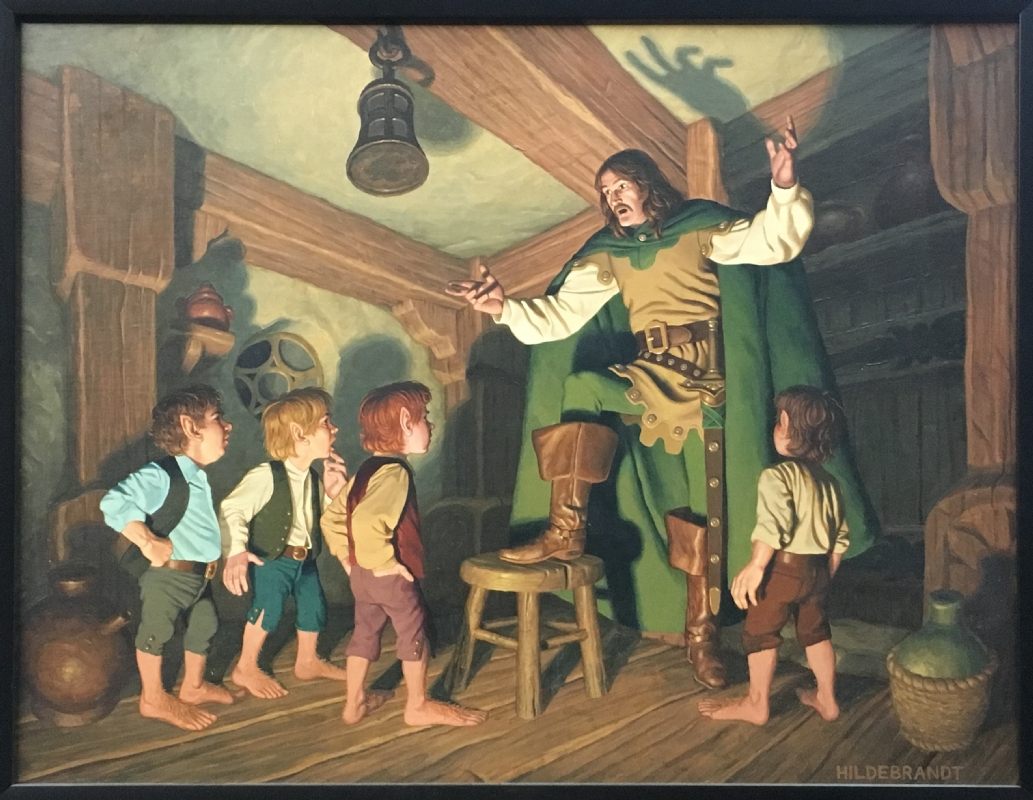
The Brothers Hildebrandt, Greg and Tim, represent another essential dimension of fantasy art: enchantment. Their Tolkien calendars and Star Wars poster art helped define the look of modern epic fantasy and space opera for a mass audience. Where Frazetta often emphasized raw vitality and danger, the Hildebrandts brought radiance, theatricality, color, and storybook splendor. Their work could be lush, ornate, sentimental, dramatic, and deeply inviting. Their images of Tolkien’s world helped countless readers picture Middle-earth not as an abstract literary setting but as a place one could almost enter: wooded, golden, perilous, noble, and full of strange light.
The Hildebrandts are especially important because they helped shape the visual bridge between literature and popular visual culture. Tolkien’s work already contained immense imaginative power, but illustration gave that power a shared visual language. Before the later dominance of film adaptations, illustrated calendars, posters, and covers were among the primary ways fans collectively imagined Middle-earth. The Hildebrandts’ Tolkien art became part of the emotional memory of a generation. Their Star Wars poster likewise demonstrates how fantasy illustration helped shape the visual identity of modern cinema. Popular culture is not visually self-generating. It depends on artists who can condense an entire mythos into one image.
This is one of the greatest achievements of fantasy artists: they create icons. An icon is not simply a pretty picture. It is an image that gathers meaning until it becomes a cultural shorthand. Frazetta’s Death Dealer is not only a warrior on a horse; it is doom, violence, mystery, and dark majesty distilled into a single figure. Vallejo’s heroic bodies are not merely anatomical studies; they are visual declarations of power, sensuality, and mythic aspiration. The Hildebrandts’ Tolkien images are not merely scenes from a book; they are invitations into enchantment. Great fantasy art does what religious art, mythic art, and national art have always done: it gives communities images around which imagination can gather.
Fantasy art also matters because it kept representational skill alive during a period when large parts of the fine-art world became suspicious of representation, beauty, narrative, and technical craft. In the twentieth century, academic and gallery art increasingly privileged abstraction, conceptualism, irony, theory, and formal experimentation. These movements produced important work, but they also contributed to a hierarchy in which skilled figurative illustration was often dismissed as commercial, sentimental, juvenile, or merely decorative. Fantasy artists refused that hierarchy, whether deliberately or simply by continuing to work. They drew, painted, composed, designed, and imagined with astonishing discipline. They studied anatomy, light, texture, gesture, costume, weapons, animals, architecture, and landscape. They built worlds.
The technical mastery of fantasy art should not be underestimated. To paint a convincing dragon is not easier than painting a horse; in some ways, it is harder. The artist must make the impossible feel physically persuasive. Fantasy art requires both invention and believability. A warrior must have weight. A monster must have anatomy, even if invented. A castle must appear buildable. A spell must seem luminous rather than merely colorful. A scene must often communicate character, setting, conflict, atmosphere, and genre in a single glance. The best fantasy artists combine the observational discipline of realism with the imaginative freedom of dream.
This is why fantasy art has had such influence beyond books. Its visual language shaped comics, animation, tabletop role-playing games, collectible card games, video games, film design, album covers, tattoo culture, heavy metal aesthetics, cosplay, concept art, and contemporary digital illustration. The modern entertainment industry owes an enormous debt to fantasy artists. Before computer-generated worlds could be rendered on screen, fantasy illustrators had already taught audiences how those worlds might look. They established the visual grammar of the barbarian, the dark lord, the elven queen, the dragon, the enchanted forest, the battle mage, the haunted ruin, the cosmic landscape, and the heroic party gathered against impossible odds.
The connection between fantasy art and gaming is especially significant. Role-playing games such as Dungeons & Dragons depend heavily on visual imagination. The rules may define what a creature is, but the art makes the creature emotionally real. Artists such as Larry Elmore, Jeff Easley, Keith Parkinson, Clyde Caldwell, Brom, and many others helped give fantasy gaming its visual identity. Their work made imagined worlds playable. They offered not only illustrations but atmospheres of adventure. A player looking at a painting of a dragon, knight, wizard, or ruined keep is not merely seeing an image; he is receiving an invitation to participate.
Fantasy art is also important because it speaks to perennial human needs. Modernity often flatters itself that myth has been outgrown, but fantasy art proves otherwise. People still hunger for dragons because dragons externalize danger, greed, chaos, and the unknown. People still respond to warriors because warriors embody courage, strength, sacrifice, and conflict. People still love enchanted forests because forests represent both danger and return, the wild beyond the managed world. People still imagine queens, sorceresses, gods, demons, monsters, and heroic companions because these figures dramatize psychic, moral, erotic, and spiritual realities. Fantasy art survives because the mythic imagination survives.
The greatness of fantasy art also lies in its emotional honesty. Much contemporary fine art requires explanation before it can be appreciated. Fantasy art, at its best, strikes directly. It is immediate without being shallow. A viewer may not know the title, story, or literary source of a painting, yet still feel awe, fear, desire, wonder, or longing. This emotional accessibility is sometimes treated as evidence of inferiority, but that is a mistake. The ability to move people immediately is one of art’s highest powers. The suspicion of accessibility is one of the more unfortunate habits of modern art criticism.
This does not mean that every fantasy painting is great art. Like every genre, fantasy art contains clichés, excesses, weak works, derivative works, and commercial formulas. It has often repeated narrow body ideals, gender conventions, racialized tropes, and adolescent fantasies of power. But the existence of weak fantasy art no more discredits the genre than weak religious paintings discredit sacred art, or mediocre portraits discredit portraiture. The best fantasy art must be judged by its strongest examples, not its weakest imitations. Frazetta should not be dismissed because lesser artists copied his muscles. Vallejo should not be dismissed because calendar art became formulaic. The Hildebrandts should not be dismissed because enchantment can become sentimental. Greatness often creates imitation, and imitation often creates cliché. That is not the fault of the original achievement.
Fantasy art should also be understood as part of the larger history of illustration. Illustration has long suffered from an artificial distinction between “fine art” and “commercial art.” Yet many works now admired in museums were made for patrons, churches, courts, books, civic buildings, propaganda, or public instruction. The idea that art becomes less serious because it has a client, a function, or an audience is historically naïve. Michelangelo had patrons. Medieval illuminators served religious institutions. Japanese printmakers worked in commercial markets. Poster artists, muralists, book illustrators, and magazine artists all created works shaped by purpose and distribution. Fantasy illustration belongs to this same broad history of commissioned, narrative, public-facing art.
The recent museum and market recognition of fantasy illustration suggests that the old hierarchy is weakening. Exhibitions devoted to fantasy illustration, the preservation of original paintings, and the rising value of major works by artists such as Frazetta show that fantasy art is increasingly being recognized as a serious component of modern visual culture. This recognition is overdue. The images that shaped the dreams of millions deserve study, preservation, and critical respect.
Yet fantasy art’s real importance cannot be measured only by auction prices or museum exhibitions. Its deepest value lies in imagination. These artists gave people worlds. They gave readers and viewers images of courage, terror, beauty, danger, magic, and impossible longing. They allowed the modern person—surrounded by offices, highways, machines, bureaucracy, and fluorescent light—to encounter the ancient drama of the heroic and the monstrous. They reminded us that art need not be embarrassed by beauty, story, or wonder.
Frank Frazetta, Boris Vallejo, Julie Bell, the Brothers Hildebrandt, and their peers are great because they restored myth to popular vision. They kept alive the grand tradition of narrative, figurative, imaginative art at a time when such art was too often dismissed by elite tastemakers. They made the impossible visible and the invisible emotionally real. They taught generations how to see fantasy—not as escapism in the cheap sense, but as a return to the deep symbolic language of human experience.
Fantasy art matters because human beings are mythmaking creatures. We do not live by facts alone. We live by images, stories, archetypes, dreams, fears, and hopes. We need art that shows us the dragon, the sword, the shadowed forest, the impossible city, the sorcerer’s fire, the goddess, the warrior, the wanderer, the beast, the starship, the haunted mountain, and the door into another world. The greatest fantasy artists opened that door. They deserve to be celebrated not as guilty pleasures, not as commercial curiosities, and not merely as fan culture, but as major contributors to the visual imagination of the modern age.