In the spring of 1968, the United States was grieving, burning, arguing, and changing. Martin Luther King Jr. had been assassinated on April 4. Cities erupted in anger. Families sat before their televisions and watched the moral crisis of the nation unfold in real time. The civil rights movement had already transformed American law, but American culture still lagged behind. Schools, neighborhoods, workplaces, churches, newspapers, and entertainment all reflected a nation still deeply divided by race.
It was in this atmosphere that Harriet Glickman, a Los Angeles schoolteacher and mother, sat down and wrote a letter to Charles M. Schulz, the creator of Peanuts. Her idea was simple, but in 1968 it was also bold: Schulz should introduce a Black child into the world of Charlie Brown, Lucy, Linus, Snoopy, and the rest of the Peanuts gang.
Today, that sounds like a small request. A single child added into a comic strip. A new face in a familiar neighborhood. But at the time, Peanuts was not a minor cultural product. It was one of the most widely read comic strips in the world. It appeared in newspapers across the country and around the globe. Its characters were already part of American life. Charlie Brown was not simply a cartoon boy; he was a symbol of childhood anxiety, loneliness, hope, defeat, resilience, and ordinary human longing. Snoopy was already an icon. Schulz had created a world that millions of readers entered every day.
Harriet Glickman understood this. She understood that the images children saw mattered. She understood that culture shapes the moral imagination long before politics finishes its work. She also understood that the absence of Black children from a beloved comic strip was not neutral. It quietly taught readers who belonged in the ordinary world of childhood and who did not.
Her letter did not demand a speech, a sermon, or a political manifesto. She was not asking Schulz to turn Peanuts into propaganda. She was asking him to imagine a Black child as part of the normal social world of American children. That was the radical part.
A Letter After King
Glickman’s letter came only days after King’s assassination. Like many Americans, she was asking herself what she could do. She was not a politician, a national organizer, or a newspaper editor. She was a teacher and a mother. But she recognized that public imagination is a field of moral struggle. Children learn from stories. They learn from pictures. They learn from who is present, who is absent, who speaks, who plays, who is named, and who is ignored.
Her proposal to Schulz was rooted in this insight. A Black child in Peanuts could help white children see Black children as neighbors, classmates, and friends. It could help Black children see themselves in one of the most beloved fictional worlds in America. It could subtly push against the cultural habits that made segregation seem natural, even after the law had begun to change.
Schulz replied. His response was thoughtful but hesitant. He had considered the issue, but he worried that introducing a Black character might come across as patronizing. This concern was not trivial. Schulz was aware that a poorly drawn character could become a token, a stereotype, or a clumsy attempt by a white cartoonist to appear socially enlightened. He did not want to insult the very people he hoped to respect.
Glickman did not dismiss his concern. Instead, she did something practical and wise. She continued the conversation by seeking out responses from Black friends and acquaintances and sharing with Schulz their views on whether such a character would be welcomed or seen as condescending. Her approach was important because she didn’t simply tell Schulz what she thought Black readers would think. She helped bring other voices into the discussion. This exchange matters because it shows how cultural change often happens. It is rarely the work of one heroic person acting alone. It is often a chain of conscience: one person writes, another hesitates, others speak, someone listens, another replies, and then a door opens.
The Arrival of Franklin
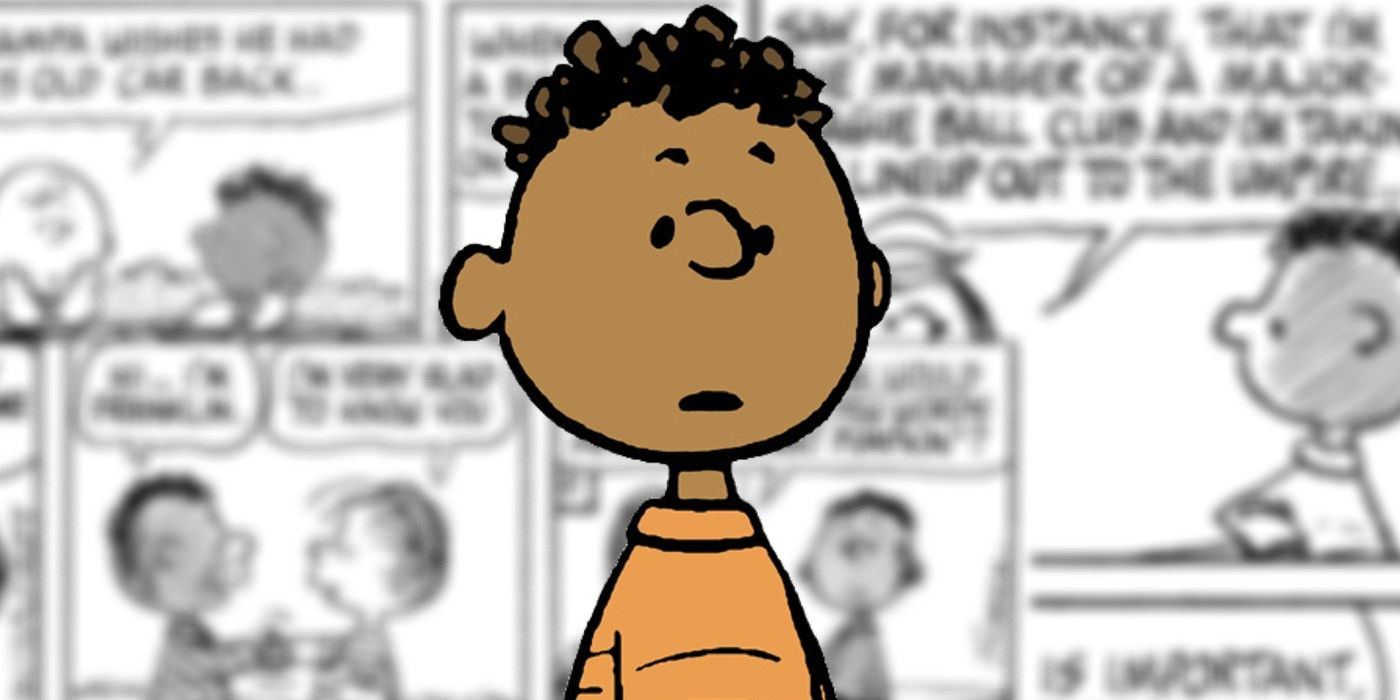
In July 1968, readers met Franklin. His first appearance was gentle. He met Charlie Brown at the beach after returning Charlie Brown’s beach ball. The two boys talked. They built a sandcastle. Charlie Brown invited Franklin to visit him. Nothing dramatic happened. No one made a speech about racial harmony. No adult entered the scene to explain the moral importance of the moment. That restraint was the power of the strip.
Franklin was introduced not as an issue, but as a child. He was not a symbol first. He was a person first. In the world of Peanuts, where children speak with philosophical weight and emotional honesty, Franklin entered as another child among children. He was calm, polite, intelligent, and grounded. Compared with many of the other Peanuts characters, Franklin often seemed remarkably balanced. Charlie Brown worried. Lucy dominated. Linus philosophized. Schroeder obsessed over Beethoven. Sally misunderstood the world with comic confidence. Franklin often brought a quieter, steadier presence.
This was both admirable and complicated. On the one hand, Schulz avoided racist caricature, dialect, or exaggerated difference. Franklin was not made ridiculous. He was not made threatening. He was not made exotic. He was presented as normal, decent, thoughtful, and worthy of friendship. In 1968, that alone was meaningful.
On the other hand, Franklin was also somewhat underdeveloped compared with the central Peanuts characters. He did not receive the same range of neuroses, flaws, contradictions, and comic obsessions that made characters like Lucy, Linus, Charlie Brown, and Snoopy so memorable. Franklin’s dignity was important, but dignity can become limiting when a character is not allowed to be as strange, funny, difficult, foolish, selfish, or emotionally messy as everyone else. In later years, some critics would describe Franklin as a token figure: present, important, but not always fully used.
Both things can be true. Franklin was groundbreaking, and Franklin was limited. His introduction was a major step forward, and it did not solve the deeper problem of representation. He mattered precisely because he entered a world from which Black children had largely been absent, but his presence also revealed how cautious mainstream representation could be.
Why It Was Groundbreaking
To understand why Franklin mattered, we have to remember the cultural landscape of 1968. Legal segregation had been challenged by landmark civil rights victories, but American life remained deeply segregated in practice. Many white Americans still resisted integration in schools, housing, public spaces, and social life. Interracial friendship between children could be seen by some not as innocent but as threatening.
Comic strips were a daily ritual. Families read them at the breakfast table. Children clipped them from newspapers. Adults followed them with affection and habit. The funny pages were not usually treated as serious political spaces, yet they helped define normal life. They showed families, neighborhoods, jokes, schools, pets, games, rivalries, and friendships. For Black children to be absent from that world was itself a cultural statement.
Franklin’s presence challenged that absence.
He did not challenge it loudly. He did not arrive carrying a protest sign. He did not make Peanuts into a civil rights strip. Instead, he did something more subtle: he stood beside Charlie Brown. He played, talked, and shared space. He entered the grammar of ordinary childhood. And tphat was the point. The revolutionary act was not that Franklin gave a speech. The revolutionary act was that Franklin belonged.
Schulz also deserves credit for holding his ground. Some editors and readers objected to Franklin’s inclusion, especially when Franklin appeared in social equality with white characters. The problem, for some critics, was not merely that a Black character existed. It was that he sat with white children, went to school with them, and shared their world as an equal. That reaction exposes exactly why the strip mattered. Franklin’s presence disturbed those who wanted racial hierarchy to remain visible even in the comics.
Schulz reportedly refused to alter the strip to satisfy those objections. That refusal was significant. He was not a radical activist in the usual sense, but in this case he used his power as a beloved cartoonist to insist that Franklin remain.
The Problem of Tokenism
The story of Franklin is often told as a simple triumph: Harriet Glickman wrote a letter, Schulz listened, Franklin appeared, and representation improved. That version is true as far as it goes, but it is incomplete.
Franklin’s creation also raises difficult questions about tokenism. What happens when a single character is asked to carry the burden of representation for an entire group of people? What happens when a Black character is included but not given the same narrative freedom as white characters? What happens when dignity comes at the cost of comic complexity?
In Peanuts, the great characters are not great because they are perfect. They are great because they are deeply particular. Charlie Brown is noble but insecure. Lucy is hilarious because she is bossy, vain, and sometimes cruel. Linus is wise and dependent on his security blanket. Snoopy is imaginative to the point of absurdity. Peppermint Patty is bold, oblivious, athletic, and emotionally vulnerable. Even minor characters often have sharp comic identities.
Franklin, by comparison, was often written more gently. He was rarely foolish. Rarely outrageous. Rarely the center of chaos. Schulz may have feared that making Franklin ridiculous would be seen as racist or disrespectful. That fear was understandable. But the result was that Franklin sometimes became too careful. He was allowed to be present, but not always allowed to be fully comic.
This is one of the central tensions in early representation. The first character through the door is often burdened with respectability. Because the culture is watching, the creator becomes cautious. Because prejudice is real, the character must not confirm stereotypes. Because the character is alone, every trait becomes symbolic. The result is often a figure who is admirable but constrained.
Franklin’s limitations are therefore not simply Schulz’s personal failure. They reflect the pressures of integration in American popular culture. When representation is rare, it becomes heavy. One character cannot simply be a character. He must stand for progress, reassure critics, avoid offense, and carry the hopes of those who have been excluded. That is too much weight for any child, even a comic strip child.
Harriet Glickman’s Moral Imagination
One of the most remarkable parts of this story is that it begins not with a corporation, a committee, or a marketing campaign, but with a citizen writing a letter. Harriet Glickman saw something missing and acted. Her action was modest, but it was not passive. She did not control Schulz. She did not have authority over the comic strip. She could not force newspapers to change. What she could do was appeal to conscience. She could point out that one of the most beloved fictional neighborhoods in America did not yet reflect the children of America.
There is a lesson here about cultural responsibility. Glickman did not say, “It is only a comic strip.” She recognized that nothing loved by millions is “only” anything. Popular art matters because it enters the daily life of ordinary people. A comic strip can soften resistance. A character can make a child feel seen. A friendship drawn in four panels can challenge a social boundary more effectively than a lecture.
Glickman’s genius was her trust in small images. She believed that if children saw Charlie Brown with a Black friend, that image would do quiet work in the mind. It would not end racism. It would not repair centuries of injustice. But it might make exclusion a little harder to defend. It might make friendship a little easier to imagine. That is how culture changes: not only through laws and speeches, but through repeated images of belonging.
Schulz’s Quiet Method
Charles Schulz was not a polemical cartoonist. Peanuts rarely addressed politics directly. Its world was mostly adultless, inward, philosophical, and emotionally precise. It was concerned with loneliness, failure, longing, friendship, faith, insecurity, and the strange seriousness of childhood. Yet this does not mean Peanuts was apolitical. A work can be political by deciding who exists in its world.
Schulz’s method with Franklin was consistent with his artistic temperament. He did not break the frame. He did not turn Charlie Brown into a spokesman. He did not write a civil rights editorial in the mouths of children. He simply allowed a Black child to enter the neighborhood. This approach had strengths. It avoided preachiness. It respected Franklin’s humanity. It trusted readers to understand the significance without being told what to think. It also made the integration of Peanuts feel natural rather than forced.
But the same quietness had weaknesses. Because race was not directly addressed, the strip did not explore Franklin’s full experience as a Black child in America. Because Schulz preferred universality, Franklin sometimes became a universal child in a way that muted the particular realities of Black life. The strip opened a door, but it did not walk very far through it. Still, that door mattered.
Cultural Effects
Franklin’s arrival had several cultural effects. First, it gave Black children a place in one of the central imaginative worlds of American childhood. Representation is not merely about pride. It is about recognition. To see someone who looks like you included in a beloved world is to receive a subtle message: you are part of the story.
Second, it normalized interracial childhood friendship. Franklin and Charlie Brown’s friendship was not treated as scandalous within the strip. That was precisely why it mattered. The normalcy was the argument.
Third, it challenged newspapers and readers who wanted the comics page to preserve segregationist assumptions. The objections to Franklin revealed that even innocent images of children could become controversial when they crossed the color line. By refusing to remove or diminish Franklin, Schulz helped move the boundary of what mainstream newspapers would carry.
Fourth, it provided an example of how creators can respond to moral moments without abandoning their art. Schulz did not transform Peanuts into something else. He allowed Peanuts to become more honest. The strip’s world expanded, and because it expanded, it became more humane.
Finally, Franklin’s history continues to shape conversations about representation. Later audiences have rightly asked why Franklin did not receive more depth, more storylines, and more centrality. Those critiques do not erase his importance. They extend the work Glickman began. Representation must begin with presence, but it cannot end there.
A Legacy Still Unfolding
More than half a century later, Franklin remains an important figure in American popular culture. He is not merely “the first Black Peanuts character,” though that historical fact matters. He is also a reminder of the power of ordinary moral initiative. Harriet Glickman was not famous when she wrote her letter. She was a citizen, a teacher, and a mother responding to a national wound. She believed that a comic strip could help children imagine a better world. And she was right.
Franklin’s introduction did not end racism in comics, in newspapers, or in American culture. It did not make Peanuts a fully integrated universe overnight. It did not answer every question about representation. But it did something real. It placed a Black child beside Charlie Brown and treated their friendship as natural. In 1968, that was not a small thing.
The story also reminds us that popular art is never trivial. The images we give children become part of the architecture of their moral world. A child who sees only one kind of person at the center of every story learns one lesson. A child who sees many kinds of people sharing the world learns another. Harriet Glickman understood that. Charles Schulz, to his credit, listened.
Franklin walked onto the beach, picked up Charlie Brown’s ball, and entered American culture quietly. No trumpet sounded. No grand declaration was made. Just two children talking by the sea.
Sometimes that is how history changes and how we make things better: not with a shout, but with a simple invitation to come over and play.