Introduction: The Problem of Popularity
Few charges are more damaging in elite art discourse than the accusation that an artist is “popular.” The word should be descriptive, even complimentary, but in many art-world contexts it functions as a form of dismissal. To be popular is often to be suspected of sentimentality, simplification, commercial compromise, aesthetic conservatism, or bad taste. Artists who achieve wide public affection are frequently treated as if that affection itself were proof of their inferiority. The more ordinary people love them, the less seriously certain critics, curators, academics, and artists appear willing to take them.
This reflexive suspicion of popularity has shaped the reputations of many artists. Thomas Kinkade, Wyland, Norman Rockwell, Bob Ross, LeRoy Neiman, Margaret Keane, Maxfield Parrish, Bev Doolittle, Patrick Nagel, Peter Max, Frank Frazetta, Boris Vallejo, Julie Bell, Robert Bateman, and many others have at various times occupied an uneasy position between public affection and elite condescension. Some are accepted more readily than others. Rockwell, for example, has undergone a significant critical rehabilitation, while Kinkade remains a favorite target for accusations of kitsch. Wyland, widely known for his marine-life murals and conservation-oriented public art, has often been treated as a popular environmental muralist rather than as a figure requiring serious art-historical study. Bob Ross, beloved by generations of viewers, is often discussed as a television personality and teacher before he is discussed as an artist.
This article argues that such artists deserve serious art-historical attention not because every popular work is a masterpiece, nor because criticism should be suspended in the face of public affection, but because popularity itself is an art-historical fact. The art people choose to hang in their homes, reproduce on calendars, preserve in memory, visit in public spaces, learn from on television, or associate with comfort, beauty, faith, nature, childhood, aspiration, and belonging is part of the real life of art. To ignore or deride such work is to narrow art history into a history of institutions rather than a history of images, practices, audiences, and meanings.
Popular artists should be celebrated, or at least studied generously, for several reasons. They keep art present in everyday life. They often preserve and transmit representational skill. They serve as gateways into artistic literacy. They reveal what broad publics desire, fear, mourn, cherish, and imagine. They complicate the boundary between fine art, illustration, décor, design, reproduction, commerce, public art, and mass media. They also expose the class politics of taste. The contempt directed toward popular artists is rarely only about brushwork, composition, or originality. It often carries a social judgment against the audiences who love them.
The question, then, is not whether Thomas Kinkade is equivalent to Rembrandt, whether Wyland should be ranked beside Michelangelo, or whether Bob Ross should be placed in the same category as Turner. Those are false comparisons. The more fruitful question is why the art world so often treats popularity as contamination. Why is art loved by ordinary people so frequently presumed to be less serious? Why are comfort, beauty, sincerity, narrative, wildlife, domesticity, fantasy, illustration, or spiritual longing treated as lesser artistic subjects? And what might art history gain if it abandoned contempt as a critical method?
Kitsch, the Avant-Garde, and the Inheritance of Suspicion
The modern suspicion of popular art owes much to the twentieth-century opposition between the avant-garde and kitsch. Clement Greenberg’s 1939 essay “Avant-Garde and Kitsch” remains one of the most influential articulations of this divide. Greenberg associated the avant-garde with difficulty, formal innovation, and resistance to mass culture, while kitsch represented manufactured sentiment, easy pleasure, and the degradation of culture under industrial capitalism. For Greenberg, kitsch was not merely bad art; it was art-like material produced for an audience that desired recognizable effects without the labor of genuine aesthetic engagement.
Greenberg’s critique emerged in a specific historical moment. The rise of mass media, advertising, political propaganda, commercial illustration, and popular entertainment made many critics anxious about the fate of serious art. The avant-garde appeared to offer resistance against standardization. It preserved the autonomy of art by refusing the obvious pleasures of narrative, representation, sentiment, and moral clarity. In this framework, art that was too easily liked became suspect. Art that consoled, pleased, decorated, or affirmed was often assumed to be aesthetically or intellectually inferior.
This framework has had enormous influence, but it also created distortions. It encouraged critics to equate difficulty with seriousness and accessibility with shallowness. It made suspicion the default posture toward art that ordinary viewers found beautiful or emotionally useful. It also allowed the art world to overlook the complexity of popular taste. People do not love images only because they are manipulated by commerce. They also love images because those images answer needs: the need for beauty, consolation, memory, identity, fantasy, moral order, humor, wonder, or reverence.
Kitsch is a useful category, but it is a dangerous one when used lazily. It can name certain forms of sentimental excess, formulaic emotion, or manufactured nostalgia. Yet it can also become a weapon used by elites to dismiss art that speaks too directly to non-elite audiences. The word “kitsch” often tells us as much about the critic as about the work. It reveals what kinds of emotion the critic finds embarrassing, what forms of beauty the critic considers vulgar, and what audiences the critic is willing to respect.
The problem is not that popular art is above criticism. Much popular art is repetitive, derivative, sentimental, commercialized, or aesthetically conservative. But these qualities do not exhaust its meaning. A serious art history must ask not only whether an image conforms to elite standards of innovation, but also what cultural work the image performs. What does it make visible? What emotions does it organize? What values does it preserve? What audiences does it gather? What forms of memory does it sustain? What kind of world does it invite viewers to imagine?
Taste, Class, and Cultural Power
Pierre Bourdieu’s Distinction: A Social Critique of the Judgement of Taste is essential for understanding why popular art is so often derided. Bourdieu argued that taste is not merely a private preference or natural sensitivity. It is socially formed. What people learn to admire, reject, classify, and display is tied to education, class, cultural capital, and social positioning. Taste becomes a way of marking distinction. To know which art to admire, which art to dismiss, and how to speak about that dismissal is itself a form of cultural power.
This does not mean that all judgments are arbitrary or that aesthetic quality does not exist. It does mean, however, that judgments of taste are rarely innocent. When critics mock the art displayed in suburban homes, church offices, tourist galleries, shopping malls, dental waiting rooms, beach-town shops, or middle-class living rooms, they are often mocking more than the art. They are mocking a social world. The insult is displaced from the buyer to the object. “That painting is kitsch” can easily become a coded way of saying, “The people who like that painting lack refinement.”
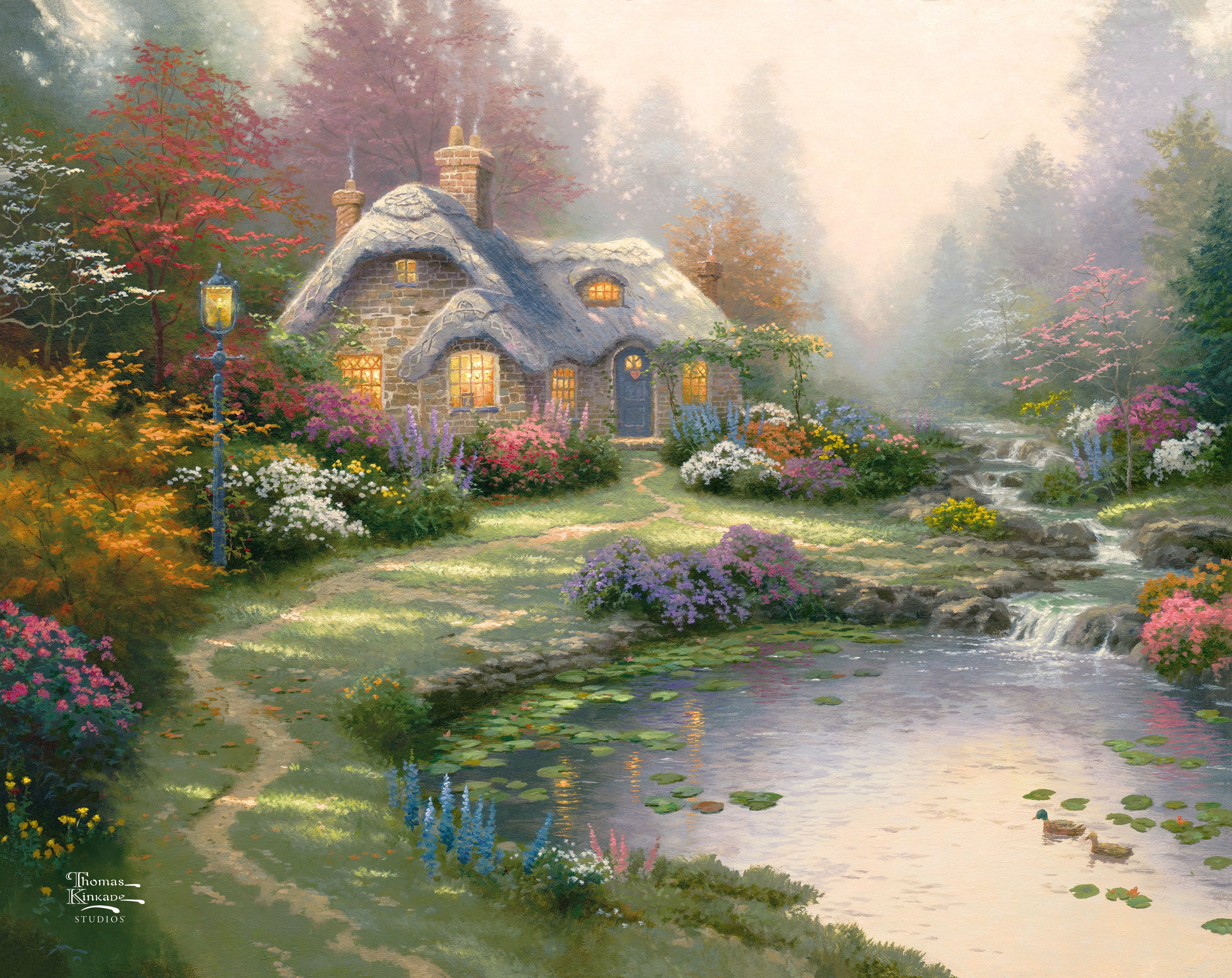
This dynamic is especially visible in responses to Thomas Kinkade. Kinkade’s glowing cottages, lamplit windows, nostalgic villages, stone bridges, snowy churches, and radiant gardens have been attacked for their formulaic sentimentality and commercial reproduction. Many of those criticisms are not without basis. His paintings often rely on repeated motifs, idealized domesticity, and an almost frictionless vision of comfort. Yet the intensity of the scorn directed at him cannot be explained by aesthetics alone. Kinkade became a symbol of everything elite art culture distrusts: mass appeal, Christian-inflected sentiment, suburban domestic fantasy, commercial franchising, reproductions marketed as collectibles, and unapologetic comfort.
But precisely for that reason, Kinkade is historically important. His work reveals a major current in late twentieth- and early twenty-first-century American visual culture. His paintings speak to longings for home, safety, light, innocence, order, family, peace, and spiritual reassurance. One may criticize the narrowness or artificiality of that vision, but one cannot deny its cultural power. Millions of people recognized something in it that the art world often failed to provide. Kinkade’s popularity should not exempt him from critique, but it should protect him from lazy dismissal. His work belongs to the history of American taste, religion, commerce, nostalgia, domestic imagery, and mass reproduction.
A similar class dynamic often surrounds other popular artists. Bob Ross is beloved not because he transformed the formal language of painting, but because he democratized the act of painting. He made art feel possible. His gentle television persona, simple landscapes, and repeated encouragement offered viewers a form of creative permission. To dismiss Ross as merely a television painter is to miss his enormous pedagogical and cultural role. He turned painting into a practice ordinary people could imagine themselves doing. He lowered the threshold of entry. That is no small achievement.
Norman Rockwell provides another instructive case. For much of the twentieth century, Rockwell was often dismissed as an illustrator rather than a serious artist. His association with magazine covers, narrative clarity, humor, sentiment, and middle-American life made him suspect to critics invested in modernist abstraction or avant-garde experimentation. Yet Rockwell’s reputation has grown more complex. His work is now recognized not only for its extraordinary technical skill but for its role in constructing, reflecting, and sometimes challenging American self-understanding. Paintings such as The Problem We All Live With demonstrate that popular illustration could carry moral and political weight. Rockwell’s rehabilitation should make us cautious about dismissing artists merely because they work in popular idioms.
Popular Art and the Preservation of Visual Literacy
One of the strongest arguments for celebrating popular artists is that they preserve visual literacy outside elite institutions. Many people encounter art first not through museums, but through illustration, posters, murals, animation, fantasy art, wildlife painting, album covers, comic books, calendars, television, religious imagery, public monuments, and decorative prints. These encounters matter. They shape the imagination long before a person learns the names of canonical artists or critical movements.
Popular artists often keep representational skill visible. This is especially significant in an art world that, since modernism, has often privileged abstraction, conceptual practice, installation, performance, institutional critique, and theory-driven work. None of these forms are illegitimate; many are among the great achievements of modern and contemporary art. But they can leave some viewers feeling excluded, especially when the work requires specialized knowledge to decode. Popular representational artists, by contrast, often invite immediate entry. A viewer can recognize a whale, a cottage, a mountain, a child, a horse, a storm, a city street, or a heroic figure. Recognition becomes the beginning of engagement.
This accessibility is sometimes mistaken for simplicity. Yet accessible art is not necessarily simple art. Maxfield Parrish’s luminous color harmonies, Frank Frazetta’s dynamic anatomy and composition, James Gurney’s imaginative world-building, Robert Bateman’s wildlife observation, Bev Doolittle’s visual puzzles, and Wyland’s large-scale marine murals all demonstrate forms of skill that deserve study. The fact that these artists appeal to broad audiences should not count against them. Indeed, their ability to communicate visually across educational and institutional boundaries is part of their achievement.
Art history has often been slow to honor illustrators, commercial artists, and genre artists. Yet the boundary between fine art and illustration has always been porous. Renaissance altarpieces, Baroque ceiling paintings, Japanese ukiyo-e prints, medieval manuscript illuminations, political posters, Art Nouveau advertisements, Pre-Raphaelite book illustrations, and Mexican muralism all complicate the idea that art must be separated from use, reproduction, narrative, or public communication. Much of what we now call “fine art” originally served religious, civic, decorative, political, commercial, or narrative purposes.
Popular art continues this broader historical reality. It reminds us that art has rarely belonged only to museums. It has belonged to churches, homes, streets, books, garments, rituals, markets, theaters, palaces, schools, taverns, public squares, and now screens. If art history narrows itself to the preferences of curators and critics, it forgets the social life of images.
Wyland and the Public Work of Art
Wyland offers a particularly useful case because his work exists at the intersection of popular art, public art, environmental messaging, muralism, and civic identity. Known for large-scale marine-life murals, especially whales, dolphins, and ocean ecosystems, Wyland brought representational marine imagery into urban spaces. His work is not only decorative. It is pedagogical and environmental. It asks city dwellers to remember the ocean. It transforms blank walls into sites of ecological imagination.
The controversy surrounding the painting over of Wyland’s Dallas mural before the 2026 World Cup illustrates how popular public art can become woven into civic memory. The mural, created in 1999 and associated with ocean conservation, was not merely an image on a wall. For many residents, it became part of the visual identity of downtown Dallas. Its destruction or covering generated public outcry precisely because people had formed an attachment to it. That attachment is art-historically significant.
Public art often matters differently than gallery art. A mural may not be encountered in silence, under museum lighting, with a label and catalog essay. It may be seen from a car, passed on the way to work, remembered from childhood, photographed by tourists, or used as a landmark. Its meaning accumulates through repetition and public familiarity. Over time, a mural can become part of the emotional geography of a city.
This is one reason popular public artists deserve serious attention. They create shared visual reference points. Their work may be loved by people who do not think of themselves as art audiences at all. In that sense, they expand the public for art. They make art unavoidable. They place images into the common environment rather than behind institutional thresholds.
The fate of Wyland’s Dallas mural also raises legal and ethical questions about public art, moral rights, conservation, civic stewardship, and the vulnerability of large-scale works attached to private or semi-public buildings. But even apart from those legal questions, the episode demonstrates the core argument of this article: popular affection is a form of evidence. When people mourn the loss of an artwork, when they petition for its protection, when they describe it as part of their city, the art historian should pay attention. Public love is not the same as aesthetic greatness, but it is one form of cultural significance.
Sentiment, Sincerity, and the Fear of Emotional Directness
Much of the derision aimed at popular artists is really discomfort with sentiment. Sentimentality is often treated as an aesthetic sin: too easy, too sweet, too manipulative, too comforting, too emotionally obvious. Kinkade is criticized for sentimentality. Rockwell was long criticized for it. Bob Ross is often gently mocked for it. Margaret Keane’s big-eyed children were dismissed for it. Wildlife art, fantasy art, and inspirational art are often similarly attacked.
There are legitimate criticisms of sentimentality. Art can manipulate emotion without earning it. It can simplify suffering, sentimentalize poverty, romanticize the past, flatten moral complexity, or offer consolation where confrontation is needed. Yet the modern art world has often overcorrected, treating emotional directness itself as suspect. Irony, fragmentation, alienation, ambiguity, and critique are frequently granted more intellectual prestige than tenderness, hope, beauty, devotion, nostalgia, or comfort.
This hierarchy is historically contingent, not universal. Much of the world’s most celebrated art is emotionally direct. Religious art seeks reverence, grief, awe, penitence, compassion, or hope. Memorial art organizes mourning. Portraiture preserves love and status. Landscape painting can evoke longing, sublimity, national identity, or spiritual presence. Romantic painting often embraces emotional intensity. Even modern abstraction can seek transcendence, silence, or spiritual force. The problem is not emotion. The problem is which emotions elite culture permits itself to respect.
Popular artists often deal in emotions that contemporary criticism finds embarrassing: comfort, innocence, wonder, patriotism, domestic peace, religious hope, animal affection, heroic fantasy, maternal tenderness, nostalgia, and joy. These emotions can certainly become simplistic or ideological. But they are not inherently unserious. Human beings need consolation as well as critique. They need beauty as well as disruption. They need images of home, nature, tenderness, and order, even when such images are imperfect or idealized.
Kinkade’s cottages may be criticized as fantasies of retreat from history, but retreat itself is a historical phenomenon. What social conditions make people long so intensely for lamplit windows, snowy chapels, garden paths, and safe villages? What anxieties are soothed by such images? What forms of alienation do they answer? To ask these questions is not to endorse Kinkade uncritically. It is to study him seriously.
Similarly, Bob Ross’s landscapes may be formulaic, but their formula matters. The mountains, trees, cabins, streams, and “happy little clouds” form a symbolic vocabulary of calm. Ross’s art and teaching style offered a ritual of reassurance. Viewers did not only watch him paint; they entered a repeated emotional environment. That environment belongs to the history of art education, television, therapeutic creativity, and popular landscape painting.
Reproduction, Commerce, and the Myth of Purity
Popular artists are often criticized for commercial reproduction. Kinkade’s business model, in particular, made his work inseparable from prints, galleries, licensing, collectibles, and branded marketing. For many critics, this commercialization confirmed the inferiority of his art. Yet the relationship between art and commerce is far more complex than such criticism allows.
Art has always existed within economies. Renaissance workshops produced objects for patrons. Dutch painters sold in competitive markets. Japanese printmakers worked within commercial publishing networks. Academic painters sought commissions and salon success. Modern artists cultivated dealers, collectors, critics, and museums. Contemporary artists participate in global markets where scarcity, branding, institutional validation, and financial speculation shape value. To condemn popular artists simply because they sell work widely is hypocritical unless the same suspicion is applied to the entire art market.
The issue is not whether art is commercial, but how commerce shapes production, reception, and meaning. Kinkade’s mass reproduction does raise important questions about authenticity, scarcity, aura, and branding. But those questions are central to modern art as a whole. Walter Benjamin’s famous analysis of mechanical reproduction argued that reproduction transforms the status and reception of artworks. Once images can circulate widely, they acquire new social lives. They leave the singular site of the original and enter homes, books, screens, posters, and commodities.
Popular artists operate openly within this world of reproduction. Their art is often made to circulate. It is designed for prints, posters, calendars, television, merchandise, murals, or instructional replication. Rather than treating this as automatic disqualification, art historians should ask how circulation functions. What happens when an image becomes part of domestic décor? What happens when a painting becomes a collectible object marketed through scarcity? What happens when a mural becomes a civic landmark? What happens when a televised painting lesson becomes a shared cultural memory?
The contempt for reproduced popular art often rests on a romantic myth of artistic purity. But art is not purified by being expensive, rare, or institutionally approved. A painting sold through a blue-chip gallery is not outside commerce; it is simply inside a more prestigious commercial system. The difference between elite and popular art markets is not the presence or absence of money. It is the kind of money, the kind of audience, and the kind of cultural legitimacy attached to the transaction.
Popular Artists as Gateways
One of the most important reasons to celebrate popular artists is that they serve as gateways into art. Many people who later develop deeper interests in painting, illustration, design, art history, animation, fantasy art, or museum culture begin with accessible images. A child who loves dinosaurs in James Gurney’s Dinotopia, heroic figures by Frank Frazetta, glowing landscapes by Kinkade, whales by Wyland, magazine covers by Rockwell, or painting lessons by Bob Ross has already begun an artistic education. That education may not begin with theory, but it begins with looking.
Gateways matter because the art world often struggles with accessibility. Museums and galleries can be intimidating. Academic art writing can be obscure. Contemporary art can appear hostile or opaque to uninitiated viewers. Popular artists lower the barrier. They tell viewers, “You are allowed to enjoy this.” That permission can be the beginning of a more complex relationship with art.
Bob Ross is perhaps the clearest example. His importance lies not in producing revolutionary canvases, but in making painting seem possible. He demystified technique. He treated mistakes as opportunities. He framed creativity as a gentle practice rather than an elite achievement. In doing so, he brought countless people closer to art-making. Art history should have room for such figures. The history of art is not only the history of objects; it is also the history of artistic participation.
The same may be said of fantasy and wildlife artists. Frank Frazetta, Boris Vallejo, Julie Bell, Roger Dean, James Gurney, and Robert Bateman inspired generations of viewers, illustrators, designers, animators, game artists, and painters. Their influence often operates outside traditional museum narratives, but it is culturally enormous. Fantasy art shaped visual expectations for books, film, comics, games, and popular mythology. Wildlife art shaped public affection for animals and habitats. These are not trivial contributions.
Who Attacks Popular Artists?
The attack on popular artists tends to come from several overlapping groups. The first is the elite critic who values formal innovation, difficulty, ambiguity, and resistance to mass taste. Such critics may regard popularity as evidence that the work is too easy. The second is the academic or theorist who reads popular art primarily as ideology, commodity, or kitsch. The third is the museum or gallery professional whose institutional framework privileges certain genealogies: modernism, postmodernism, conceptualism, identity-based critique, institutional critique, or global contemporary practice. The fourth is the practicing artist who fears that popular representational art weakens the boundary between fine art and illustration, décor, entertainment, or commerce.
These critiques are not always wrong. Popular art can be ideologically loaded. It can be aesthetically conservative. It can be commercially cynical. It can recycle clichés. It can avoid difficult realities. The problem is not that popular art receives criticism. The problem is that it often receives contempt in place of criticism.
Contempt is intellectually lazy. It relieves the critic of the responsibility to understand why people love something. It turns taste into a moral hierarchy. It allows the critic to defend cultural status under the guise of aesthetic judgment. It also impoverishes art history by excluding images that have mattered deeply to millions of people.
A better criticism would be neither naive celebration nor reflexive dismissal. It would ask hard questions while taking audiences seriously. It would be willing to say that Kinkade’s work is formulaic while still asking why his formula worked. It would be willing to critique Wyland’s imagery while recognizing the civic and environmental function of his murals. It would be willing to distinguish between Rockwell’s weaker sentimental scenes and his stronger moral compositions. It would be willing to see Bob Ross as both formulaic and culturally transformative. It would be willing to admit that a work can be aesthetically limited and historically important at the same time.
Toward a More Generous Art History
A more generous art history would not collapse all distinctions. It would not pretend that popularity and greatness are identical. It would not abandon standards, skill, interpretation, or critique. Rather, it would expand the range of what deserves attention. It would study museum masterpieces and living-room prints, avant-garde installations and public murals, canonical painters and television instructors, elite taste and popular affection.
Such an art history would recognize that art lives in multiple worlds. It lives in museums, but also in homes. It lives in academic journals, but also in children’s books. It lives in galleries, but also on city walls. It lives in sacred spaces, commercial spaces, digital spaces, and private memory. It lives wherever images gather meaning.
Popular artists are especially important because they reveal the emotional democracy of art. They show us what people seek when they are not trying to impress critics. They reveal the images people choose for comfort, aspiration, memory, identity, fantasy, and joy. They remind us that art is not only a history of innovation but also a history of attachment.
This is why Thomas Kinkade, Wyland, Norman Rockwell, Bob Ross, LeRoy Neiman, Margaret Keane, Maxfield Parrish, Bev Doolittle, Patrick Nagel, Peter Max, Frank Frazetta, Boris Vallejo, Julie Bell, Robert Bateman, and similar artists deserve more thoughtful attention. They may not all belong in the same category. They may not all be equally skilled, original, or significant. But each demonstrates some aspect of the relationship between art and the public.
Kinkade reveals the power of domestic nostalgia and spiritualized comfort in late modern America. Wyland reveals the civic and environmental potential of accessible public muralism. Rockwell reveals the narrative construction of American identity. Ross reveals the democratization of painting through television. Keane reveals the strange emotional force of mass-market vulnerability. Parrish reveals the endurance of luminous fantasy and decorative beauty. Frazetta reveals the mythic power of genre illustration. Bateman reveals the role of wildlife art in shaping reverence for the natural world.
To take such artists seriously is not to surrender judgment. It is to deepen judgment. It is to admit that art history must account not only for what critics admire, but for what people love.
Conclusion: Against Contempt
Popular artists should be celebrated not because they are beyond criticism, but because they keep art alive in the public imagination. They place images where people can encounter them without permission. They preserve skill, beauty, story, wonder, and emotional directness. They invite people into art who might otherwise feel excluded from it. They reveal the desires and anxieties of their cultures. They expose the class politics of taste. They remind us that art is not the private property of institutions.
The derision directed at popular artists often says less about the art itself than about the social boundaries being defended. To sneer at Kinkade is often to sneer at the people who find comfort in him. To dismiss Wyland is often to overlook the civic life of public imagery. To mock Bob Ross is to misunderstand the value of creative permission. To reduce Rockwell to sentiment is to ignore the power of narrative illustration. To dismiss fantasy, wildlife, decorative, or commercial artists is to forget that art has always moved between beauty, use, story, market, and devotion.
A mature art criticism should be capable of critique without contempt. It should be able to distinguish greatness from popularity without treating popularity as disgrace. It should be able to recognize sentimentality without despising sincerity. It should be able to study commerce without pretending that elite art is untouched by money. It should be able to honor the museum and the living room, the gallery and the mural wall, the avant-garde experiment and the beloved print.
Art belongs not only to those trained to explain it. It belongs also to those who live with it, remember it, learn from it, and love it. Popular artists have kept art in the public eye, in ordinary homes, in civic spaces, and in the emotional lives of millions. For that reason alone, they deserve serious art-historical attention.
Selected References
Benjamin, Walter. “The Work of Art in the Age of Mechanical Reproduction.” 1935.
Berger, John. Ways of Seeing. London: BBC and Penguin, 1972.
Bourdieu, Pierre. Distinction: A Social Critique of the Judgement of Taste. Translated by Richard Nice. Cambridge, MA: Harvard University Press, 1984.
Doss, Erika. Benton, Pollock, and the Politics of Modernism: From Regionalism to Abstract Expressionism. Chicago: University of Chicago Press, 1991.
Gabilliet, Jean-Paul. Of Comics and Men: A Cultural History of American Comic Books. Translated by Bart Beaty and Nick Nguyen. Jackson: University Press of Mississippi, 2010.
Greenberg, Clement. “Avant-Garde and Kitsch.” Partisan Review 6, no. 5, 1939.
Huyssen, Andreas. After the Great Divide: Modernism, Mass Culture, Postmodernism. Bloomington: Indiana University Press, 1986.
Macdonald, Dwight. “Masscult and Midcult.” Partisan Review, 1960.
Meyer, Richard. What Was Contemporary Art? Cambridge, MA: MIT Press, 2013.
Molesworth, Helen. Leap Before You Look: Black Mountain College 1933–1957. New Haven: Yale University Press, 2015.
Prown, Jules David. “Mind in Matter: An Introduction to Material Culture Theory and Method.” Winterthur Portfolio 17, no. 1, 1982.
Solomon, Deborah. American Mirror: The Life and Art of Norman Rockwell. New York: Farrar, Straus and Giroux, 2013.
Varnedoe, Kirk, and Adam Gopnik. High and Low: Modern Art and Popular Culture. New York: Museum of Modern Art, 1990.
Wyland Foundation. Public materials on marine conservation murals and environmental education.
Recent news reporting on the 2026 Dallas Wyland mural controversy, including Associated Press and Reuters coverage.