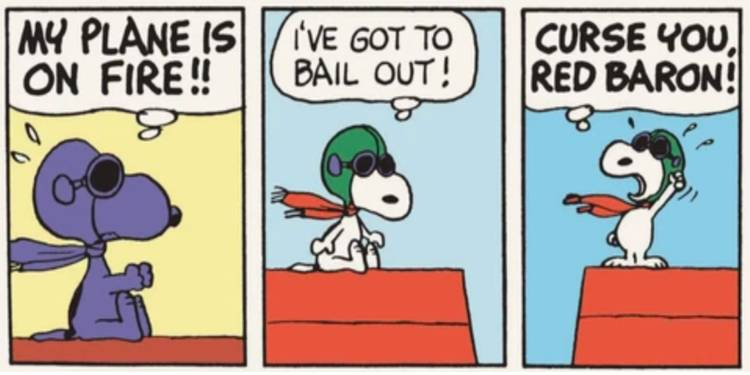
One of the great mysteries of Peanuts is that its most imaginative character is not one of the children, but the dog. Charlie Brown worries. Linus theologizes. Lucy analyzes, bullies, advises, and declares. Schroeder disappears into music. But Snoopy dreams. He climbs onto the roof of his doghouse and becomes a World War I flying ace. He sits at a typewriter and becomes a novelist. He puts on sunglasses and becomes Joe Cool. He is a vulture, a surgeon, a lawyer, a foreign legionnaire, a hockey player, a scout leader, an astronaut, a dancer, and whatever else the moment requires. While the children often seem trapped inside their personalities, Snoopy escapes through imagination.
That escape is not merely comic. It is one of the deepest and most enduring parts of Charles M. Schulz’s art. Snoopy’s fantasies give Peanuts a second world, one that runs beside the ordinary world of school, baseball, unrequited love, failed kites, and psychiatric booths. In the ordinary world, Charlie Brown cannot kick the football. In Snoopy’s world, a doghouse becomes a Sopwith Camel, the backyard becomes the skies over France, and a beagle becomes the heroic center of a grand adventure. The comedy comes from the absurdity, but the fascination comes from something more serious: Snoopy shows us what imagination does for the human soul.
Peanuts is often remembered as gentle and nostalgic, but Schulz’s world is not sentimental in the simple sense. It is full of frustration, loneliness, embarrassment, envy, disappointment, and longing. Charlie Brown is not merely unlucky; he is a child who repeatedly confronts failure without being granted easy victory. Linus is wise but insecure. Lucy is confident but emotionally needy. Sally is innocent but self-centered. Even the games are rarely triumphant. Baseball is defeat. Kite flying is disaster. Love is mostly unreturned. Friendship is real, but it is not always kind.
Into this world steps Snoopy, who is not free from limitation but refuses to be defined by it. He is still a dog. He still sleeps on a doghouse, waits for supper, depends on Charlie Brown, and lives within the boundaries of the neighborhood. Yet inwardly he is immense. His imagination does not erase reality, but it transforms it. The doghouse does not literally fly, but neither is it only a doghouse. In Snoopy’s mind, the ordinary object becomes a stage for courage, drama, romance, danger, literary ambition, and heroic self-invention.
This is one reason Snoopy’s adventures are so fascinating. They are fantasies built out of almost nothing. Schulz did not need elaborate scenery. A few lines, a pose, a caption, and Snoopy’s utter seriousness were enough. The minimalism is essential. The less Schulz shows us, the more we supply. A child’s backyard becomes a battlefield because Snoopy believes it is one. A blank sheet of paper becomes the beginning of a great novel because Snoopy sits before it with confidence. A pair of sunglasses becomes an identity. Schulz understood that imagination does not always require abundance. Often it requires only permission.
Snoopy’s imagination also parallels childhood play. Children transform objects naturally: a stick becomes a sword, a blanket becomes a cape, a cardboard box becomes a castle. But Snoopy’s fantasies are not limited to childhood. In fact, they may speak even more strongly to adults, because adults know what it means to feel trapped inside a role. We become our job, our responsibilities, our failures, our habits, our name. Snoopy refuses such confinement. He is a beagle, yes, but never only a beagle. He reminds us that identity is partly received, partly performed, and partly imagined.
This is where Snoopy becomes a kind of artist within the comic strip. He is constantly composing himself. His adventures are not just daydreams; they are acts of creation. When he becomes the Flying Ace, he enters a story. When he writes his novel, he tries to make a story. When he becomes Joe Cool, he crafts an image. Snoopy is both actor and author, performer and audience. He lives theatrically, not because he is dishonest, but because he understands that life without imagination becomes too small.
Why did Schulz give this imaginative life to Snoopy? Part of the answer is artistic freedom. Snoopy allowed Schulz to break the limits of the strip without breaking its world. Peanuts did not need to leave the neighborhood because Snoopy could make the neighborhood infinite. Through him, Schulz could parody war stories, adventure fiction, literary ambition, romance, campus coolness, sports heroics, and popular culture. Snoopy became a flexible comic instrument. He could carry slapstick one day, satire the next, and melancholy the day after.
But there is also a psychological reason. Snoopy’s fantasies balance Charlie Brown’s disappointments. Charlie Brown often represents the burden of self-consciousness: he knows he is failing, knows others see him failing, and cannot stop thinking about it. Snoopy, by contrast, possesses a strange confidence. He does not ask whether he has permission to imagine greatness. He simply begins. He climbs onto the doghouse and becomes the ace. He sits at the typewriter and becomes the author. He is absurd, but he is also free.
The contrast between Charlie Brown and Snoopy is one of the great pairings in American comics. Charlie Brown lives under the weight of reality. Snoopy lives in creative negotiation with reality. Charlie Brown hopes the world will finally let him win. Snoopy invents a world in which he can already act. Charlie Brown is anxious about who he is. Snoopy explores who he might be. Neither one is complete without the other. Charlie Brown gives Peanuts its heartache; Snoopy gives it flight.
There is a spiritual lesson hidden in this comedy. Snoopy does not escape the world by denying it. He escapes the prison of literalism. He sees more than one layer in things. The doghouse is a doghouse, but it is also an airplane. Supper is supper, but it is also ceremony. A blank page is failure waiting to happen, but it is also possibility. Snoopy’s imagination teaches that the world is not exhausted by its surface. Reality may be fixed in some ways, but meaning is astonishingly flexible.
At the same time, Schulz never lets Snoopy’s fantasies become pure triumph. The Flying Ace is often shot down. The novelist never quite writes the masterpiece he imagines. Joe Cool is not as cool as he thinks. Snoopy’s dreams are funny because they are grand, but also because they are fragile. This prevents the strip from becoming escapist in a shallow sense. Imagination does not guarantee success. It does not make us invincible. It may even make us ridiculous. But it gives us a way to continue.
That may be the most important lesson. Snoopy’s imagination is not a cure for disappointment; it is a response to it. He does not dream because life is easy. He dreams because life is bounded. His adventures are comic acts of resilience. In a world where the baseball team loses, the football is pulled away, the kite is eaten by the tree, and love letters go unanswered, Snoopy keeps inventing. He keeps climbing onto the doghouse. He keeps typing. He keeps dancing.
This is why we find him fascinating. Snoopy embodies the fantasy that we might be more than our circumstances. We know he is a dog, and that knowledge makes the fantasy funnier. But we also know that we, too, are creatures of limitation. We live inside bodies, histories, obligations, fears, and failures. We cannot simply become anything we want. Yet we can imagine, and imagination changes the quality of our lives. It gives us distance from pain, shape to desire, and courage to endure ordinary humiliations.
Snoopy also teaches that imagination needs seriousness. He is funny because he takes his roles completely seriously. He does not wink at the reader. He does not apologize for pretending. That seriousness matters. Many adults lose imagination not because they lose the ability to pretend, but because they become embarrassed by it. Snoopy has no such embarrassment. He commits. He shows us that play is not the opposite of seriousness. Play is one of the ways seriousness becomes bearable.
There is also a lesson here about art itself. Schulz’s drawings are simple, but not simplistic. Snoopy’s fantasies demonstrate how a few marks on paper can open entire worlds. This is the magic of comics: the reader participates. We are not handed a fully rendered battlefield or a cinematic sky; we are given a dog on a roof and invited to see what he sees. The strip becomes a collaboration between artist, character, and reader. Snoopy imagines, Schulz suggests, and we complete the adventure.
In that sense, Snoopy is not merely a character who imagines. He is a symbol of the reader’s imagination. We believe in the Flying Ace because we agree to believe. We see the doghouse become an airplane because we accept the rules of play. Schulz trusts us to enter the fantasy, and that trust is part of the joy. The best Peanuts strips do not overexplain Snoopy’s inner world. They leave space for us to inhabit it.
The enduring cultural power of Snoopy comes from this union of melancholy and make-believe. He is joyful, but not shallow. He is absurd, but not empty. He is independent, but still attached to Charlie Brown. His imagination does not remove him from the emotional universe of Peanuts; it deepens that universe. Without Snoopy, Peanuts might become too heavy. Without Charlie Brown, Snoopy might become too weightless. Together, they form a complete vision of human life: sorrow and play, failure and fantasy, vulnerability and performance, earth and sky.
What can we learn from Snoopy? We can learn that imagination is not childish in the dismissive sense. It is one of the ways we survive childhood, adulthood, and everything after. We can learn that ordinary places may contain hidden stages. We can learn that our identities are not always as narrow as they seem. We can learn that humor and dignity can coexist, even when we are being ridiculous. We can learn that defeat is real, but it is not the only reality.
Most of all, Snoopy teaches us that inner freedom matters. The world may not always recognize our heroism. The novel may not be finished. The Red Baron may win again. Supper may be late. But the imagination remains a place where the self can stretch, rehearse, recover, and begin again. Schulz gave this gift to a beagle, and through that beagle, he gave it to everyone who has ever needed a larger life than the one immediately visible.
Snoopy’s adventures fascinate us because they are not really about a dog pretending to be a pilot, writer, or cool college student. They are about the secret life inside every ordinary creature. They are about the hidden theater of the self. They are about the stubborn refusal to let disappointment have the final word. In the end, Snoopy climbs onto the doghouse not to flee the world, but to enlarge it. And perhaps that is what imagination is for: not to deny reality, but to give reality wings.