The first time I had the privilege of standing before an original Johannes Vermeer was at the Timken Museum of Art in San Diego, where Woman in Blue Reading a Letter was on loan from Amsterdam’s Rijksmuseum. Until then, like most admirers of Vermeer, I had known his paintings only through books, museum catalogs, and digital reproductions. None of them prepared me for the experience of seeing the painting itself. At first glance, there seems to be almost nothing to it. A woman stands quietly in a modest room, absorbed in reading a letter. There are no saints, no kings, no dramatic landscapes, no battles, no miracles. There is no grand historical event unfolding before us, nor any overt religious symbolism demanding interpretation. It is, on its surface, an utterly ordinary moment from everyday life.
And yet it is breathtaking.
For more than an hour I found myself unable to leave. The soft daylight entering through the window, the remarkable harmony of blues and ochres, the exquisite balance of the composition, and the profound stillness of the scene held me in place. The painting seemed almost alive. Every brushstroke appeared intentional, every shadow perfectly judged, every subtle shift of color contributing to an atmosphere that is extraordinarily difficult to describe. Eventually, I am quite certain my wife had to gently pull me away so we could continue exploring the museum.
That experience taught me something no reproduction ever could. Vermeer is not simply a painter of domestic interiors; he is a painter of attention itself. He asks us to slow down, to linger, and to discover that beauty often resides not in extraordinary events but in ordinary moments observed with extraordinary care. His paintings possess a serenity that borders on the sublime. They remind us that the commonplace can become timeless when seen through the eyes of a master.
Few painters in the history of Western art have created a body of work as small, quiet, and yet enduringly captivating as Johannes Vermeer. His paintings rarely depict kings, battles, miracles, or great moments of history. Instead, they invite us into rooms. A woman reads a letter beside a window. Another pours milk from a simple earthenware jug. A young woman turns toward us, her lips slightly parted, a pearl hanging from her ear. A geographer bends over his maps. Sunlight enters through glass, falls across a wall, catches the edge of a chair, and transforms the ordinary into something almost timeless.
Today, Johannes Vermeer is regarded as one of the great masters of European painting. Girl with a Pearl Earring, The Milkmaid, View of Delft, and The Art of Painting have become among the most recognizable images of the Dutch Golden Age. Yet Vermeer’s modern fame is somewhat deceptive. During his lifetime he was primarily a local painter, known within Delft and among a relatively small circle of patrons and collectors. After his death, his reputation faded so dramatically that some of his paintings were attributed to other artists. Only centuries later was Vermeer rediscovered and elevated to the extraordinary position he occupies today.
His story is therefore not simply the biography of a painter. It is also a story about the Dutch Republic at the height of its prosperity, the development of a new art market, the emergence of paintings celebrating ordinary domestic life, and the remarkable ability of an artist to find mystery in the everyday.
Delft and the World of Vermeer
Johannes Vermeer was born in Delft in the Dutch Republic in 1632. The Netherlands of Vermeer’s lifetime was experiencing one of the most remarkable periods of economic and cultural expansion in European history. During the seventeenth century, Dutch merchants established vast trading networks extending across Europe, Asia, Africa, and the Americas. Cities such as Amsterdam, Haarlem, Leiden, The Hague, and Delft became prosperous centers of commerce and culture.
This prosperity helped create an unusual artistic environment. Elsewhere in Europe, painters frequently depended upon royal courts, aristocratic patrons, or the Catholic Church for major commissions. The predominantly Protestant Dutch Republic offered fewer opportunities for enormous church altarpieces or elaborate royal decorative programs. Instead, a large commercial market developed for paintings intended for private homes.
Dutch citizens purchased landscapes, portraits, still lifes, seascapes, city views, and scenes of everyday life. Paintings became part of the visual culture of prosperous households. This encouraged artists to specialize. Some became famous for flowers, others for ships, cattle, winter landscapes, tavern scenes, portraits, or meticulously painted interiors.
It was within this world that Vermeer developed his art.
His father, Reijnier Janszoon, worked in the silk trade, operated an inn, and also dealt in paintings. The young Vermeer therefore grew up in an environment where art and commerce intersected. Unfortunately, we know remarkably little about his artistic education. No surviving document identifies his teacher with certainty. Art historians have proposed several possibilities, but none has been conclusively established.
What we do know is that by December 1653 Vermeer had become a master in Delft’s Guild of Saint Luke, the professional organization to which painters and other artists belonged. Admission as a master indicates that he had completed the expected artistic training and could operate independently as a painter.
That same year, Vermeer married Catharina Bolnes. The marriage connected him to a Catholic family through Catharina’s mother, Maria Thins. Although the Dutch Republic was predominantly Protestant, Catholic communities continued to exist and worship, often discreetly. Vermeer apparently moved into his mother-in-law’s relatively prosperous household, where he and Catharina eventually raised a very large family.
The religious environment of this household has generated considerable scholarly interest. Vermeer may have converted to Catholicism around the time of his marriage, although the surviving evidence does not permit absolute certainty. Religious imagery appears occasionally in his work, most explicitly in his later Allegory of the Catholic Faith. Yet religion is generally not the dominant subject of his surviving paintings.
Instead, Vermeer became the painter of another kind of revelation: light entering an ordinary room.
The Dutch Golden Age and the Delft School
Vermeer belongs broadly to what art historians call the Dutch Golden Age, the extraordinary flourishing of Dutch painting during the seventeenth century. This was the age of Rembrandt van Rijn, Frans Hals, Jacob van Ruisdael, Jan Steen, Pieter de Hooch, Gerard ter Borch, and many other painters whose works explored virtually every dimension of Dutch society and landscape.
More specifically, Vermeer is associated with the Delft School, a loose grouping of artists working in and around Delft during the middle decades of the seventeenth century. It was not a formal school with a common academy or manifesto. Rather, the term describes painters who shared certain interests, particularly architectural space, carefully organized perspective, domestic interiors, city views, and the effects of natural light.
Among the artists particularly important for understanding Vermeer’s environment is Pieter de Hooch. De Hooch became known for domestic interiors and courtyards organized through sophisticated perspective. Doors frequently open into additional rooms, creating carefully constructed sequences of space. His paintings demonstrate how apparently ordinary household environments could become subjects of serious artistic investigation.
Vermeer shared this fascination with domestic space but transformed it into something distinctly his own. Where de Hooch often invites the eye through interconnected rooms and courtyards, Vermeer frequently concentrates attention upon a single figure or small group within a carefully controlled interior. His rooms can feel almost suspended outside ordinary time.
Learning to See the Ordinary
Vermeer’s earliest surviving works are different from the paintings for which he is famous today. Works such as Diana and Her Companions and Christ in the House of Martha and Mary demonstrate an early interest in religious and mythological subjects. They also reveal a young painter still developing the visual language that would eventually distinguish him.
By the later 1650s, however, Vermeer increasingly turned toward the domestic genre scenes that became his signature.
Genre painting—the representation of everyday life—was enormously popular in the Dutch Republic. Artists depicted soldiers drinking, women preparing food, musicians performing, servants working, families celebrating, physicians visiting patients, and people reading or writing letters.
Yet these paintings were rarely simple snapshots of daily existence. Objects could carry symbolic meanings. Musical instruments might suggest courtship. Wine could signify pleasure but also temptation. Mirrors might imply vanity or self-knowledge. Letters could suggest love, absence, secrecy, or emotional longing.
Vermeer participated in this tradition, but his pictures are often unusually restrained. Instead of filling his rooms with bustling activity, he reduces them to a few carefully selected elements. A table. A chair. A window. A map. A curtain. A tiled floor. One or two figures.
Then there is the light.
Again and again, illumination enters from a window on the left side of the composition. It passes through glass and spreads across walls, faces, clothing, bread, ceramic vessels, and furniture. Vermeer does not merely use light to reveal objects. Light becomes one of the principal subjects of the painting.
The Milkmaid and the Dignity of Work
One of the finest examples is The Milkmaid, painted around 1658–1660.
The scene could hardly be simpler. A domestic servant stands beside a table and carefully pours milk from a jug. Bread lies before her. A window illuminates the room. The wall behind her is largely bare.
Yet Vermeer turns this ordinary act into a monumental image of concentration.
The woman’s physical presence is unusually substantial. Her sleeves are rolled for work. Her attention is completely focused upon what she is doing. The stream of milk creates a delicate visual line connecting the jug to the vessel below. Nothing dramatic occurs, yet the intensity of observation gives the moment extraordinary gravity.
Vermeer’s treatment of bread demonstrates his remarkable sensitivity to light. Small points and patches of paint suggest how illumination catches the uneven surfaces of the loaves. The rough wall, woven basket, pottery, clothing, and food each possess a different visual texture.
The painting illustrates something central to Vermeer’s achievement: he could make ordinary domestic existence worthy of prolonged contemplation.
Woman Reading a Letter
Letters appear repeatedly in Dutch genre painting, and Vermeer returned to them several times. In Girl Reading a Letter at an Open Window, probably painted around 1657–1659, a young woman stands beside a window absorbed in a letter.
We do not know what the letter says.
That uncertainty is precisely what gives the painting its emotional power.
Her reflection appears faintly in the window. Fruit spills across a table in the foreground. A curtain partially frames the scene. The viewer is placed close enough to witness an intimate moment but remains excluded from its meaning.
Modern conservation revealed another important aspect of the painting. A large image of Cupid on the rear wall, painted by Vermeer but subsequently covered by another hand, has been uncovered. Its restoration significantly changes our interpretation of the scene, making the letter’s association with love much more explicit.
The discovery also reminds us that paintings are physical objects with histories. What modern audiences see may differ from what an artist originally intended.
Girl with a Pearl Earring
No Vermeer painting has achieved greater popular fame than Girl with a Pearl Earring, probably painted around 1665.
Yet even its familiar description can mislead us.
The work is not necessarily a conventional portrait of a specific individual. It is generally understood as a tronie, a type of Dutch painting depicting a character, expression, costume, or idealized face rather than functioning primarily as a commissioned portrait.
The girl turns toward us against a dark background. She wears an exotic-looking head covering, and a large pearl-like ornament hangs from her ear. Her mouth is slightly open, as though she has just turned in response to someone calling her.
The composition is remarkably economical. There is almost nothing to distract us from the face.
The famous earring itself demonstrates Vermeer’s extraordinary ability to create visual effects with minimal means. Rather than meticulously describing every surface, he uses carefully placed highlights to suggest the reflective object. Our eye completes what the brush merely indicates.
The painting’s modern nickname, “the Mona Lisa of the North,” reflects its fame, although the comparison can obscure what makes Vermeer distinctive. The power of the image comes not from elaborate symbolism but from immediacy. We seem to have interrupted a moment that existed before we arrived and will continue after we leave.
View of Delft
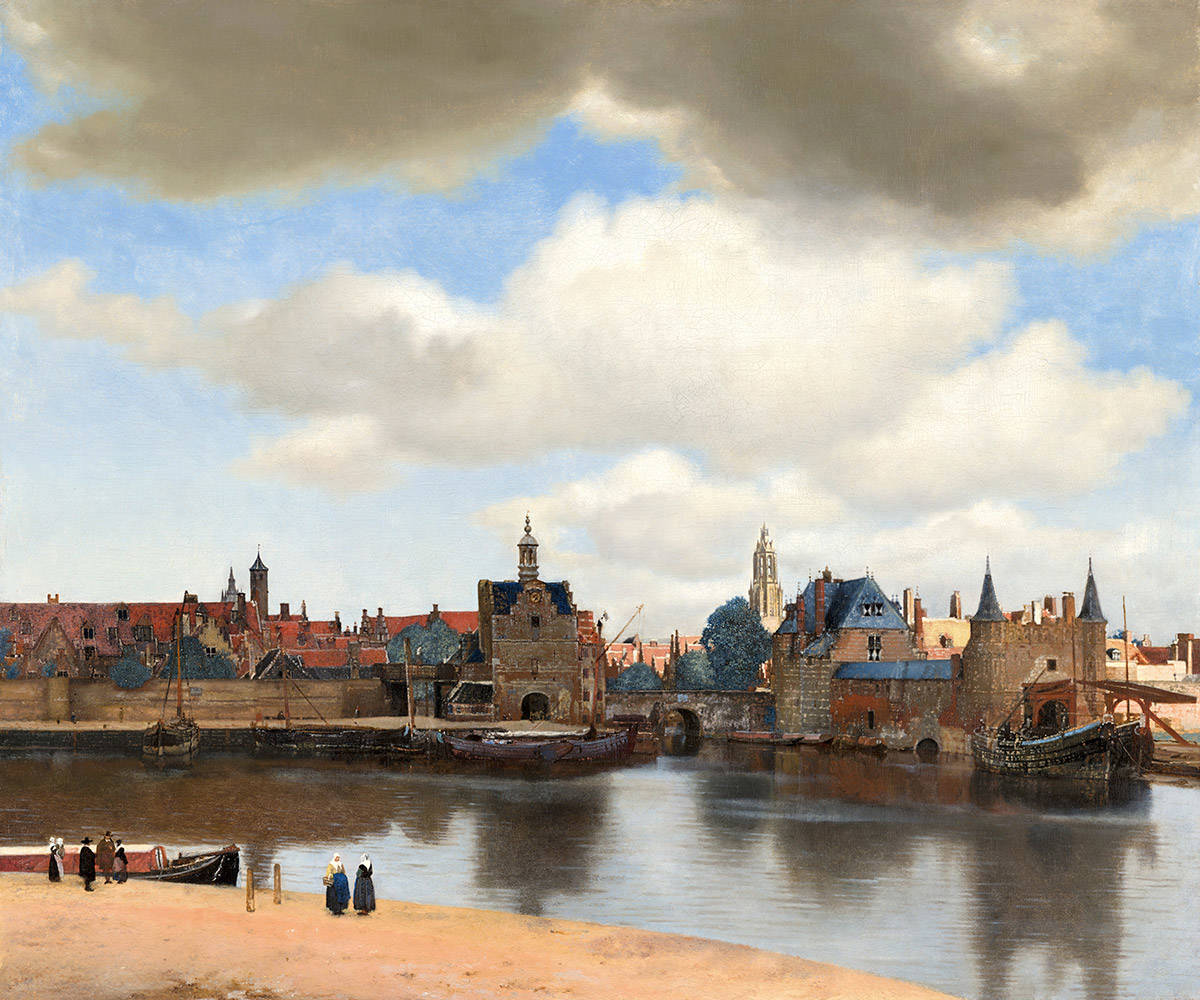
Vermeer painted relatively few landscapes or cityscapes, making View of Delft especially important.
The painting depicts Delft from across the water under a vast and changing sky. Buildings stretch horizontally across the composition while clouds gather above them. Light strikes portions of the city unevenly, creating the impression of weather moving through space.
Unlike an idealized fantasy city, Delft feels physically present. Brick, water, roofs, towers, clouds, and reflections possess weight and atmosphere.
Yet Vermeer carefully organizes reality. Buildings and lighting are adjusted to strengthen the composition. The result occupies a fascinating space between observation and construction.
The nineteenth-century French writer Marcel Proust later admired View of Delft intensely, helping to make the painting part of modern literary as well as artistic culture. A small section of yellow wall in the painting became particularly famous through Proust’s novel In Search of Lost Time.
The Art of Painting
Among Vermeer’s most intellectually ambitious works is The Art of Painting, sometimes called The Allegory of Painting.
Here Vermeer turns his attention toward the act of art itself.
We look into a studio where an artist sits with his back toward us, painting a young woman dressed as an allegorical figure. A curtain has been pulled aside as though revealing a theatrical stage. A large map hangs upon the rear wall. A chandelier descends from above.
The painting becomes an image about images.
The artist observes the model. Vermeer observes the artist. We observe them both.
The woman is often identified with Clio, the muse of history, because of attributes associated with her, including a trumpet and book. If so, Vermeer may be connecting painting with history, memory, fame, and the preservation of human experience.
The work appears to have possessed particular importance for Vermeer. Despite his financial difficulties, it remained in his possession rather than being sold during his lifetime.
Maps, Music, Science, and the Wider World
Vermeer’s interiors may seem secluded, but they contain evidence of a much larger world.
Maps frequently hang on his walls. Musical instruments appear throughout his paintings. Fine textiles, ceramics, pearls, books, and scientific instruments suggest the material and intellectual culture of the prosperous Dutch Republic.
In The Geographer and The Astronomer, Vermeer depicts learned men engaged with knowledge. They examine maps, instruments, globes, and books. These paintings belong to an age fascinated by navigation, geography, astronomy, commerce, and scientific investigation.
The quiet room therefore opens onto the world.
A map on a wall represents territories far beyond Delft. A letter connects someone inside the room with someone absent. A globe embodies distant continents. Imported objects testify to international trade.
There is also a more complicated history behind this prosperity. The wealth of the Dutch Golden Age was connected to global commercial networks that included colonial expansion, exploitation, and slavery. Understanding Dutch art historically requires acknowledging both the extraordinary cultural achievements of the period and the economic systems that helped make them possible.
How Did Vermeer Paint Light?
The technical qualities of Vermeer’s paintings have fascinated artists, historians, and scientists for generations.
His compositions are extraordinarily controlled. Perspective directs the eye through the room. Objects are arranged according to carefully balanced shapes. Colors repeat across the composition. Light unifies everything.
Vermeer also used expensive pigments when circumstances permitted. He is particularly famous for his use of natural ultramarine, derived from lapis lazuli, which was considerably more costly than many alternative blue pigments. His willingness to use it extensively contributes to the luminous blues associated with his work.
Some visual effects in Vermeer’s paintings have also led scholars to investigate whether he used optical devices such as the camera obscura. A camera obscura projects an image through a small opening or lens onto another surface. Certain effects in Vermeer’s paintings—softened edges, intensified highlights, unusual circles of light, and photographic-seeming focus—have encouraged speculation that he studied such projected images.
There is no documentary proof that Vermeer actually used a camera obscura in making his paintings. The theory therefore remains a subject of debate. More importantly, even if optical devices contributed to his process, they would not explain his artistry. A device might help an artist study light or perspective; it cannot decide what should be painted, where figures should stand, which colors should dominate, or what emotional atmosphere a painting should possess.
The intelligence behind Vermeer’s paintings remains unmistakably human.
A Small Body of Work
One of the most remarkable facts about Vermeer is how little surviving work can confidently be attributed to him.
Only roughly three dozen paintings are generally accepted as authentic Vermeers, with occasional scholarly disagreements over individual works. Compared with the enormous output of artists such as Rembrandt, this is an astonishingly small body of work.
Why did Vermeer produce so few paintings?
He appears to have worked slowly and meticulously. He also had responsibilities beyond painting. He served in leadership positions within Delft’s Guild of Saint Luke and participated in the art trade. His large household would also have placed considerable demands upon him.
He may also have relied upon a relatively small group of patrons rather than continuously producing paintings for the open market. Pieter van Ruijven and his family appear to have owned a significant collection of Vermeer’s work, suggesting that patronage may have provided an important part of his artistic livelihood.
Whatever the explanation, scarcity has become part of Vermeer’s modern mystique. There is no enormous catalogue through which to travel. His artistic universe consists of only a few dozen surviving windows.
Financial Disaster and Death
The tranquility of Vermeer’s paintings should not be mistaken for evidence of a tranquil life.
The Dutch economy suffered severely during the early 1670s. In 1672, remembered in Dutch history as the “Disaster Year,” the Republic faced invasion and political crisis. The art market deteriorated, and Vermeer’s livelihood suffered.
He died unexpectedly in December 1675 at only forty-three years old.
His widow, Catharina, was left with children, debts, and serious financial difficulties. In subsequent testimony, she described the economic pressures her husband had experienced, explaining that the collapse of the art market had left him unable to sell paintings and burdened by expenses.
It is one of art history’s great ironies. A painter whose works would eventually become priceless died amid financial distress.
The Forgotten Master
Vermeer’s death was followed by an extraordinary decline in reputation.
He was never completely unknown, but his fame remained limited, and some of his paintings were eventually attributed to better-known artists. Because he had produced relatively few works and had spent most of his career in Delft, he lacked the enormous reputation and body of work that preserved the names of painters such as Rembrandt.
His great revival came during the nineteenth century.
The French critic Théophile Thoré-Bürger became fascinated with Vermeer and undertook extensive research into his work. Beginning in the 1860s, Thoré published studies that helped reconstruct Vermeer’s catalogue and reputation. In effect, nineteenth-century scholarship reintroduced Vermeer to the European art world.
The quiet painter of Delft began his second life.
Vermeer’s Influence
Vermeer’s influence differs from that of artists who founded formal movements or attracted large workshops of students. There is no “Vermeer school” comparable to artistic movements built around direct followers. His importance is instead found in the way later generations learned to look at his paintings.
Nineteenth- and twentieth-century artists admired his treatment of color, light, geometry, and domestic space. Photographers found his compositions particularly compelling because his paintings seem to anticipate certain photographic concerns: cropping, focus, luminous interiors, and apparently spontaneous moments that are actually carefully constructed.
Modern filmmakers and cinematographers have likewise drawn inspiration from Vermeer’s interiors. The familiar visual language of a solitary figure standing beside a window, illuminated by soft natural light against a darker room, owes something to the cultural afterlife of Dutch painting and especially to Vermeer.
His influence extends beyond painting. Novelists, poets, filmmakers, photographers, and musicians have responded to his images. Tracy Chevalier’s novel Girl with a Pearl Earring, and the later film adaptation, transformed one enigmatic painting into an imagined story about the unknown young woman and the artist who painted her.
This continuing fascination reveals something important about Vermeer. His paintings provide just enough information to create a world, but rarely enough to explain it completely.
We want to know what the letter says.
We want to know who the girl was.
We want to know what happened immediately before the scene and what will happen afterward.
Vermeer refuses to tell us.
Silence as an Artistic Language
Perhaps this is why Vermeer continues to feel surprisingly modern.
Much seventeenth-century European art announces itself dramatically. Baroque saints ascend toward heaven. Kings stand surrounded by symbols of authority. Battles explode across enormous canvases. Bodies twist, angels descend, and theatrical light reveals divine intervention.
Vermeer usually gives us something very different.
A woman holds a pitcher.
Someone reads a letter.
A servant pours milk.
A musician waits.
A scholar studies a map.
A young woman turns her head.
Nothing happens, and yet everything seems to be happening.
Vermeer discovered that human attention itself could become a subject worthy of painting. His figures are often absorbed in something—a task, a letter, music, thought, measurement. They inhabit moments when the outside world seems temporarily distant.
The viewer becomes another silent presence inside the room.
This is one reason his paintings reward slow looking. At first they seem simple. Then relationships emerge: the geometry of a window repeating the geometry of a picture frame; a patch of blue balancing another patch across the canvas; the direction of a woman’s gaze leading toward an unseen thought; the light changing almost imperceptibly as it crosses a wall.
Vermeer teaches us to look at looking.
The Enduring Mystery of Johannes Vermeer
We know surprisingly little about the man himself. No diary survives. No letters explaining his artistic philosophy have been discovered. No securely identified self-portrait gives us his face. We do not know with certainty who trained him. We cannot always identify his models. Even the precise techniques behind some of his visual effects continue to inspire debate.
What survives instead are the paintings.
And perhaps that is appropriate.
Johannes Vermeer built his reputation not upon grand historical narratives but upon small moments of human existence. He showed that a room could contain a universe, that sunlight on a wall could be as worthy of attention as a battlefield, and that a person quietly reading a letter could possess the dignity traditionally reserved for heroes and saints.
His place within the Dutch Golden Age connects him to a remarkable culture of artistic experimentation, commercial prosperity, scientific curiosity, global exchange, and domestic life. His association with the Delft School helps us understand his fascination with perspective, architecture, and interior space. Yet neither category completely explains him.
Vermeer ultimately stands apart.
There is a stillness in his paintings that is difficult to describe because it depends less upon subject than upon experience. Standing before a Vermeer, we become conscious of light, distance, texture, silence, and time. Ordinary things become strangely important: bread, glass, plaster, cloth, paper, maps, pearls.
Perhaps that is his greatest contribution to art history.
Vermeer did not need to invent another world in order to reveal beauty. He looked closely enough at this one.
And nearly four centuries later, his paintings continue to ask us to do the same.