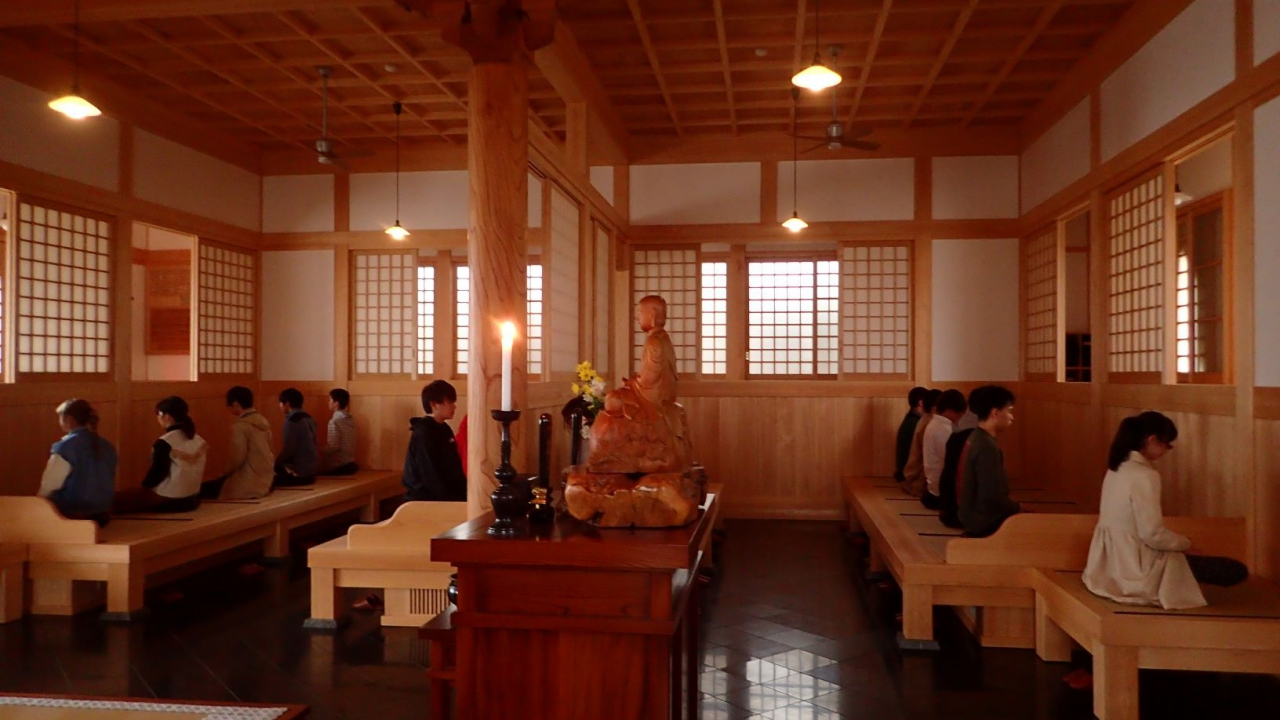
Zen has a reputation—sometimes earned—for being the tradition that shrugs at forms. “Just sit.” “Don’t get stuck on words.” “Let body and mind drop away.” And yet if you walk into a Zen temple or a small neighborhood zendo, you will find bows done a certain way, chants at certain times, robes folded with care, incense offered precisely, liturgy spoken in rhythms that have been kept for centuries. To someone new, it can feel like a contradiction: if emptiness is the heart of it, why all this form? If awakening isn’t manufactured, why the choreography?
But Zen’s forms aren’t there to add something extra to practice. They are there because practice is not only what happens in the quiet of your skull. Zen trains the whole person—body, speech, and mind—and it trains them in the exact place where we usually drift into autopilot. We can sit zazen and still remain subtly self-centered: “my meditation,” “my insights,” “my calm.” Ritual interrupts that possessiveness. When you bow, you’re not performing for someone watching. You’re giving the body a job that expresses what the heart is trying to learn: humility, gratitude, willingness, and surrender. The body learns what the mind argues with. Liturgy is a way of teaching the body the Dharma.
Chanting does something similar with speech. Zen is often allergic to “too many words,” because words can become a substitute for direct seeing. But words can also be a vehicle for direct seeing when they’re used as practice rather than commentary. In chanting, speech stops being a tool for convincing, explaining, or performing identity. It becomes an offering. The chant doesn’t exist to impress you with theology; it exists to gather scattered attention into one voice, one breath, one community. It’s hard to keep polishing the ego while chanting the same lines beside other human beings—some you like, some you don’t, some who annoy you, some who inspire you. That’s the point. Liturgy is a practice of harmonizing with reality as it is, not as you wish it were.
And then there’s the deeper Zen truth: emptiness is not “nothing,” and it’s not “anti-form.” Emptiness means that things do not exist as isolated, independent entities. Everything arises in relationship. Form is not the enemy of emptiness—form is how emptiness appears. The old line “form is emptiness, emptiness is form” isn’t a poetic flourish; it’s a correction. When Zen insists on precise forms, it’s not clinging to superstition. It is training you to meet form without grasping, and to meet emptiness without dissociation. A ritual done carefully is a lesson in non-grasping: you do it fully, wholeheartedly, without needing it to be “yours,” and without needing it to mean what your preferences demand.
Precision matters for another very practical reason: Zen is a lineage tradition. Liturgy is a living thread that connects your ordinary Tuesday night sitting to the experience of countless practitioners before you. That thread is not about nostalgia; it’s about humility and reliability. If everything becomes improvised according to taste, practice quietly shifts into self-expression. We begin to worship our own personality. The form protects us from that. It gives us a container that is not authored by our moods. It holds us steady when inspiration fails, when our life is messy, when we don’t feel spiritual, when the mind is noisy. You can walk into the same chant on the worst day of your year and let it carry you. That’s not rigidity; that’s compassion.
Ritual also protects community. Zen isn’t a hobby performed in isolation. It’s a communal path, even when your temperament is solitary. Shared liturgy is one of the most powerful ways a group becomes a sangha rather than a room full of individuals. It creates a common language of reverence, apology, gratitude, aspiration. It teaches you how to enter, how to leave, how to take your place without taking over. It gives newcomers something concrete to do when they don’t yet understand what’s happening. It gives long-timers a way to keep practicing when concepts have worn thin. And because it’s shared, the ritual is bigger than any one person’s preferences—so it teaches the sangha how to practice together without requiring unanimity of personality.
There’s also a subtle psychological wisdom in ritual that Zen has always understood: we become what we repeatedly enact. The mind may proclaim emptiness, but the nervous system keeps score. When you repeatedly enact reverence, patience, restraint, and care, you start to become a person who naturally embodies those qualities. In that sense, ritual is not a set of “belief statements.” It’s behavioral training in awakening. It’s how you practice the Dharma in the muscles.
And yes, ritual can be misused. Zen knows this too. Forms can become theater. Liturgy can become a badge of belonging. Precision can harden into judgment. The cure is not to throw away the forms; the cure is to return them to their original purpose: to make you honest. A bow that becomes self-righteous is not a bow. A chant that becomes performance is not a chant. But a bow done with sincerity—even if clumsy—can cut through ego in a way that clever opinions never will.
So why does Zen keep liturgy and ritual, even with its emphasis on just sitting? Because “just sitting” isn’t meant to be confined to the cushion. Zen wants you to become zazen in how you enter a room, how you speak, how you eat, how you relate to others, how you meet beauty and grief, how you handle your own importance. Liturgy and ritual are simply zazen wearing clothes.
In the end, Zen forms are not a contradiction of emptiness. They are the place where emptiness is tested and made real. If you can chant wholeheartedly without grasping, bow without self-consciousness, and follow the forms without turning them into identity—then the Dharma is no longer a philosophy you agree with. It is something your whole life is learning to express.