There is a persistent misunderstanding about humanism that reduces it to what it does not believe. Humanists are sometimes described primarily as people who reject gods, reject organized religion, reject supernatural explanations, or reject traditional sources of authority. Those things may describe the beliefs of some humanists, but they do not tell us very much about humanism itself. A philosophy cannot sustain a life merely by saying no. It must eventually say yes. It must tell us what is worth loving, what is worth protecting, how we ought to treat one another, and what kind of world we should hope to leave behind.
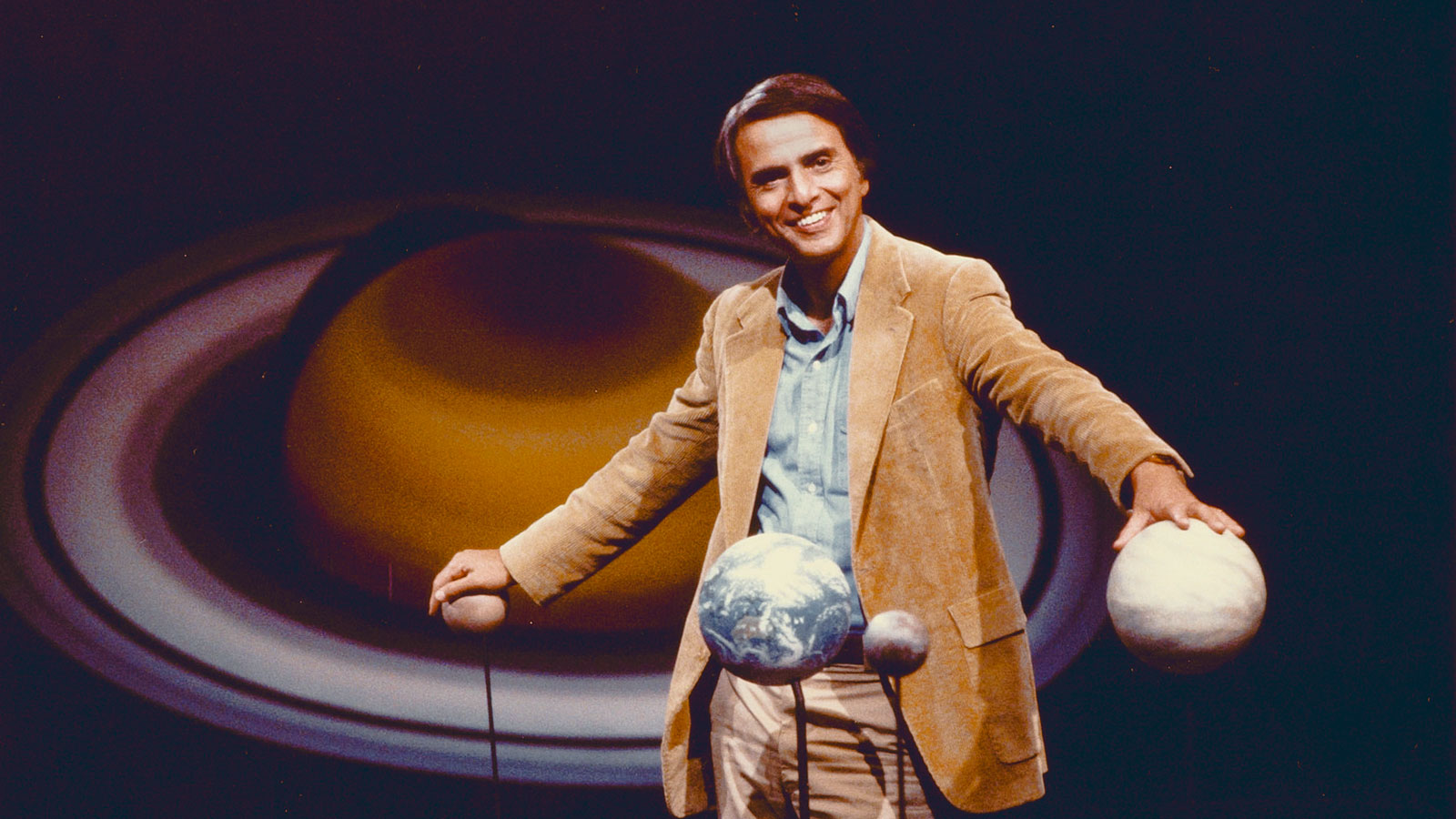
Few people articulated that affirmative side of humanism as beautifully as Carl Sagan.
Sagan was not merely a scientist who happened to be skeptical of religion. He was publicly recognized as a humanist, receiving the American Humanist Association’s Humanist of the Year award in 1981. Yet his importance to humanism reaches far beyond organizational affiliation. Throughout Cosmos, The Demon-Haunted World, Pale Blue Dot, The Dragons of Eden, Contact, and his many essays and lectures, Sagan developed something remarkably close to a complete humanist vision of life. It was a vision grounded in science but not confined to laboratories, skeptical without becoming cynical, awestruck without becoming supernatural, and deeply conscious that our intelligence gives us not merely power but responsibility.
Perhaps the most important thing about Sagan’s humanism was that he refused to accept the premise that abandoning supernatural explanations requires abandoning wonder.
For Sagan, the universe revealed by science was not cold, sterile, or meaningless. It was magnificent. A universe billions of years old, containing hundreds of billions of stars within galaxies scattered across unimaginable distances, was not somehow less astonishing because it could be studied scientifically. It was more astonishing. Understanding the mechanisms of a star did not destroy its beauty any more than understanding the biology of love destroys love. Knowledge deepened wonder.
This was one of Sagan’s great contributions to the humanist imagination. He understood that people need more than facts. We need awe. We need perspective. We need moments in which the boundaries of the ordinary fall away and we become aware that we participate in something vastly larger than ourselves. Religion has traditionally been very good at providing those experiences. Sagan demonstrated that the natural universe can do the same thing.
We do not need to imagine ourselves standing at the center of creation in order for our lives to matter.
Indeed, Sagan repeatedly turned the old assumption upside down. For most of human history, civilizations tended to place themselves somewhere near the center of existence. Our tribe was special. Our nation was special. Our religion possessed the truth. Our species occupied the center of creation. Our planet occupied the center of the cosmos. One scientific discovery after another gradually dismantled those comfortable assumptions.
Earth is not the center of the solar system. The Sun is an ordinary star. Our solar system occupies no privileged location in the Milky Way. Our galaxy is one among an enormous number of galaxies. Humanity arrived very late in the history of the universe.
A more insecure philosophy might interpret all of this as humiliation. Sagan however, interpreted it as liberation.
There is something healthy about discovering that the universe was not constructed specifically for us. It encourages humility. Human beings remain extraordinary creatures, but our importance cannot depend upon imagining ourselves cosmically privileged. Meaning is something we create through relationships, discovery, creativity, compassion, memory, and the lives we build together.
This is where Sagan’s cosmic perspective becomes unmistakably humanist. The farther outward he looked, the more intensely he returned to the value of human life.
Nowhere is that clearer than in the famous image known as the Pale Blue Dot. At Sagan’s urging, Voyager 1 turned its camera back toward Earth in February 1990 as the spacecraft traveled outward from the planets. From roughly four billion miles away, Earth appeared as little more than a tiny illuminated speck suspended in darkness. The photograph later inspired Sagan’s meditation in Pale Blue Dot, in which that almost invisible point becomes the setting of every human life, civilization, triumph, tragedy, war, love, ambition, and dream that we have ever known.
The extraordinary power of the Pale Blue Dot is that it begins with astronomy and ends with ethics.
Seen from such a distance, our divisions become almost absurd. Borders disappear. Nations disappear. Palaces and slums disappear. Cathedrals, temples, mosques, parliaments, armies, monuments, prisons, universities, and cemeteries all vanish into the same point of light. Every emperor and peasant occupies the same dot. Every religious war has been fought there. Every racial hierarchy has been invented there. Every political ideology that proclaimed itself destined to rule history emerged there. Every person we have ever loved lived there.
The photograph does not tell us that our lives are meaningless. Rather, it tells us that our quarrels are smaller than we imagine and our responsibilities are greater.
From the perspective Sagan offered, there is nowhere else to which we can casually retreat. There is no second Earth waiting conveniently nearby if we destroy this one. Whatever our theological beliefs may be, the practical responsibility for human civilization rests overwhelmingly in human hands. As Sagan emphasized in his reflection on that distant image, seeing Earth in this way should encourage us to treat one another more kindly and to care for the world that sustains us. Humanist Heritage describes the Pale Blue Dot precisely in these terms: as a call toward responsibility for both humanity and the planet.
That connection between knowledge and responsibility appears throughout Sagan’s work.
Science, in Sagan’s understanding, was never simply a collection of information. It was a method for disciplining one of the most dangerous things in the universe: the human mind.
We are extraordinarily intelligent animals, but intelligence does not guarantee wisdom. Human beings are capable of discovering quantum mechanics and believing ridiculous rumors before breakfast. We can map the human genome while remaining vulnerable to propaganda, superstition, prejudice, conspiracy theories, wishful thinking, charismatic leaders, and our own psychological biases. Education alone does not eliminate these weaknesses because highly educated people are entirely capable of rationalizing things they desperately want to believe.
Skepticism therefore becomes more than an intellectual preference; it becomes an ethical discipline that requires us to ask questions, demand evidence, recognize uncertainty, be willing to say “I don’t know,” remain wary of ideas that conveniently confirm what we already believe, and, perhaps most importantly, stay open to the possibility that we are wrong.
Sagan’s skepticism was therefore profoundly different from fashionable cynicism. Cynicism begins by assuming that everything is corrupt, everyone is lying, and nothing deserves trust. Scientific skepticism begins somewhere else entirely. It asks what the evidence supports. A skeptic can conclude that something is true just as readily as something is false. The purpose is not disbelief. The purpose is intellectual honesty.
That distinction matters enormously for humanism.
If there is no supernatural authority waiting to correct our mistakes, then our obligation to reason carefully becomes even more serious. We cannot simply declare something true because it comforts us. We cannot outsource our moral judgment to tradition, political parties, religious authorities, charismatic personalities, or popular opinion. We must learn to think, question, compare evidence, admit error, and revise our conclusions.
Humanism demands humility because human beings are inherently fallible, and Sagan fully recognized this truth. At the same time, he understood an equally vital principle: that reason on its own is not enough, and without compassion to guide it, even the most disciplined intellect can fall short of genuine wisdom.
Science can tell us how to split an atom. It cannot by itself tell us whether we should drop the resulting bomb on a city. Science can help us manipulate genetics, build artificial intelligence, alter ecosystems, explore other planets, and transform the climate. Every increase in knowledge expands both our possibilities and our responsibilities.
Sagan spent significant energy warning about nuclear war and participated in research concerning the potential climatic consequences of large-scale nuclear conflict. His public work on nuclear winter became part of a larger effort to force political leaders and ordinary citizens to confront what technological civilization had made possible.
There is something profoundly humanist in that concern. Scientific progress is not automatically moral progress. A civilization can become technologically brilliant while remaining ethically primitive. We can develop weapons capable of destroying cities long before we develop the political maturity necessary to live with them.
That gap between technological power and moral wisdom may be one of the defining problems of civilization.
Sagan did not respond to science with pessimism or with any romantic rejection of it; on the contrary, he was deeply committed to scientific inquiry, but he insisted that humanity’s growing technological power must be matched by moral development. For him, knowledge needed to be paired with wisdom, power tempered by restraint, and skepticism balanced with compassion. In this sense, his vision extended far beyond secularism, because what ultimately concerned him was not simply what humans know or believe, but what they might become.
There is an optimism running beneath much of his work, although it is never a naïve optimism. Humanity is capable of terrible things. Our history is soaked with war, slavery, persecution, fanaticism, cruelty, and exploitation. Sagan never needed to pretend otherwise. Yet the same species that created concentration camps also composed symphonies, developed medicine, painted masterpieces, built libraries, explored the planets, abolished institutions once considered permanent, expanded circles of moral concern, and learned something about the history of the cosmos.
We are neither angels nor monsters, but something still in the making—unfinished, evolving, and capable of becoming more than what we have been. That sense of incompleteness may be one of the most deeply humanist ideas imaginable, because it leaves open the possibility of growth, change, and moral becoming.
Human nature does not condemn us permanently to the worst chapters of our history. Culture changes. Moral understanding develops. Knowledge accumulates. Institutions can improve. Old prejudices can weaken. Cruelties once considered ordinary can eventually become intolerable.
Progress is never guaranteed. It must be created. And that task belongs to us.
Sagan’s fascination with extraterrestrial intelligence also reflected this humanist perspective. Searching for life elsewhere in the cosmos was obviously a scientific question, but behind it lay another fascinating possibility. What would humanity look like to another civilization? Would beings who had survived for thousands or millions of years beyond our technological adolescence have overcome warfare, tribalism, environmental destruction, and ideological fanaticism? Would survival itself require civilizations eventually to become wiser?
We do not know. But the question forces us to look at ourselves from outside.
Perhaps that is what Sagan did better than almost anyone. He repeatedly moved the camera backward. From the individual to the civilization. From the civilization to humanity. From humanity to Earth. From Earth to the solar system. From the solar system to the galaxy. From the galaxy to the cosmos.
And then, after all the vast journeys of thought and imagination, he always brought us back home. No matter how far the mind traveled—across billions of light-years, through galaxies and epochs—the question ultimately returned to something immediate and unavoidable: how should we live here, on this small world?
Sagan never offered a single creed or rigid doctrine in response. Instead, his answer can be pieced together from the consistent values that shaped his life and work. He urged us to remain curious, to think critically, and to resist the temptation to claim certainty where none exists. He reminded us not to pretend knowledge we do not have, and to follow evidence even when it unsettles our assumptions. Life, in his view, is astonishingly improbable and therefore deeply precious, and it deserves both protection and care.
From this perspective, we are called to guard the fragile conditions that make life possible, to resist the pull of tribal thinking, and to be wary of those who demand unquestioning obedience. We are encouraged to celebrate discovery, to share what we learn, to use our growing technological power with wisdom and restraint, and to treat one another with greater kindness. And throughout it all, Sagan insisted that skepticism should never be allowed to extinguish wonder.
This, for him, was humanism at its most complete. It did not place humanity arrogantly at the center of the universe. In fact, Sagan did the opposite: he removed us from that imagined center entirely. Yet in doing so, he did not diminish us. Instead, he made human life feel more fragile, more remarkable, and ultimately more precious than before.
There is no contradiction in this. Our smallness does not make us worthless. A child is small beneath the stars, but no less beloved because of it. A human life occupies an infinitesimal fraction of cosmic time, but within that moment someone can love, discover, create, laugh, teach, comfort, explore, forgive, and change another person’s life.
Meaning does not have to be eternal in order to be real, nor does beauty need anything supernatural to be sacred. Wonder can exist without ignorance, morality can stand without fear, and humility does not require us to see ourselves as insignificant.
Perhaps this is why Carl Sagan remains such an important figure for modern humanism. He offered something humanists sometimes struggle to communicate: not merely an argument against supernaturalism, but an emotionally compelling vision of what can stand in its place.
There is the universe itself—ancient, immense, mysterious, beautiful, and still largely unknown—and alongside it, science, the imperfect yet astonishing human effort to make sense of it. Within this vastness stands humanity, a contradictory species capable of both extraordinary foolishness and extraordinary courage, living on Earth, a fragile world suspended in the depths of cosmic darkness. And then there is us, here together for the moment, sharing this brief span of existence. That is not a small thing.
A mature humanism does not look into the night sky and declare that because no divine voice answers from the stars, nothing matters. It looks into that immense silence and recognizes something far more demanding. There may be no cosmic parent coming to settle our disputes, repair our environment, dismantle our weapons, overcome our prejudices, comfort our neighbors, or build a more humane civilization for us.
We must do those things ourselves.
And yet Sagan’s universe is not therefore bleak. Quite the opposite. We are pieces of the universe that have become capable of contemplating the universe. Matter has somehow learned to wonder about matter. The products of ancient stars have assembled themselves into creatures capable of building telescopes, writing poetry, falling in love, asking questions, and extending their imaginations across billions of light-years.
There is grandeur enough in that.
Carl Sagan’s humanism therefore leaves us with both humility and hope. We are small, but we can understand. We are fallible, but we can learn. We are divided, but we can cooperate. We are mortal, but we can create meaning. We have inherited terrible problems, but we also possess remarkable capacities for reason, imagination, compassion, and change.
The Pale Blue Dot remains suspended in the darkness.
It is tiny.
It is vulnerable.
It is beautiful.
And, for now, it is home.
What becomes of it is largely up to us.