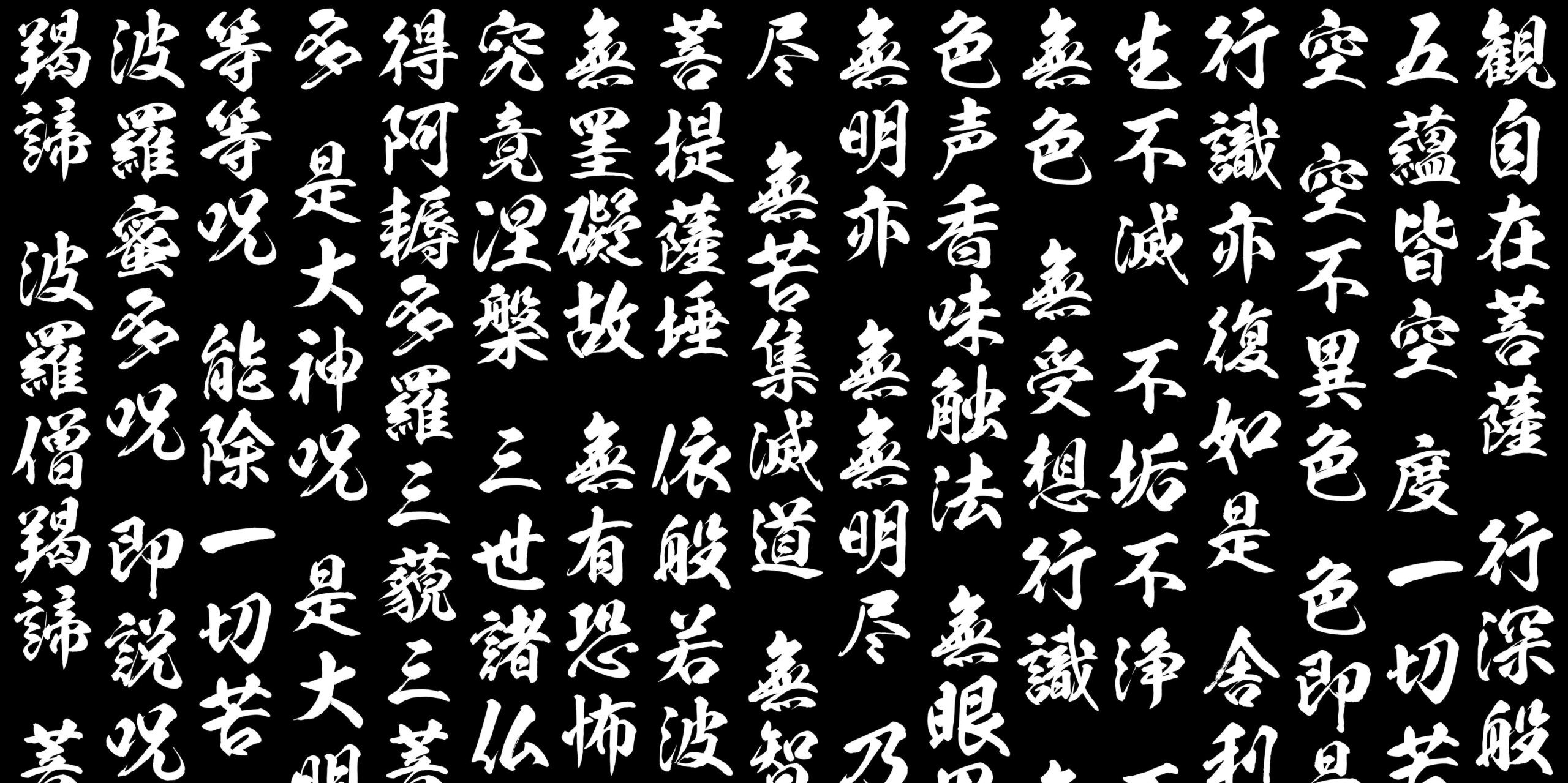
Among all Mahayana Buddhist scriptures, few are as brief, beloved, mysterious, and widely recited as the Heart Sutra. In many Zen temples it is chanted daily. It is heard at memorial services, sesshin retreats, morning practice, evening service, lay ceremonies, monastic liturgies, and private home altars. It is short enough to memorize, yet deep enough to occupy a lifetime. It is both scripture and koan. It is doctrine, chant, medicine, thunderclap, and mirror.
The full title is usually rendered as The Heart of the Perfection of Wisdom Sutra, or in Japanese Zen, Maka Hannya Haramita Shingyo. “Heart” here does not mean emotion alone, though the sutra has always had a devotional force. It means essence, core, center, or vital point. The Heart Sutra is the heart of the Prajnaparamita tradition, the “Perfection of Wisdom” literature of Mahayana Buddhism. These texts teach prajna, liberating wisdom, the direct seeing that all things are empty of fixed, separate, independent self-nature. The Heart Sutra compresses this vast teaching into a few lines.
Yet compression does not mean simplification. The Heart Sutra is not a slogan about nothingness. It is not a denial of life, body, suffering, ethics, practice, or awakening. It is a medicine against clinging. It takes the structures by which ordinary Buddhist teaching is often explained, such as the five aggregates, the sense fields, the Four Noble Truths, and even wisdom and attainment, and shows that none of them can be grasped as a permanent object. The sutra does not destroy Buddhism. It frees Buddhism from becoming another thing to cling to.
This is why the Heart Sutra is central to Zen. Zen does not reject scripture, though it often warns against becoming trapped by words. Zen receives the Heart Sutra as a living expression of the same insight pointed to in zazen: when we sit, breathe, and stop trying to possess ourselves, we begin to see that what we call “I” is not a solid object. Body, feeling, perception, formations, and consciousness arise together with the whole universe. Nothing stands alone. Nothing can be held. And because nothing can be held, everything can be met.
Historical Background
The Heart Sutra belongs to the Prajnaparamita family of Mahayana scriptures. The larger Prajnaparamita texts include vast works such as the Perfection of Wisdom in 8,000 Lines, 25,000 Lines, and even 100,000 Lines. These scriptures developed around the central insight that wisdom is not merely intellectual knowledge but the direct realization of emptiness. Emptiness means that all phenomena lack independent, unchanging self-existence. Things exist, but they exist dependently, relationally, conditionally.
Traditionally, the Heart Sutra has been treated as an Indian Mahayana scripture transmitted into China and then throughout East Asia. It is associated especially with the Chinese monk Xuanzang, one of the great translator-scholars of Buddhist history. Xuanzang traveled to India in the seventh century, returned to China with Buddhist texts, and became a towering figure in the transmission of Buddhist learning.
Modern scholarship, however, has complicated the traditional story. Jan Nattier famously argued that the Heart Sutra may have first taken shape in China, drawing heavily from Chinese translations of larger Prajnaparamita materials, and was later translated or back-translated into Sanskrit. Other scholars have debated, refined, and challenged parts of that theory, but Nattier’s work remains one of the most important modern studies of the text’s origin. Whether one accepts the Chinese-origin hypothesis fully or not, it is clear that the Heart Sutra is deeply rooted in the wider Prajnaparamita tradition and became especially powerful in East Asian Buddhism.
For practitioners, this history need not weaken the sutra’s authority. In Mahayana Buddhism, scripture is not merely a fossil from the past. It is a living vehicle of awakening. If the Heart Sutra emerged through translation, condensation, liturgical use, and cross-cultural creativity, that only shows how Buddhism itself has often lived: by carrying the Dharma across languages, cultures, and forms while preserving the essential insight.
The Heart Sutra appears in both shorter and longer versions. The shorter version, most commonly chanted in Zen, begins directly with Avalokiteshvara Bodhisattva practicing deep wisdom. The longer version includes a more conventional sutra opening, with the Buddha present, a setting, and a conclusion. Zen liturgy generally uses the shorter form because of its compactness, rhythm, and force.
The Heart Sutra in Zen Practice
In Zen, the Heart Sutra is not merely studied. It is chanted. This matters.
Chanting is not the same as reading silently. When the Heart Sutra is chanted, the teaching enters the body. Breath, sound, posture, rhythm, and community become part of the meaning. The line “form is emptiness, emptiness is form” is no longer an abstract doctrine. It is voiced by lungs, ribs, tongue, ears, floor, bell, incense, and sangha. The doctrine of interdependence is enacted in the very act of chanting.
In Soto Zen, the Heart Sutra is part of daily services and temple liturgy. In Rinzai Zen, it is also widely recited and often treated with a sharp koan-like energy. Across Zen lineages, the sutra is chanted for wisdom, protection, dedication of merit, memorials, and the cultivation of insight. In Japanese Zen, its sound has become almost inseparable from the religious atmosphere of the temple: Maka hannya haramita shingyo.
Dogen, the founder of Soto Zen in Japan, wrote a fascicle of the Shobogenzo called Maka Hannya Haramitsu, “Great Prajnaparamita.” For Dogen, wisdom is not separate from practice. Prajnaparamita is not simply an idea one understands. It is sitting, bowing, eating, walking, working, and meeting the world without clinging. Dogen’s reading of wisdom is characteristically radical: the whole body practices wisdom; the whole world expresses wisdom. Emptiness is not somewhere else. It is the activity of this very life.
Modern Zen teachers have continued this embodied reading. Shunryu Suzuki emphasized beginner’s mind, an openness that does not freeze reality into fixed conclusions. Thich Nhat Hanh, though rooted in Vietnamese Zen and broader engaged Buddhism, interpreted the Heart Sutra through the language of “interbeing”: nothing exists by itself; everything exists together with everything else. Shohaku Okumura has often emphasized that emptiness is not a metaphysical theory but the reality of our life as interdependent, impermanent, and ungraspable. Kazuaki Tanahashi, a Zen teacher, artist, and translator, has highlighted the poetic and transformative power of the sutra’s language. Red Pine, in his commentary, draws deeply from classical sources while keeping the sutra grounded in practice.
The Zen approach may be summarized simply: do not merely think emptiness. Sit emptiness. Breathe emptiness. Bow emptiness. Wash your bowl emptiness. Meet grief, joy, fear, and love as empty, not because they are unreal, but because they are alive, changing, and not yours to possess.
A Working Translation
The following is a simple working translation for commentary purposes:
Avalokiteshvara Bodhisattva, practicing deep Prajnaparamita, clearly saw that the five aggregates are empty, and was freed from all suffering.
Shariputra, form is emptiness; emptiness is form. Form is not other than emptiness; emptiness is not other than form. The same is true of feeling, perception, mental formations, and consciousness.
Shariputra, all things are marked by emptiness. They do not arise or cease, are not pure or impure, do not increase or decrease.
Therefore, in emptiness there is no form, no feeling, no perception, no formations, no consciousness; no eye, ear, nose, tongue, body, or mind; no sight, sound, smell, taste, touch, or object of mind; no realm of eye, up to no realm of mind-consciousness.
There is no ignorance and no end of ignorance, up to no aging and death and no end of aging and death.
There is no suffering, no cause of suffering, no cessation of suffering, and no path.
There is no wisdom and no attainment.
Because there is nothing to attain, the bodhisattva relies on Prajnaparamita, and the mind has no obstruction. Without obstruction, there is no fear. Far beyond deluded views, the bodhisattva realizes nirvana.
All Buddhas of past, present, and future rely on Prajnaparamita and attain complete, perfect awakening.
Therefore know that Prajnaparamita is the great sacred mantra, the great bright mantra, the supreme mantra, the incomparable mantra, which removes all suffering. This is true and not false.
Therefore proclaim the Prajnaparamita mantra:
Gate gate paragate parasamgate bodhi svaha.
Gone, gone, gone beyond, gone completely beyond, awakening, svaha.
Line-by-Line Walkthrough
“Avalokiteshvara Bodhisattva”
The sutra begins not with a philosophical argument, but with a bodhisattva. Avalokiteshvara is the bodhisattva of compassion, known in Chinese as Guanyin, in Japanese as Kannon or Kanzeon, and in many forms throughout Mahayana Buddhism. This is crucial. The Heart Sutra is often thought of as a scripture of wisdom, but the speaker is compassion.
In Mahayana Buddhism, wisdom and compassion are inseparable. Wisdom without compassion can become cold abstraction. Compassion without wisdom can become attachment, sentimentality, or exhaustion. Avalokiteshvara embodies the union of both. The one who sees emptiness is the one who hears the cries of the world.
This is a major practical teaching. Emptiness does not mean withdrawal from suffering. It means freedom from the self-centered grasping that prevents us from responding clearly. To see emptiness is not to care less. It is to care without possession.
“Practicing deep Prajnaparamita”
Prajnaparamita means the perfection, completion, or going-beyond of wisdom. It is wisdom that carries one to the “other shore,” beyond delusion, clinging, and fear.
The sutra does not say Avalokiteshvara was thinking about Prajnaparamita. It says he was practicing it. This is central to Zen. Wisdom is not merely a doctrine to believe. It is a way of seeing and living. In zazen, we practice letting thoughts arise and pass without building an identity out of them. In bowing, we practice releasing pride. In work practice, we practice meeting ordinary tasks as the Way. In relationship, we practice listening without immediately defending the self.
“Deep” Prajnaparamita means wisdom that has gone below concepts. It is not satisfied with repeating “everything is empty.” It sees directly that the one who repeats the phrase is also empty.
“Clearly saw that the five aggregates are empty”
The five aggregates are form, feeling, perception, mental formations, and consciousness. In early Buddhist teaching, these are the basic components of personal experience. What we call a “self” is not a single permanent entity but a changing collection of processes.
Form is body and materiality. Feeling is the basic tone of pleasant, unpleasant, or neutral experience. Perception identifies and labels. Mental formations include impulses, habits, intentions, emotions, and karmic tendencies. Consciousness is awareness of objects through the senses and mind.
Avalokiteshvara sees that these aggregates are empty. This does not mean they do not exist. It means they do not exist as a fixed, independent self. Body changes. Feelings change. Perceptions change. Habits change. Consciousness changes. There is experience, but no permanent owner hidden inside experience.
This is one of the sutra’s great liberations. Much suffering comes from mistaking the aggregates for “me” and “mine.” My body, my pain, my opinion, my fear, my memory, my story. The sutra does not deny these experiences. It simply asks us to look closely. Where is the fixed self inside them?
“And was freed from all suffering”
Seeing emptiness frees Avalokiteshvara from suffering because clinging depends on the illusion of solidity. If I believe that my identity is fixed, then every change becomes a threat. Aging becomes humiliation. Loss becomes annihilation. Criticism becomes an attack on my being. Death becomes the destruction of something I imagine to be permanent.
But when the aggregates are seen as empty, experience is still experience, yet the grip loosens. Pain may remain, but the extra suffering created by clinging begins to dissolve. Zen does not promise that practice prevents grief, illness, or death. It teaches that we can meet them without building a prison around them.
“Shariputra”
Avalokiteshvara now addresses Shariputra, one of the Buddha’s great disciples, traditionally known for wisdom in the early Buddhist tradition. This creates a symbolic conversation between early Buddhist analysis and Mahayana emptiness teaching.
The Heart Sutra does not insult Shariputra. It honors him by addressing him directly. But it also pushes beyond any tendency to turn Buddhist categories into fixed realities. Even the most useful teachings can become obstacles if clung to.
For Zen practitioners, Shariputra represents the intelligent student, the one who understands doctrine, lists, categories, and analysis. Avalokiteshvara represents the wisdom that goes beyond even correct understanding. We need both. But finally, the map must open into the territory.
“Form is emptiness; emptiness is form”
This is the most famous line of the sutra. It is also one of the most misunderstood.
“Form is emptiness” means that every form, every body, object, thought, tree, stone, person, and world, is empty of independent self-existence. Nothing stands alone. Everything is made of conditions.
“Emptiness is form” prevents us from turning emptiness into a blank void. Emptiness is not somewhere behind the world. It is the relational nature of the world itself. Because things are empty, they can appear, change, relate, function, and transform.
A flower is empty because it is made of sun, soil, rain, seed, air, time, insects, and human perception. But that emptiness is not separate from the flower. The flower is precisely this dependent arising. Its emptiness is its form.
Zen practice brings this down to the cushion. This breath is empty: it depends on lungs, trees, atmosphere, food, posture, ancestry, and countless causes. But the breath is not unreal. It is vividly here. Empty does not mean absent. Empty means ungraspable.
“Form is not other than emptiness; emptiness is not other than form”
The sutra repeats and intensifies the point. It is not saying that form disappears into emptiness, or that emptiness exists as a separate spiritual substance. Form and emptiness are not two different things.
This is important because spiritual practice often creates subtle dualisms. We imagine ordinary life over here and enlightenment over there. Body over here and spirit over there. Samsara over here and nirvana over there. The Heart Sutra cuts through this. The ordinary world, seen clearly, is empty. Emptiness, lived fully, is the ordinary world.
Dogen’s Zen is especially strong on this point. Practice is not a ladder used to escape life. Practice is the expression of awakening within life. To wash the bowl completely is Prajnaparamita. To sit upright in silence is Prajnaparamita. To meet one difficult conversation without self-protection is Prajnaparamita.
“The same is true of feeling, perception, mental formations, and consciousness”
The sutra extends the teaching to all five aggregates. It is not only physical form that is empty. Our inner life is empty too.
Feelings are empty. A pleasant feeling arises due to conditions and passes when conditions change. An unpleasant feeling does the same. This is why meditation trains us not to chase pleasure or flee discomfort automatically.
Perceptions are empty. What we think we see is shaped by memory, language, culture, fear, desire, and habit. We do not encounter the world as pure observers. We participate in constructing our experience.
Mental formations are empty. Anger, envy, love, patience, anxiety, and courage all arise due to causes and conditions. Because they are empty, they can be transformed. This is the basis of practice.
Consciousness is empty. Awareness is not a fixed soul-substance standing outside experience. It arises in relation to objects, body, senses, and conditions.
This is deeply practical. If anger were solid, no one could become patient. If fear were solid, no one could become brave. If identity were solid, no one could awaken. Emptiness is the possibility of liberation.
“All things are marked by emptiness”
The sutra now expands from the person to all phenomena. Not only the self, but all things are empty. This is the Mahayana widening of insight: the emptiness of self and the emptiness of dharmas, or phenomena.
This prevents us from secretly relocating permanence somewhere else. We may accept that the ego is empty, but then cling to doctrines, institutions, rituals, nations, roles, memories, or spiritual attainments as though they were fixed. The sutra says no. All things are marked by emptiness.
Zen often expresses this through direct, earthy images. The sound of the bell is empty. The incense smoke is empty. The teacher’s words are empty. The student’s confusion is empty. The robe, bowl, sutra, altar, and zafu are empty. Because they are empty, they can function.
“They do not arise or cease”
At first, this seems to contradict obvious experience. Things arise and cease constantly. Thoughts arise. Sounds cease. Lives begin and end.
The sutra speaks from the perspective of emptiness. Since no thing exists independently in the first place, no separate thing truly arises as a self-contained entity, and no separate thing truly vanishes into nothingness. What we call arising is the gathering of conditions. What we call ceasing is the dispersing of conditions.
A wave rises and falls, but water is not born when the wave appears, nor destroyed when the wave disappears. Likewise, the self we defend so fiercely is a temporary wave of causes and conditions.
This does not erase grief. When someone dies, we grieve. Zen does not ask us to pretend otherwise. But the Heart Sutra invites us to see death differently: not as the annihilation of a separate essence, but as transformation within the boundless web of conditions.
“Are not pure or impure”
Purity and impurity are also empty. This does not mean ethics disappear. It means our rigid judgments are not ultimate.
We often divide the world into clean and unclean, sacred and profane, worthy and unworthy, enlightened and deluded. The sutra cuts through the arrogance that can hide inside these divisions. From the standpoint of emptiness, nothing possesses permanent purity or impurity.
Practically, this is a profound antidote to shame. A person is not permanently stained by their worst moment. A mind filled with confusion is not beyond awakening. A life of mistakes can still become a life of practice.
At the same time, the teaching must not be abused. Emptiness does not mean harmful actions do not matter. In fact, because everything is interdependent, actions matter deeply. There is no fixed impurity, but there are consequences. There is no permanent sinner, but there is harm to repair.
“Do not increase or decrease”
Reality does not become more or less empty. Awakening does not add something to our nature, and delusion does not remove something from reality. Practice does not manufacture Buddha nature as though assembling a machine. Practice reveals what clinging obscures.
This line is especially important in Zen because Zen often speaks of practice-realization. We practice not in order to become worthy someday, but because practice itself expresses the awakened life. Sitting does not increase emptiness. Failing to sit does not decrease emptiness. But sitting may allow us to live in accord with what is already true.
“Therefore, in emptiness there is no form, no feeling, no perception, no formations, no consciousness”
The sutra now begins its famous series of negations. It has just said form is emptiness; now it says in emptiness there is no form. This is not contradiction but medicine.
First, the sutra shows that all things are empty. Then it prevents us from grasping them again as “empty things.” Even the five aggregates, useful as teaching categories, cannot be found as fixed entities in emptiness.
This is Zen’s relentless refusal to let the mind settle into a concept. If you cling to self, the sutra says empty. If you cling to emptiness, the sutra says no emptiness. If you cling to no emptiness, the teacher may strike the floor, ring the bell, or ask you to wash your bowl.
“No eye, ear, nose, tongue, body, or mind”
These are the six sense faculties in Buddhist analysis. The mind is included as a sense faculty because thoughts, memories, and ideas are also objects of awareness.
The sutra does not deny that eyes see or ears hear. It denies that the sense faculties exist independently. The eye depends on body, light, object, attention, brain, and consciousness. Hearing depends on ear, vibration, space, and awareness. Mind depends on conditions no less than sight or sound.
In practice, this line invites humility. What we perceive is not absolute truth. It is conditioned experience. When we understand this, we become less rigid, less reactive, and more able to listen.
“No sight, sound, smell, taste, touch, or object of mind”
The six sense objects are also empty. The world we experience is not made of isolated things waiting to be possessed by isolated selves. Sense faculty, sense object, and consciousness arise together.
This insight can change ordinary life. When we drink tea, there is not simply “me” over here and “tea” over there. There is warmth, hand, cup, water, leaf, tongue, memory, attention, and the whole earth. Tea drinking becomes an expression of interdependence.
Zen ritual trains this kind of perception. Bowing, chanting, eating, and walking are ways of entering non-separation. The Heart Sutra is not telling us to reject the senses. It is teaching us to meet them without grasping.
“No realm of eye, up to no realm of mind-consciousness”
This refers to the eighteen realms: six sense faculties, six sense objects, and six corresponding consciousnesses. The sutra negates the whole structure.
Again, the point is not that Buddhist analysis is wrong. The point is that analysis is empty. Categories help us practice, but they are not reality itself. The finger points to the moon; the finger is not the moon.
Zen often warns against mistaking explanation for realization. One may know the eighteen realms, twelve links, five aggregates, and Four Noble Truths, yet still be bound by anger and fear. The Heart Sutra honors Buddhist teaching by freeing us from attachment to Buddhist teaching.
“No ignorance and no end of ignorance”
Here the sutra turns to the chain of dependent origination, traditionally beginning with ignorance and ending with aging and death. Dependent origination explains how suffering unfolds through conditions. Ignorance conditions formations, formations condition consciousness, and so on.
But in emptiness, there is no fixed thing called ignorance and no fixed thing called the ending of ignorance. Why? Because ignorance itself is dependently arisen. It has no independent essence. Awakening also cannot be grasped as an object.
This is a subtle but important point. Many practitioners turn enlightenment into a fantasy object. “I am ignorant now, but someday I will possess awakening.” The Heart Sutra dismantles this. Awakening is not an object acquired by the self. It is the falling away of the delusion that there was a separate self to acquire it.
“Up to no aging and death and no end of aging and death”
The sutra carries the negation to the end of the chain. Aging and death are real in ordinary experience. Bodies age. Loved ones die. We die. Buddhism begins with the seriousness of this fact.
But the Heart Sutra asks us to look deeper. What is aging, if there is no fixed self that remains the same from moment to moment? What is death, if life itself has always been a flow of conditions? What is the end of death, if death was never a separate enemy standing outside life?
This does not make death trivial. Rather, it removes some of the metaphysical terror we attach to it. In Zen, meditation on death is not morbid. It is clarifying. Because life is impermanent, this breath matters. Because nothing can be possessed, love must be lived now.
“No suffering, no cause of suffering, no cessation of suffering, and no path”
This line negates the Four Noble Truths, the foundational teaching of Buddhism. This is shocking. The Buddha taught suffering, its cause, its cessation, and the path. Now the Heart Sutra says there is no suffering, no cause, no cessation, and no path.
This does not reject the Four Noble Truths. It prevents us from reifying them. From the standpoint of emptiness, even the noblest teachings are empty. Suffering is not a fixed substance. Its cause is not a fixed substance. Cessation is not a fixed object. The path is not a fixed road existing apart from walking.
Zen practice lives this paradox. There is a path, and we must practice sincerely. Yet the path is empty. There is awakening, but no thing called awakening that can be possessed. There is suffering, and we must respond compassionately. Yet suffering too is empty, changing, workable, and not-self.
“No wisdom and no attainment”
Even wisdom is empty. Even attainment is empty.
This may be the most important warning in the sutra for serious practitioners. Spiritual ambition can be more subtle than ordinary ambition. We may want to become wise, awakened, advanced, pure, recognized, authorized, or special. We may turn practice into self-improvement for the ego.
The Heart Sutra cuts this off. No wisdom. No attainment. Nothing to possess. Nothing to display. Nothing to become proud of.
This does not mean wisdom is worthless. It means true wisdom is not owned. The moment we say, “I have wisdom,” we have probably lost it. In Zen, the deepest practice is often ordinary, humble, and unadorned. Sit down. Stand up. Bow. Serve. Listen. Begin again.
“Because there is nothing to attain”
This is not nihilism. It is freedom.
If there is nothing to attain, practice is released from desperation. We no longer practice in order to become someone else. We practice because this is how awakened life expresses itself. Zazen is not a transaction. Compassion is not a strategy. Wisdom is not a trophy.
This line is also deeply pastoral. Many people come to practice feeling broken, unworthy, or incomplete. The Heart Sutra does not say, “Work hard enough and someday you will become real.” It says the very self you think must be perfected is empty. Nothing is lacking. Therefore, practice.
“The bodhisattva relies on Prajnaparamita”
The bodhisattva does not rely on ego, doctrine, status, identity, metaphysics, ritual correctness, or spiritual achievement. The bodhisattva relies on liberating wisdom.
To rely on Prajnaparamita is to trust reality as empty, interdependent, and ungraspable. It is to trust that letting go is wiser than clinging. It is to trust that compassion is possible because self and other are not ultimately separate.
In practical terms, relying on Prajnaparamita means asking: What am I clinging to right now? What fixed story am I defending? What would this situation look like if I did not make it about me?
“And the mind has no obstruction”
An obstructed mind is caught, blocked, narrowed, and defended. It is tangled in fear, resentment, craving, ideology, or self-image. A mind without obstruction is not blank. It is open.
Zen practice often works directly with obstruction. In sitting, we see how thoughts obstruct. In relationship, we see how pride obstructs. In grief, we see how resistance obstructs. In ethical failure, we see how denial obstructs.
Prajnaparamita does not remove life’s difficulties. It removes the extra obstruction created by clinging to a fixed self in the middle of them.
“Without obstruction, there is no fear”
Fear depends on something to defend. The more solid the self feels, the more threatened it becomes. When self is seen as empty, fear loses its foundation.
This does not mean the body never feels fear. A loud sound may startle us. Danger may require action. But existential fear, the deep terror of losing the self we imagine ourselves to be, begins to loosen.
The Heart Sutra is therefore not only a philosophical text. It is a text of courage. It teaches fearlessness not by promising safety, but by revealing that the one who seeks absolute safety cannot be found.
“Far beyond deluded views”
Deluded views are not merely incorrect opinions. They are ways of seeing rooted in grasping. Eternalism says things truly and permanently exist. Nihilism says nothing matters. The Middle Way avoids both. Things exist dependently, not absolutely. Things are empty, not meaningless.
The Heart Sutra carries us beyond views by refusing to let us cling even to emptiness as a view. This is why Zen can sound paradoxical. It is not playing games. It is trying to loosen the mind’s addiction to fixed positions.
“The bodhisattva realizes nirvana”
Nirvana is not presented here as escape to another world. It is realized through unobstructed wisdom. When clinging falls away, the burning of greed, hatred, and delusion is cooled.
For Zen, nirvana is not separate from samsara rightly seen. The ordinary world, empty of self-nature, is not a prison. The prison is clinging. The same life that appears as confusion when grasped appears as awakening when released.
“All Buddhas of past, present, and future rely on Prajnaparamita”
The sutra now universalizes the teaching. Every Buddha awakens through this wisdom. Past, present, and future Buddhas all rely on Prajnaparamita.
This line places the Heart Sutra within the cosmic scale of Mahayana devotion. We are not practicing alone. We stand in the lineage of all awakened beings. When we chant, we join our breath to countless practitioners across centuries.
Zen can sometimes appear austere, but it is also deeply devotional. Bowing to the Buddhas, chanting the sutras, honoring ancestors, and dedicating merit all express gratitude. The Heart Sutra is not only insight into emptiness. It is a song of continuity.
“And attain complete, perfect awakening”
The sutra has already said there is no attainment. Now it speaks of awakening. Again, this is not contradiction but nonduality. From the standpoint of clinging, there is no attainment to possess. From the standpoint of practice, awakening is real.
This is like saying there is no fixed self, yet persons matter. There is no inherent path, yet walking is necessary. There is no separate awakening, yet Buddhas awaken.
The Zen practitioner must learn to live this paradox without flattening it. Practice wholeheartedly. Do not grasp the results. Seek awakening. Do not turn awakening into an object. Let go of self. Serve all beings.
“Therefore know that Prajnaparamita is the great sacred mantra”
The sutra now shifts into praise. Prajnaparamita is called a mantra. In some traditions, this gives the Heart Sutra a tantric or dharani-like function. In Zen, it is often chanted as a wisdom text, but its ending preserves the power of sacred sound.
A mantra is not merely a statement. It is something recited, embodied, and entrusted to breath. The Heart Sutra has spent its lines dismantling concepts. Now it gives sound.
This is fitting. After analysis, chant. After philosophy, breath. After emptiness, voice.
“The great bright mantra, the supreme mantra, the incomparable mantra”
Wisdom is bright because it illuminates. It is supreme not because it dominates other teachings, but because it cuts the root of clinging. It is incomparable because emptiness is not one doctrine among many; it is the open nature of all doctrines, beings, and things.
For devotional practice, these lines are an act of reverence. We praise wisdom not as an abstraction but as liberating presence. We bow to the wisdom that frees beings from fear.
“Which removes all suffering”
Earlier, Avalokiteshvara was freed from suffering by seeing the aggregates as empty. Now the sutra declares Prajnaparamita to be the mantra that removes suffering.
This should be understood carefully. The Heart Sutra does not promise that wisdom removes all pain from life. Rather, it removes the suffering rooted in delusion, grasping, and false selfhood. The body may hurt, grief may come, and injustice may need to be confronted. But wisdom changes our relationship to all of it.
This is also where compassion returns. If wisdom removes suffering, then the wise life must be compassionate. To understand the Heart Sutra but ignore the cries of beings is to misunderstand the Heart Sutra.
“This is true and not false”
After so much negation, the sutra makes a strong affirmation. This is true. Not false.
The truth of the Heart Sutra is not merely conceptual accuracy. It is truth tested in practice. Does clinging create suffering? Yes. Are all things interdependent? Yes. Does the self fail to appear when examined deeply? Yes. Does letting go open compassion? Yes.
Zen asks us not merely to believe this, but to verify it. Sit. Watch. Listen. Suffer honestly. Let go. See what remains.
“Gate gate paragate parasamgate bodhi svaha”
The mantra is often left untranslated because its sound matters. A common rendering is:
Gone, gone, gone beyond, gone completely beyond, awakening, svaha.
The mantra is movement. It does not define emptiness; it enacts passage. Gone beyond what? Beyond clinging. Beyond fixed views. Beyond fear. Beyond self and other. Beyond even the idea of beyond.
“Svaha” is an exclamation of offering, completion, or blessing. The mantra is not merely a conclusion. It is the sutra’s final release. After all the teaching, the practitioner is invited to cross.
The Heart Sutra as Devotional Practice
To chant the Heart Sutra devotionally is to place oneself in the stream of wisdom. One need not understand every technical term before chanting. In fact, chanting often works below the level of ordinary understanding. The rhythm softens the self. The repetition plants the teaching in the body.
A simple home practice might look like this:
Sit quietly for a few breaths.
Light a candle or offer incense if appropriate.
Bow once.
Chant the Heart Sutra slowly and clearly.
Sit in silence for five to ten minutes.
Dedicate the merit to all beings.
This practice joins study, devotion, and meditation. The sutra is not merely read. It is entered.
The Heart Sutra as Practical Training
The Heart Sutra can also be used in daily life as a direct practice of release.
When anger arises, contemplate: anger is empty. This does not mean anger is bad or unreal. It means anger is conditioned, impermanent, and not-self. Because it is empty, I do not have to obey it.
When fear arises, contemplate: fear is empty. It has causes. It has sensations. It has stories. But it is not a permanent identity.
When pride arises, contemplate: no wisdom, no attainment. Whatever insight I have is not mine to possess.
When grief arises, contemplate: form is emptiness, emptiness is form. The one I love cannot be reduced to a separate object that has simply vanished. Life is relational, immeasurable, and continuing in ways beyond possession.
When confusion arises, contemplate: no obstruction. What am I adding to this moment? What would remain if I stopped defending a fixed self?
In this way, the Heart Sutra becomes a practical manual for freedom.
Classical and Contemporary Voices
Classical Mahayana commentators often read the Heart Sutra through Madhyamaka philosophy, especially the teaching that all phenomena are empty of svabhava, or inherent existence. From this perspective, the sutra is a concise presentation of the Middle Way. Things are not absolutely real, but neither are they nothing. They arise dependently.
Yogacara-influenced readings may emphasize the transformation of consciousness and the way experience is shaped by mind. Tantric readings sometimes emphasize the mantra and the sacred power of Prajnaparamita as a divine or liberating force. East Asian commentators, including those shaped by Tiantai, Huayan, Chan, Zen, and Shingon, often drew out the sutra’s implications for interpenetration, practice, ritual, and direct realization.
Dogen’s Zen reading is especially important for us. For Dogen, Prajnaparamita is not simply the object of study. It is the living activity of practice. The whole body is wisdom. Zazen is wisdom. The world itself preaches wisdom when seen without clinging.
Thich Nhat Hanh emphasized that emptiness means empty of a separate self, not empty of existence. His language of interbeing has helped many modern readers avoid nihilistic misunderstandings. Red Pine’s commentary gathers classical voices and shows the sutra as a layered text of Indian, Chinese, and Zen meaning. Kazuaki Tanahashi approaches the sutra as translator, calligrapher, and Zen practitioner, emphasizing both linguistic precision and spiritual immediacy. Shohaku Okumura reads emptiness through the actual life of practice, showing that the self is not a fixed entity but a living intersection of all beings.
Across these voices, a shared warning appears: do not turn emptiness into an idea. Emptiness is not a belief to defend. It is a reality to realize and embody.
Common Misunderstandings
The first misunderstanding is nihilism. Some hear “no suffering, no path, no wisdom, no attainment” and think Buddhism is saying nothing matters. This is wrong. The Heart Sutra does not deny conventional reality. It reveals that conventional reality is empty, dependent, and therefore workable.
The second misunderstanding is spiritual bypassing. A person may use emptiness to avoid responsibility: “Everything is empty, so harm does not matter.” This is a serious distortion. Because all things are interdependent, harm matters profoundly. Every action enters the web of causes and conditions.
The third misunderstanding is anti-intellectualism. Zen warns against clinging to words, but it does not require ignorance. Study is valuable. Doctrine is valuable. The problem is not learning; the problem is attachment to learning.
The fourth misunderstanding is treating the Heart Sutra as merely negative. It uses negation, but its purpose is liberation. It says “no” to fixed views so that compassion can say “yes” to life.
Conclusion: The Heart of Zen Wisdom
The Heart Sutra endures because it is inexhaustible. A beginner can chant it with sincerity. A scholar can study its textual history for decades. A Zen practitioner can sit with one line for a lifetime. A grieving person can find courage in it. A dying person can hear in it the sound of release.
Its message is not that nothing exists. Its message is that nothing exists alone. Nothing can be possessed. Nothing can be frozen. Nothing can be made into a permanent self. Because of this, everything is open.
Form is emptiness. Emptiness is form.
This body, this breath, this sorrow, this joy, this bowl, this bell, this moment: empty, vivid, ungraspable, complete.
Gate gate paragate parasamgate bodhi svaha.
Gone, gone, gone beyond, gone completely beyond.
Awakening.
Svaha.