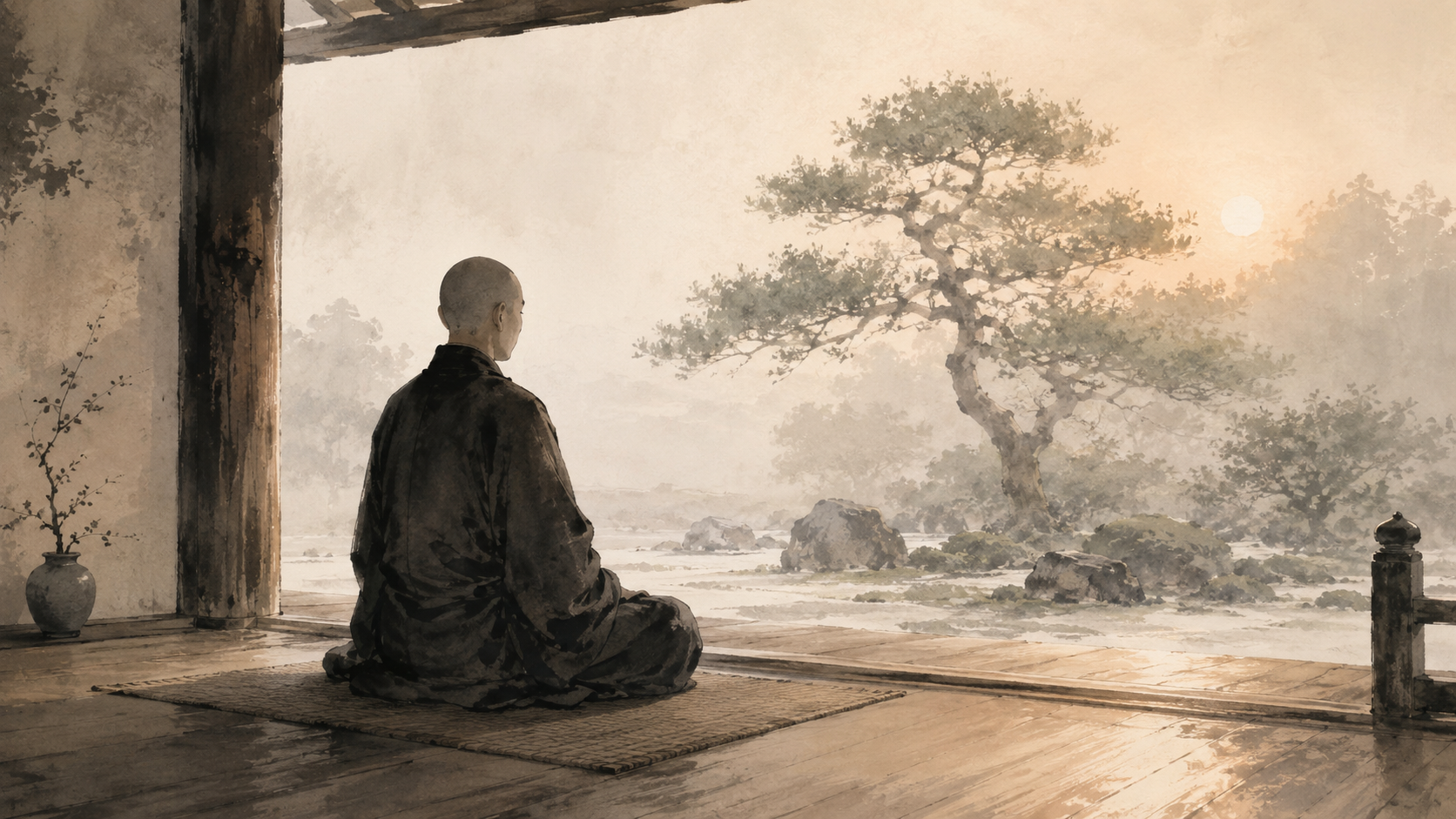
There are certain words in Zen that should be handled carefully, almost as one would handle a candle flame in a dark room. Kensho and satori are such words. They are beautiful words, powerful words, and easily misunderstood words. They point toward awakening, but they can also become distractions if we turn them into objects of ambition.
It is tempting to speak of enlightenment as though it were a distant mountain peak, something rare and shining that only a few extraordinary people ever reach. It is also tempting to speak of it as though it were a possession, an experience one can acquire, display, and keep. But the Way is subtler than this. What Zen points toward is not somewhere else. It is not hidden in another world. It is not reserved for saints, monks, scholars, or people with perfect lives. It is here.
And yet, though it is here, we do not usually see it. We live as if separated from life, as if we are small selves enclosed in skin, looking out at a world of separate things. We chase what we desire, resist what we fear, defend what we imagine ourselves to be, and suffer from the burden of this division. Then, sometimes, through practice, silence, grief, beauty, exhaustion, devotion, or simple attention, the wall becomes thin. The world does not change, but the way we have been holding it falls away. This is where words like kensho and satori begin to make sense.
What Is Kensho?
Kensho is often translated as “seeing one’s true nature.” This is a useful translation, though it can still mislead us if we think “true nature” is some hidden object inside us. Kensho is not finding a secret spiritual self behind the ordinary self. It is not discovering a glowing essence somewhere within the chest or mind. It is more like seeing, with startling simplicity, that the self we have spent so much energy defending is not what we thought it was.
This seeing is not merely intellectual. One can read books about non-self, emptiness, interdependence, Buddha nature, and suchness, and still remain untouched at the root. Concepts may prepare the ground, but kensho is not a concept. It is a direct seeing.
In ordinary consciousness, there is “me” and “the world.” There is the watcher and the watched, the subject and the object, the one who wants and the thing wanted, the one who fears and the thing feared. This division feels obvious. It feels natural. It feels like reality itself. Then, for a moment, the division may open.
A sound may simply be sound. A breath may simply be breath. A tree, a bowl, a hand, a passing face, the cry of a bird, the floor beneath the feet — each thing may appear without the old layer of grasping. There is no need to turn it into a symbol or doctrine. It is just this. Completely this. And in that seeing, the burden of the separate self becomes strangely transparent.
Nothing supernatural needs to happen. There may be no vision, no light, no voice, no dramatic emotion. In fact, one of the surprising things about such seeing is how ordinary it may be. The world remains the world. The cup remains a cup. The hand remains a hand. But the cup is no longer merely an object for “me.” The hand is no longer merely “mine.” Everything is intimate before thought divides it.
Kensho is this kind of seeing. It is seeing into the nature of things before the mind has finished making them into possessions.
What Is Satori?
Satori is usually translated as awakening or enlightenment. Sometimes it is used almost interchangeably with kensho. Sometimes kensho is used for an initial glimpse, while satori points to a deeper and more settled awakening. Different Zen teachers and traditions use these words differently, so we should not become too rigid about definitions.
Still, there is a helpful distinction. Kensho may be the seeing. Satori may be the awakening that begins to live through the seeing.
A glimpse can come suddenly. It may arrive like a door opening where one did not know there was a door. But living from that opening is another matter. The old habits of self do not always disappear at once. Fear may return. Pride may return. Anger, desire, confusion, defensiveness, sorrow, and self-concern may return. The difference is that once the dream has been seen through, even briefly, it cannot be believed in quite the same way.
This is why Zen practice does not end with insight. If anything, the need for practice becomes more obvious. Before insight, we may practice in order to become awakened. After insight, we practice because life itself is practice. Sitting is practice. Speaking is practice. Washing a bowl is practice. Caring for another person is practice. Meeting irritation without becoming it is practice. Letting go of the need to be seen as wise is practice.
Satori is not an escape from ordinary life. It is the opening of ordinary life.
Glimpses of Enlightenment
Many people have moments that might be called glimpses of enlightenment, though they may not use that language. These moments can arise in meditation, but they do not belong only to meditation. They may come while walking in the early morning, holding a dying loved one’s hand, listening to rain, sweeping a floor, sitting alone in silence, or looking into the face of another person without the usual story.
For a moment, the constant machinery of self may stop. The world is no longer arranged around “my” fear, “my” desire, “my” opinion, “my” wound, “my” achievement. There is just life, immediate and whole. Not vague, not abstract, not somewhere else. Here. This breath. This body. This sound. This moment.
Such glimpses can be profoundly important. They show us that our ordinary way of seeing is not final. They reveal that beneath the restless mind there is stillness. Beneath the defended self there is openness. Beneath the effort to possess life there is life itself.
But a glimpse is not the same as complete liberation. A window opening is not the same as living in the open air. A flash of clarity is not the same as freedom from delusion. The glimpse is real, but it must not be clung to.
This is one of the great tests. After such a moment, the mind wants to own it. It says, “I had an experience.” Then it says, “How can I get it back?” Then perhaps, more dangerously, it says, “What does this make me?” The self that briefly became transparent returns wearing spiritual robes.
Zen asks us to be very careful here. Bow to the glimpse. Be grateful. Then return to the cushion, the kitchen, the family, the work, the precepts, the silence. Do not chase yesterday’s light. Attend to this moment’s truth.
What Kensho and Satori Are Not
Kensho is not a supernatural reward. It is not a prize given to the spiritually impressive. It is not proof that one is special. In fact, any genuine seeing tends to undermine the desire to be special. The more clearly one sees, the harder it becomes to take one’s self-image seriously.
Satori is not emotional intensity. It may be accompanied by joy, tears, laughter, trembling, silence, peace, or wonder. But those are passing expressions. They are not the essence of awakening. A powerful emotional state can be beautiful and still not be insight. It can also be distracting. Zen does not measure awakening by drama.
Kensho is not dissociation. It is not spacing out, numbing out, or floating above human life. True seeing does not make the world less real. It makes the world more intimate. It does not make suffering irrelevant. It makes suffering harder to ignore. When the wall between self and other becomes thin, compassion is no longer merely an ethical ideal. It becomes the natural response of an undivided heart.
Satori is not nihilism. To see that the self is empty does not mean nothing exists or nothing matters. Emptiness does not mean blankness. It means that nothing exists as a separate, permanent, isolated thing. Everything arises in relationship. Everything is woven through causes and conditions. Because things are empty, they are not dead. They are alive, relational, flowing, and intimate.
Nor is awakening a replacement for practice. After seeing, one still must live. One must answer kindly. One must apologize. One must work. One must endure discomfort. One must keep the precepts. One must learn where old wounds still govern behavior. One must become honest about the places where insight has not yet reached.
The bowl still needs washing.
The Danger of Spiritual Possession
The ego is clever. It can make an identity out of anything, even emptiness. It can become proud of humility, attached to non-attachment, and self-important about having seen through the self.
This is why Zen teachers often warn students not to cling to experiences. It is not because insight is unimportant. It is because attachment to insight can become one of the most subtle obstacles. The moment we say, inwardly or outwardly, “I have attained something,” we should be cautious. Who is this “I”? What is it trying to hold?
There is a kind of spiritual materialism that collects experiences the way others collect titles or possessions. But awakening cannot be kept in a display case. It is not an ornament for the self. It is the falling away of the one who wants ornaments.
The real question is not, “Did I have an experience?” The real question is, “Has my life become more truthful?”
Am I less defensive? Am I more patient? Am I less cruel in thought and speech? Am I more willing to listen? Can I be corrected? Can I serve without needing recognition? Can I meet ordinary life without constantly trying to escape it?
If insight does not become compassion, humility, and ethical clarity, then it remains incomplete.
Sudden and Gradual
Zen often speaks of sudden awakening and gradual cultivation. At first, this may sound contradictory, but in practice it makes perfect sense.
Awakening is sudden because reality is not hidden in the future. One does not manufacture Buddha nature through effort. One does not assemble enlightenment piece by piece. What is true is true now. When the mind stops dividing, even briefly, the immediacy of reality is obvious.
But cultivation is gradual because our habits are deep. We may see through the illusion of self and still continue to act from it. We may glimpse openness and still contract in fear. We may understand emptiness and still cling to opinions. We may taste freedom and still be governed by old patterns.
So we continue.
This continuation is not failure. It is the Way. Practice after insight is not a lesser thing. It is how insight becomes embodied. It is how awakening descends into the hands, the voice, the eyes, the nervous system, the daily choices. It is how the glimpse becomes character.
Sudden awakening without gradual cultivation may become unstable or inflated. Gradual cultivation without openness to awakening may become dry and mechanical. Zen requires both: the lightning flash and the long rain.
Ordinary Mind and the Extraordinary Moment
One of the strange gifts of Zen is discovering that the ordinary was never merely ordinary. We pass through our lives overlooking almost everything. We think the sacred must be rare, distant, dramatic, or hidden. But the Way appears as this breath, this step, this cup, this face, this sound of traffic, this ache in the knees, this morning light on the wall.
Before practice, a tree is just a tree. During practice, perhaps the tree becomes a symbol, a teaching, an object of meditation. Then, in clearer seeing, the tree is simply a tree again — but now there is no “just” about it.
The ordinary is not opposed to awakening. The ordinary is where awakening flowers.
This is why Zen gives such attention to simple things: sitting, walking, bowing, chanting, sweeping, cooking, eating, breathing. These are not preliminary practices we discard once something profound happens. They are the very field of awakening. If one cannot find the Way while washing a cup, where else will it be found?
The extraordinary moment is not the one in which the world becomes magical in the usual sense. It is the moment in which nothing needs to be added.
The Ethical Meaning of Awakening
Any true discussion of kensho or satori must return to ethics. Without ethics, awakening-talk becomes dangerous. It becomes too easy to excuse arrogance, harm, manipulation, or indifference in the name of spiritual insight.
To see clearly should make us more responsible, not less. If the self is not separate in the way we imagined, then the suffering of others is not distant from us. If all things arise in relationship, then every action matters. If emptiness is real, then our fixed judgments, grudges, and identities deserve to be softened.
Wisdom and compassion are not two separate attainments. They are two sides of the same opening. When the illusion of separateness weakens, compassion is no longer something we force ourselves to perform. It becomes a more natural movement of life responding to life.
This does not mean we become sentimental or passive. Compassion may be gentle, but it may also be firm. It may comfort, but it may also set boundaries. It may forgive, but it does not require pretending harm is harmless. Awakening is not vagueness. It is intimacy with reality, and reality includes consequence.
A person who has seen even a little should become more careful with speech, more honest about motive, more willing to repair harm, and less interested in being admired.
Practice After the Glimpse
What should one do after a glimpse? Do not make too much of it. Do not make too little of it.
If you dismiss it entirely, you may miss the invitation. If you cling to it, you may turn it into another chain. Receive it, bow to it, and continue. Sit again. Return to the breath. Return to posture. Return to silence. Return to the precepts. Return to the people nearest you. Return to the work you do not feel like doing. Return to the dishes. Return to the difficult conversation. Return to the body. Do not try to recover the past moment. The desire to recreate a spiritual experience is still desire. Yesterday’s clarity is not today’s practice. The gate opens only here.
Let the glimpse make you humble. If you have seen even a little, then you know the Dharma is vast. You know that words fail. You know that pride is absurd. You know that the most ordinary person, object, or moment may reveal more than a thousand explanations.
And if no glimpse has come, do not despair. Sit sincerely. Live ethically. Pay attention. Stop running from silence. Let the body become still. Let the breath become simple. Let the mind exhaust its need to possess everything. The Way is not absent because you have not named it. The moon is reflected even in water that does not know the word “moon.”
Conclusion: The Gate Opens Here
Kensho and satori are not myths, but neither are they trophies. They point to the real possibility of awakening: seeing directly into the nature of self and reality. Yet Zen insists that such seeing must be lived. A glimpse is precious, but it is not the whole path. An opening is not the same as complete freedom.
Enlightenment is not escape from the world. It is intimacy with the world. It is not becoming special. It is becoming simple. It is not floating above suffering. It is meeting suffering with wisdom and compassion.
The gate of awakening does not open somewhere else. It opens here.
In this breath.
In this body.
In this silence.
In this work.
In this relationship.
In this moment.
Kensho may be the sudden seeing of that truth. Satori may be its deep awakening. Practice is learning to live it until nothing is left outside the Way.