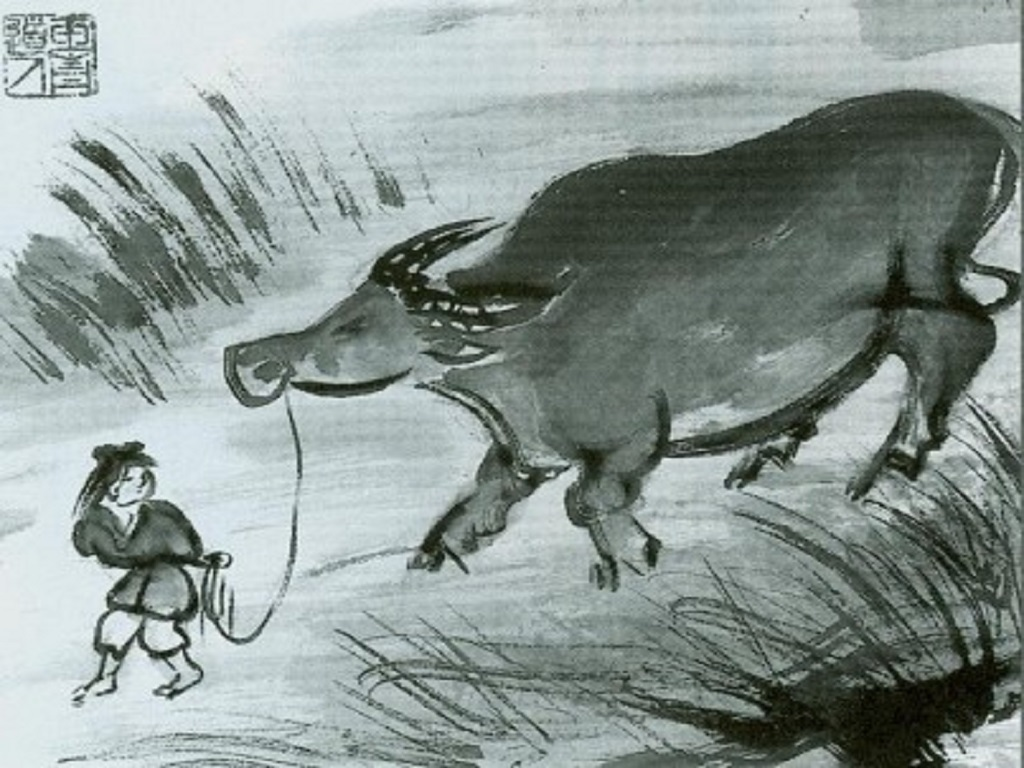
Zen likes to say there is nothing to attain. Just sit. Just this. And yet, anyone who has actually tried to practice knows how quickly the mind turns “just this” into a thousand other things: plans, regrets, old wounds, new cravings, spiritual ambitions, private disappointments. So Zen, in its very practical compassion, has always used stories and images, simple enough to remember, deep enough to grow with, to help us recognize ourselves without turning the path into a theory.
The Ten Oxherding Pictures are one of the most beloved of these teaching mirrors. They are a small sequence of scenes, often accompanied by short poems, showing a herdboy searching for, finding, and learning to live with an ox. The ox stands for the mind, for our true nature, for the raw energy of life itself, stubborn, magnificent, sometimes destructive, sometimes strangely gentle. The boy is the practitioner: not a saint, not a philosopher, just a human being who has realized that something is off and cannot be ignored anymore.
Where the pictures came from, and why they spread
Long before the “ten” pictures were standardized, Chan teachers in China were already using the image of the ox and the herdboy to talk about the path, because it is a picture that ordinary people understand in their bones. An untamed animal doesn’t become tame through a single clever idea. It becomes tame through time, patience, intimacy, and steady return. Likewise, the mind does not settle because we scold it. It settles because we learn how to meet it without flinching.
Over time, several different sequences circulated, some shorter, some longer, some emphasizing purification and gradual refinement. The best-known ten-picture set is commonly associated with the twelfth-century Chan master Kuoan Shiyuan (Kakuan in Japanese), and his version became especially influential in later Chan and Zen settings. It traveled, was recopied, re-illustrated, and taught in monasteries and lay communities alike, eventually becoming one of those “shared languages” across Zen: a way of speaking about practice that is intimate, humane, and hard to fake.
But Zen never offered these images as a ladder to climb while looking down at others. Their purpose was always more modest and more piercing: Here is what the path tends to feel like. Here is how we get lost. Here is how we come home. And here is the point we often miss—practice does not end in a private spiritual hideout. It returns to the world.
How Zen uses them
In a Zen community, the Ten Oxherding Pictures might show up in a dharma talk, a retreat theme, a set of scrolls on a wall, or a quiet conversation between teacher and student. They function less like a map with mile markers and more like a mirror you hold up at different moments in your life. You don’t use them to declare, “I’m on picture seven.” You use them to ask, honestly, “What am I doing right now? Am I searching? Am I clinging? Am I trying to control? Am I hiding in emptiness? Am I returning?”
And that last question matters, because the series does not end with mystical fireworks. It ends with the marketplace, ordinary life, because Zen insists that realization ripens as kindness, as steadiness, as a willingness to be in the world without being captured by it.
The picture story
1) Searching for the Ox
It begins the way many awakenings begin: not with certainty, but with a kind of quiet dissatisfaction. You can’t quite explain it. Your life may look fine from the outside. You may be competent, loved, respected, successful. And still there is a feeling, like a low hum in the walls, that something essential is missing, or scattered, or untrusted. So you begin to look. You read. You visit temples. You try meditation. You chase something you can’t name. This is not failure; it is the first honest movement of the heart.
2) Seeing the Traces
Then, one day, you find footprints. Something in a teaching lands cleanly. A moment of stillness appears in the middle of your usual noise. You catch yourself reacting and, for once, you don’t fully obey it. You can’t yet say you’ve “found” anything, but you have evidence now, small signs that the mind is not an unchangeable prison. The path has a scent. There are traces in the grass.
3) Seeing the Ox
Eventually, the ox itself appears. Not as a concept, not as a spiritual idea, but as a direct recognition: Oh. This is it. Sometimes it’s dramatic, sometimes it’s almost disappointingly simple. The world looks the same, and yet you can feel a shift in how you meet it. The present moment stops being theoretical. You see the mind more clearly, its patterns, its speed, its hunger, its fear, and you also glimpse something underneath that is wide, quiet, and not owned by your stories.
4) Catching the Ox
But the ox does not politely walk into your life and lie down. Insight does not erase habit. So now the work becomes real: you catch the ox. This doesn’t mean domination. It means you stop pretending the mind will train itself. You sit even when you don’t feel like sitting. You return even after you’ve drifted. You learn how quickly you rationalize. You discover how much of your “self” is just momentum. This stage can feel like struggle because it is the first time you’re no longer romanticizing the path.
5) Taming the Ox
With time, something changes. The struggle softens, not because the mind becomes perfect, but because you stop being shocked by it. You learn its seasons. You learn how to guide it without cruelty. You begin to recognize craving as craving, anger as anger, fear as fear, without needing to become them. The ox still has power, still has muscle, still has instincts—but it begins to cooperate. There is a growing sense that this life can be lived from steadiness rather than reaction.
6) Riding the Ox Home
Then comes a kind of ease. Practice starts to carry you. You’re no longer wrestling your mind every minute; you’re living with it. The boy rides the ox, and there is music in the scene because something has harmonized. This is not the bliss of escaping life, it is the relief of no longer being at war with it. “Home” here is not a special place. It is this body, this breath, this moment, returned to again and again.
7) The Ox Forgotten, the Person Remains
At a certain point, the ox as a symbol becomes less necessary. The practitioner no longer needs an object called “awakening” to chase. There is less division between seeker and sought. Practice is not something you do as much as something you live. And still, Zen is careful here, because this is also where spiritual pride loves to grow: “I’ve got it now.” The pictures keep going precisely because Zen refuses to let you stop at a subtle self-congratulation.
8) Both Ox and Person Forgotten
Now even the practitioner falls away. No ox. No herdboy. No one achieving anything. Often this is depicted as an empty circle: the great Zen image for emptiness, suchness, the dropping away of subject and object. It is not a blank void. It is freedom from the compulsive habit of turning reality into “me” and “mine.” And yet even here the teaching whispers: don’t make a home out of emptiness. Don’t build a shrine to silence.
9) Returning to the Source
So the world returns, clean and vivid, without your grip around it. Mountains are mountains again. Rivers are rivers again. But now they are not “other.” They are intimate. This stage is sometimes described as returning to the source, but it doesn’t mean going backward. It means meeting things as they are before your opinions harden into barriers. There is a naturalness here: reality just doing reality, and you no longer needing to stand apart from it.
10) Entering the Marketplace with Helping Hands
And finally, the last picture: the marketplace. Ordinary people. Ordinary life. Noise, commerce, laughter, suffering, need. The practitioner returns there, not as a perfected holy person, but as someone unafraid to be human. In many versions, the figure is relaxed, smiling, even a little comic, because the end of the path is not grim seriousness. The end of the path is freedom that can mingle.
This is where Zen makes its final insistence: if your realization cannot show up as compassion, patience, generosity, and presence, then it has not fully ripened. Awakening is not an achievement you hoard. It is something that flows into your life until your life begins to feed others, sometimes through words, sometimes through action, often through nothing more exotic than being steady and kind when the world is unsteady.
Why these pictures still matter
The Ten Oxherding Pictures endure because they refuse to lie to us. They acknowledge the longing that starts practice, the confusion that complicates it, the discipline that steadies it, and the temptation to turn even emptiness into a hiding place. And they offer a conclusion that is both ordinary and demanding: return to the world. Let your practice become your hands. Let it become your listening. Let it become how you treat the person in front of you.
If you want to work with them gently, you don’t have to “place yourself” on a stage. Just let one picture hover in the background of your week and ask, without judgment: Where am I searching? Where am I controlling? Where am I hiding? And what would it mean, today, to walk back into the marketplace with an open hand?