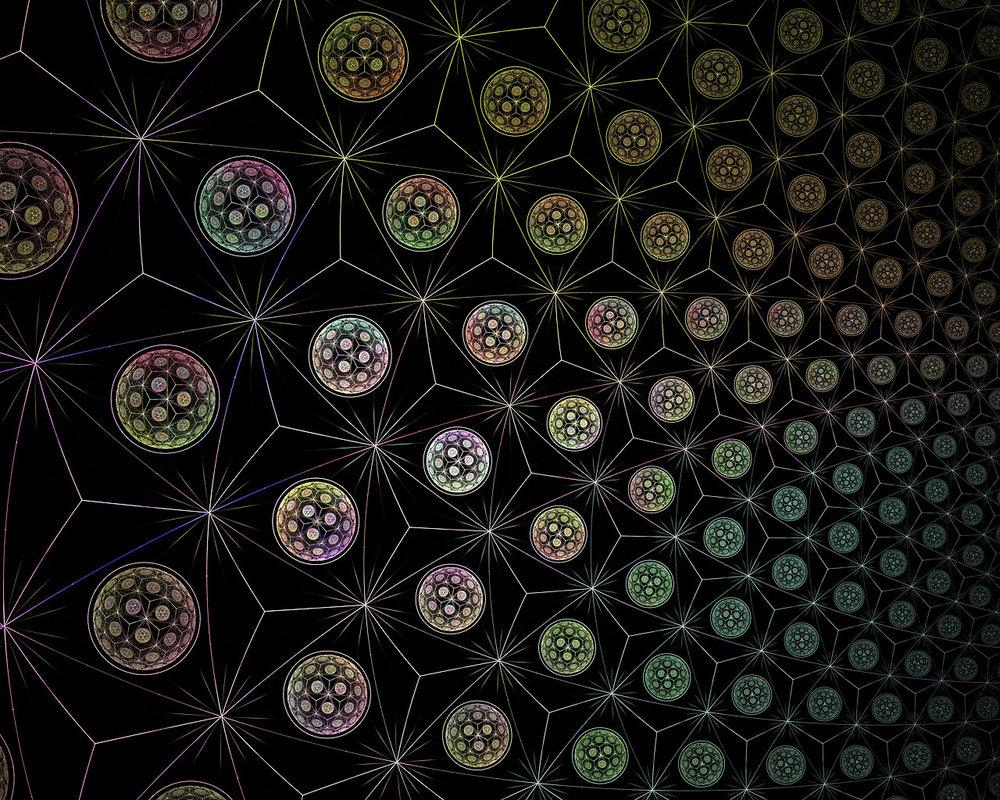
Indra’s Net is one of those images that, once it really lands, you start seeing it everywhere. It comes to us from the great Mahayana imagination, especially the Avatamsaka (Flower Garland) world, where reality is not pictured as a set of separate things bumping into each other, but as a single boundless field of relationship. The metaphor is simple: imagine an infinite net stretched across the cosmos. At every knot of the net there is a jewel, perfectly clear, perfectly faceted. Each jewel reflects all the other jewels, and in each reflection you can see every jewel again, and again—reflections within reflections without end. Nothing stands alone. Nothing is merely itself. Everything is what it is only by being woven into everything else.
At first glance it can sound like poetry. But it’s more than a pretty thought. It’s a way of pointing to what Buddhist practice keeps revealing: that the “separate self” we defend, fear for, promote, and grieve over is not as solid as it feels. We are real, yes, but we are not isolated. We are not self-made. We are not self-contained. We are not independent entities floating through an empty universe. We are contingent, relational, and permeable. We arise because countless conditions arise. We continue because countless conditions continue. We change because everything changes. The jewel shines because the net holds it; the jewel reflects because the other jewels are there to be reflected.
In Zen, we can sometimes reduce “interdependence” to a pleasant slogan. Indra’s Net won’t let us do that. It pushes the teaching beyond “everything is connected” into something stranger and more intimate: everything interpenetrates. Not in a mystical way that ignores ordinary cause and effect, but in the very ordinary way that makes your life impossible to separate from air, water, food, language, culture, teachers, ancestors, microbes, strangers, and the long chain of decisions—wise and foolish—that brought this moment into being. Your breath is not “yours.” Your thoughts are not purely “yours.” Even the sense of being “you” is conditioned and supported, arising within a web you didn’t choose and can’t fully control.
And yet Indra’s Net is not meant to make you feel small or helpless. It’s meant to correct a distortion. The distortion is the feeling that you stand apart from life, and must therefore fight it, win it, secure it, or at least manage it. In the net, there is no outside. There is no place to stand where you can finally be safe from change, from loss, from uncertainty. But there is also no place where you are truly abandoned. You are held, by conditions, by relationship, by the fact of mutual influence. Even your suffering is not private. It ripples. Even your kindness is not private. It ripples. You are always affecting the net, because you are the net in one particular place.
This is where the teaching stops being metaphysics and becomes ethics. If every jewel reflects every jewel, then what you do matters in a way that is both obvious and easy to forget. A small act of cruelty doesn’t stay small. A small act of honesty doesn’t stay small. A habit of resentment doesn’t remain safely inside your skull. It shapes your face, your voice, your choices, the atmosphere around you. It teaches other people how to treat you, and how to treat each other. In Indra’s Net, karma is not a cosmic punishment system; it is the natural consequence of being woven together. The net remembers because the net is continuous.
It also reframes compassion. Compassion is often imagined as something we “add” to life, like a virtue we cultivate so we can be nicer people. Indra’s Net suggests something more fundamental: compassion is what makes sense when you see clearly. If there is no clean boundary between “my well-being” and “your well-being,” then caring for you is not self-sacrifice in the usual sense. It’s sanity. It’s alignment with reality. When we harm others, we harm the net that holds us. When we care for others, we strengthen the net that holds us. This is not sentimental. It doesn’t mean you never set boundaries, never say no, never protect what must be protected. It means that even your boundaries can be made from wisdom rather than hatred, from clarity rather than fear.
There is also a subtle comfort in Indra’s Net that Zen practitioners sometimes need to hear. We tend to make practice into a private project: my zazen, my insight, my progress, my failure. But in the net, awakening is not a possession. It is not something you hoard. It is not even something that happens only “inside” you. To see clearly in one knot of the net is to brighten the whole net, because it changes how you speak, how you listen, how you touch the world. Your practice becomes part of the world’s practice. Your steadiness becomes part of the world’s steadiness. Your honesty becomes part of the world’s honesty. This is one reason sangha matters: not because group practice is a nice accessory, but because we are never practicing alone in the first place. Even solitary sitting is sitting in the net.
So how do we work with Indra’s Net without turning it into an idea we admire from afar? We return to the simplest thing: this moment as relationship. Notice how the world is already touching you. Sound, temperature, memory, mood, posture, light through the window, the pressure of the floor beneath you. Nothing is isolated, not even your thoughts. Then notice how you are already touching the world. Through attention. Through intention. Through the next word you speak, or the word you refuse to speak. Through the way you meet irritation. Through the way you meet desire. Through the way you meet fear. The net is not somewhere else. It is this.
Indra’s Net is a mirror held up to the modern myth of the isolated individual. It does not erase individuality; it places it where it belongs: as a unique facet within a shared reality. You are a jewel—distinct, luminous, particular. And you are also a reflection of countless jewels, and a reflector of countless jewels. When you forget this, life becomes a lonely struggle for control. When you remember it, life becomes an intimate responsibility. Not a burden—an intimacy. A reason to practice. A reason to be careful. A reason to forgive faster. A reason to bow, not because you are small, but because you are connected.
And perhaps that is the deepest point of the metaphor: the net is infinite, but it is also immediate. If you want to see it, you do not need to travel anywhere. You only need to look closely—at this life, as it actually is—until the illusion of separateness softens, and what remains is the quiet, undeniable fact of mutual belonging.