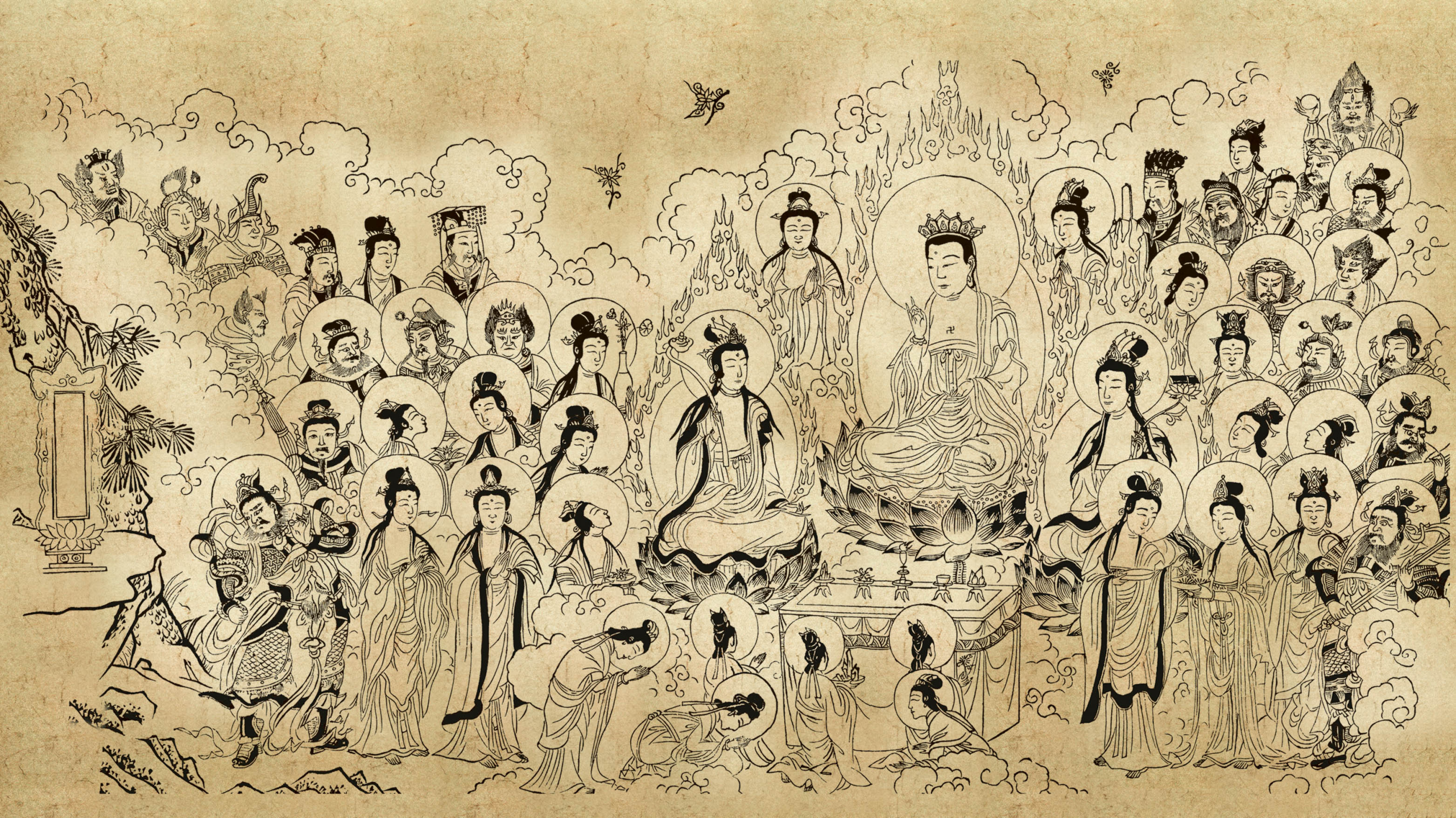
The Avatamsaka Sutra, often called the Flower Garland Sutra, is one of the great visionary texts of Mahayana Buddhism. It is not written like a simple handbook, or even like a single linear sermon. It reads more like a vast sacred landscape: shimmering images, soaring declarations, and long sequences of teaching that move from intimate mind to cosmic scale and back again. In its world, awakening is not merely a private experience inside one person’s skull. Awakening is the revelation of a whole reality, a reality in which every being and every moment is intertwined with every other. This is why Huayan Buddhism in China (and Kegon in Japan) treasured it so deeply. The sutra became a kind of scriptural home for the Huayan vision of interpenetration: the teaching that all phenomena arise together, contain one another, and reflect one another, like jewels in Indra’s Net.
The Avatamsaka also does something else that can feel almost paradoxical when you first meet it. It speaks as if buddhahood is immediate—here, now, not waiting at the end of time—and at the same time it describes the bodhisattva path as an enormous unfolding of training and maturation. It refuses to let you choose only one side. If you only hear “awakening is already here,” you may become vague, casual, or spiritually lazy. If you only hear “the path is long,” you may become anxious, striving, and quietly self-centered. The Avatamsaka refuses both distortions. It gives you a way to practice with a heart that is both settled and alive, both confident and humble, both intimate and vast.
One of the most widely used ways to hold this teaching is the map of fifty-two stages of the bodhisattva path. Within that map, the Ten Grounds—the ten bhumis—stand like a bright spine running through the later half of the journey. But in the Avatamsaka spirit, these are not meant to become a scoreboard. They are meant to become a mirror. They are a way of describing what it looks like when compassion and wisdom stop being something you “try” to do and start being what your life naturally expresses. They are also a way of protecting you from two common mistakes: confusing inspiration for realization, and confusing realization for the end of practice.
The journey begins where all real journeys begin: with a turning. In the language of the Ten Faiths, the first movement is not intellectual agreement. It is the moment your heart actually leans toward the Dharma. It is the moment you stop treating practice like a hobby and start treating it like a vow. At first this faith can be fragile, not because it is false, but because it is new. It is like a small flame you have to shield from the wind. So the next maturation is mindfulness, not as a technique but as a kind of fidelity—returning again and again, remembering again and again what you are doing here. From mindfulness comes diligence, the quiet decision to continue even when you do not feel inspired. This is where practice becomes real, because it becomes ordinary. From that steadiness arises a settling of mind, a stability that is not stiff, and from that stability the beginnings of wisdom. Wisdom here is not a philosophy you can recite; it is a growing ability to see clearly what leads to suffering and what leads to freedom, what is grasping and what is release.
As the mind clarifies, something else begins to change: ethics stops feeling like a set of external rules and starts feeling like a natural expression of clarity. You begin to sense that unskillful actions are not “sins” so much as forms of confusion, ways the mind injures itself and others by acting from contraction. And as ethics matures, the heart starts to widen. You begin to dedicate what is good outward rather than hoarding it inward. This is subtle at first. It may show up as a small shift: you practice not only for your own relief, but because you do not want to add harm to the world. That outward turn grows into a protective tenderness toward the Dharma itself: you start to care that what is good in you is protected, and you start to care that what is good in the world is protected. You become less interested in spiritual entertainment and more interested in what actually works. Eventually, faith ripens into letting go, into a loosening of the tight grip around identity and outcomes, and then into aspiration, into vow. At that point, “faith” has completed its transformation. It is no longer merely trust. It is direction.
From there the path becomes a kind of dwelling. The Ten Abodes are a way of saying that bodhicitta, the wish to awaken for the benefit of beings, stops being something you visit and starts being something you live in. You begin by arousing the mind of awakening again and again, because the mind does not stay aroused by itself. Then you begin to put your life in order around that aspiration. This is where the Avatamsaka becomes extremely practical, even if its imagery is cosmic. You cannot “live” the bodhisattva vow if your life is a chaos of half-promises and scattered attention. So you begin to practice in a way that is not merely occasional. Practice becomes patterned, structured, a real part of how you live. As that becomes steady, the sutra tradition describes it as a kind of rebirth. Something in you has changed direction. You still have the same personality, the same history, the same old habits that need working with, but the axis of your life is shifting.
As the abodes mature, skillful means appears. At first, many of us only know one way to be “good”: we try to be kind in the way we wish others were kind to us. But beings are different. Needs are different. Conditions are different. Skillful means is compassion that learns to be intelligent, flexible, and responsive. Alongside this, the mind is rectified, not made perfect, but made more upright, less self-deceiving, less slippery. Here the texts speak of non-retrogression, the sense that the path is becoming irreversible. It is not that you never struggle again. It is that something deeper than struggle has taken root. The later abodes use tender images: childlike goodness, prince of truth, coronation. They are not praising innocence in a naive sense; they are describing a heart that has grown clean and direct again, a heart that can meet reality without so much armor. The coronation image points to empowerment. Something in you is now entrusted with responsibility. The vow is not a private dream. It is becoming a public life.
Then practice begins to show its hands and feet. The Ten Practices are the maturation of conduct, not as moral performance, but as the natural outflow of an awakened direction. At first there is joy, not the excitement of novelty but the joy of congruence, the joy of living in alignment with what you know to be true. From joy grows beneficial action, the quiet habit of doing what helps rather than what harms. The mind begins to feel less obstructed. You start to notice, in real time, when you are about to speak from irritation, when you are about to act from fear, when you are about to withdraw from discomfort. And sometimes, because you notice, you do not do it. That is what unobstructed begins to mean: you are less compelled. The practice becomes unwavering. Not rigid, unwavering. The difference matters. Rigid practice is brittle and self-righteous. Unwavering practice is steady and humane.
As steadiness grows, confusion thins. Not all confusion. Not the ordinary complexity of life. But the particular confusion that comes from not seeing your own mind. You become more familiar with the movements of craving and aversion, and because you see them sooner, they do not carry you as far. Virtue becomes attractive, not in the sense of being charismatic, but in the sense that it draws beings because it feels safe. Some people will naturally feel calmer around you. That is a sign, not of special attainment, but of reduced harm. Unattachment begins to appear. You can care without clinging, help without controlling, speak truth without needing to win. You discover that genuine compassion is sometimes soft and sometimes fierce, sometimes patient and sometimes direct, but it is always less about you. The later practices speak of what is hard-won and exemplary and true. This is not about becoming a saint in a storybook. It is about becoming a person whose inner life and outer life are not divided into two separate worlds.
And then the path takes a turn that many practitioners, especially those who have been quietly using practice to build a better self-image, find surprisingly challenging. The Ten Dedications are a training in giving the whole project away. They teach you how to stop owning your goodness. They teach you how to stop treating merit like property. They teach you how to release the subtle pride of being “a practitioner.” You begin by dedicating yourself to saving beings while simultaneously loosening your fixation on beings. This is classic Mahayana: you vow to liberate all beings, and you also learn that “beings” are not fixed entities you can possess, categorize, or complete like a task. You practice not destroying distinctions while realizing their emptiness. You learn to live in a world of names and forms without getting trapped by them. You begin to align yourself with the buddhas, not as a comparison game but as a shared direction. You honor the buddhas, not merely with ritual but by living in a way that respects the Dharma.
As dedication deepens, you begin to experience merit as inexhaustible precisely because you stop treating it as scarce. When you hoard virtue, you fear losing it. When you offer it, it multiplies. You enter non-differentiation not as an abstraction but as a lived loosening of favoritism, less “my people” and “not my people,” less “worthy” and “unworthy.” You begin to treat beings as equally deserving, not because you feel the same about everyone, but because you understand that preference is not the measure of compassion. Dedication aligned with suchness is dedication that is not sentimental. It is dedication rooted in reality as it is, including suffering as it is. The later dedications speak of liberation without bondage and of entering the infinite Dharma realm. This is not escapism. It is the widening of the mind until it can include without drowning, until it can meet suffering without collapsing, until it can act without being bound by results.
When the path ripens through these dedications, the Ten Grounds come into view not as titles but as descriptions of mature bodhisattva life. The first ground is called Very Joyous, and it points to a joy that is not dependent on comfort. It is the joy of real entry. Something has crossed a threshold. The vow is no longer theoretical. The insight is no longer merely conceptual. The bodhisattva begins to move with a kind of clean happiness that comes from direction. The second ground, Stainless, speaks to purity. Here purity does not mean being morally spotless in a performative way. It means the mind is less willing to cooperate with self-deception. The stains of gross harm become harder to carry. The bodhisattva still faces difficulty, still encounters afflictions, but there is a strong impulse toward integrity that is increasingly natural.
The third ground, Light-Maker, is where wisdom begins to illumine everything. There is a sense that the Dharma is no longer only something you “apply” during meditation; it becomes a light through which your whole life is seen. The fourth ground, Radiant or Blazing, is often described with the imagery of fire. Wisdom becomes a steady burning that consumes what is false and clung to, not as punishment but as purification. This is where practice can feel intense, not because life becomes dramatic, but because subtler layers of attachment become visible. When the gross knots loosen, you begin to find the fine threads.
The fifth ground, Difficult to Conquer, speaks of a strength that is not aggressive. It is the strength of perseverance, the strength of steadiness. The bodhisattva becomes harder to knock off course. Praise and blame have less power. Comfort and discomfort have less power. This is not numbness. It is freedom. The sixth ground, Manifest or Face-to-Face, points to a directness in the encounter with reality. The mind is less mediated by stories. Suchness is less of an idea and more of an intimacy. The bodhisattva meets the world with fewer filters, and because of that, compassion becomes less self-conscious. It is easier to respond, easier to be present, easier to act without delay.
The seventh ground, Gone Afar, is the widening of range. The bodhisattva’s compassion is less provincial. The mind is less trapped in narrow frameworks. “Afar” here is not simply distance in space; it is distance from the small self’s limitations. The bodhisattva becomes capable of entering many worlds, many kinds of suffering, many kinds of beings, without losing the root. The eighth ground, Immovable, is one of the great markers in Mahayana maps: profound non-retrogression. The bodhisattva is steady in a way that does not depend on conditions. Even strong winds do not uproot the vow. This does not mean the bodhisattva never feels pain. It means pain does not overturn the direction of the heart.
The ninth ground, Good Intelligence, is where wisdom becomes exquisitely skillful. The bodhisattva understands beings more deeply and can meet them with the appropriate medicine. This is not cleverness. It is responsiveness born from intimacy with reality. And the tenth ground, Dharma Cloud, is a beautiful image to end the series. A cloud does not choose which field deserves rain. It simply rains. The bodhisattva’s activity becomes nourishing, broad, impartial. Compassion is no longer something the bodhisattva “does.” It becomes what the bodhisattva is like. It falls like rain on the world.
After the ten grounds, the map offers two culminating stages: Equal Enlightenment and Marvelous Enlightenment. Equal Enlightenment describes a bodhisattva so mature that they are, in a sense, equal to the buddhas, with only the faintest remainder of ignorance to be released. Marvelous Enlightenment is full buddhahood. And yet, in the Avatamsaka spirit, even this completion is not treated as a personal endpoint. It is treated as complete integration: wisdom and compassion unobstructed, benefiting beings without preference, without fatigue, without self.
If you are reading all of this and thinking, “What does any of this have to do with my life, my messy mind, my ordinary day?” then you are asking exactly the right question. The Avatamsaka is not asking you to cosplay cosmic sainthood. It is asking you to practice in a way that is both grounded and vast. The way to hold the fifty-two stages is not to decide where you rank. It is to recognize what is ripening in you right now. Some days the work is faith: returning, remembering, starting again. Some seasons the work is abiding: making the vow your home, ordering your life so practice can actually happen. Some periods the work is practice in the most literal sense: learning to speak kindly, to act beneficially, to remain steady when you are provoked. And again and again, the work is dedication: giving away the fruits so you do not turn the path into a private possession.
This is how the Avatamsaka makes a map feel like a living path. It reminds you that the whole of awakening is not elsewhere, and it also reminds you that your life is the place where awakening must mature. It gives you permission to be patient without becoming complacent, and it gives you permission to feel the completeness of this moment without abandoning the discipline of training. In that balance, the bodhisattva path stops being a distant ideal and becomes what it was always meant to be: the steady, luminous work of becoming a person who harms less, sees more clearly, loves more widely, and gives it all away.