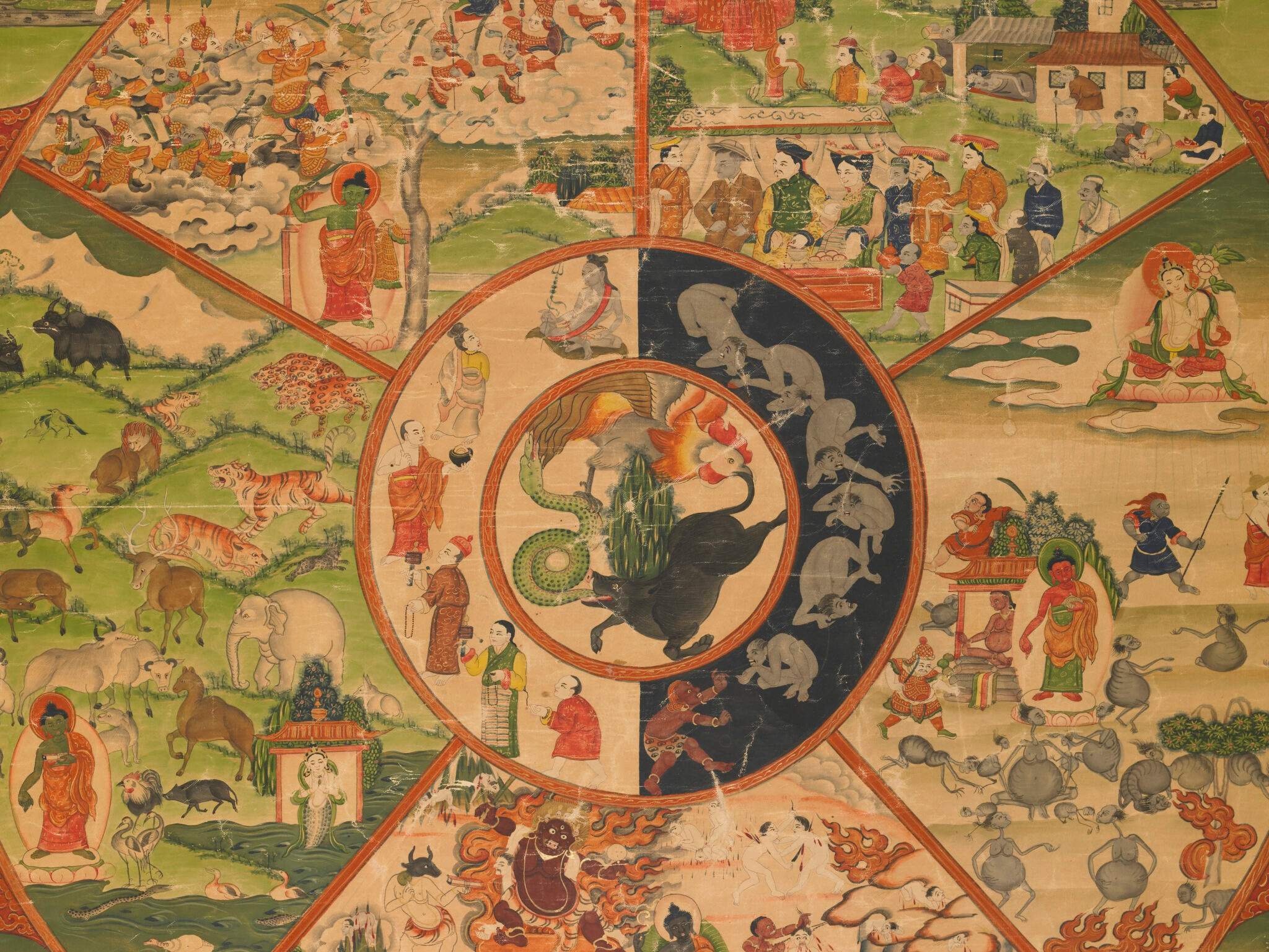
Buddhist cosmology can feel like an awkward inheritance. Many of us come to practice through the door of mindfulness, ethics, and meditation, and then—somewhere along the way—we meet the old maps: heavens stacked above heavens, hells layered beneath hells, hungry ghosts wandering in thirst, jealous gods locked in rivalry, demons and temptations, rebirth moving the whole wheel forward without end. If you were raised in a modern, secular frame, you may feel a quiet tension: Do I have to believe this? Is Buddhism asking me to accept a literal universe I can’t reconcile—or is it speaking in symbols?
It helps to start with a softer, kinder truth: Buddhism has never been a single voice about this. It is a tradition with deep roots, many climates, and more than one way of teaching what is, in the end, a single aim—liberation from suffering and the flowering of compassion. Cosmology is part of that teaching, and like everything in the dharma, it is meant to serve awakening rather than replace it.
In the earliest Buddhist texts, cosmological language is not presented as decorative poetry. The Buddha speaks of realms and rebirth as normal features of saṃsara, and these appear not only as background assumptions but as direct teaching material: accounts of beings reborn in painful states, or in radiant heavenly states, or in human life where practice is possible. The Devaduta Sutta (MN 130) is one of the clearest examples, with its vivid portrayal of suffering and moral causality, including the figure of Yama questioning beings who have fallen into torment. The Saṃyutta Nikaya likewise preserves many discourses in which devas appear, speak, and sometimes offer verses or questions, reminding us that early Buddhism did not shy away from a populated cosmos. Later Theravada tradition systematizes this into more explicit “planes” or “realms” of existence—often summarized as “31 planes”—emphasizing a point that is easy to miss: even the highest heavens are impermanent, and even the deepest hells are not eternal. Saṃsāra has many rooms, but none of them are forever homes.
If we stop there, the conclusion seems simple: these realms are “real.” And for many Buddhists across history and into the present—especially in traditional Theravada settings, and in much of Tibetan Buddhism—this is essentially the lived understanding. Cosmology is part of how the moral world works, part of how karma and rebirth are spoken about, part of the larger story of why practice matters.
And yet, if we listen carefully, something else is also happening—something the tradition has been doing for a long time, and something Zen in particular makes hard to ignore. Buddhism consistently points out that the world we live in is not merely “out there.” Our experience is shaped, moment by moment, by conditions: perception, intention, craving, aversion, confusion, clarity, generosity, love. This is not a denial of external reality; it is a deep insistence that the world we inhabit is co-created by mind and action. Dependent arising is not only about metaphysics; it is about how realities form.
This is where the “symbolic” reading enters—not as a modern escape hatch, but as a natural extension of Buddhist psychology. When teachers speak of the “six realms” as states of mind, they’re not merely modernizing Buddhism. They’re pointing to a practical truth: hell is not only a place you might fear after death; it is also the way anger and despair can become an atmosphere you breathe. Hungry ghost is not only a mythic being with a needle-thin throat; it is also the shape of compulsive craving. Asura is not only a warlike realm; it is also the mind that can’t stop comparing, competing, and resenting. Even contemporary psychology-oriented reflections on the “six realms of the mind” show how readily the ancient map overlays our inner life. And Zen teachers frequently emphasize that this is not abstract: you can watch realms arise and pass during a single day of ordinary living.
So are the heavens and hells real, or symbolic?
A mature Buddhist answer is: both, and not in a confused way. They can be real as realms of rebirth within saṃsara, and symbolic as descriptions of how mind and karma create lived worlds. Buddhism does not require us to choose a single flat register. It is quite capable of teaching on multiple levels at once—ethical, psychological, and cosmological—because suffering itself operates on multiple levels at once.
This is also where we have to clarify a word that often misleads: “reincarnation.” In much Western usage, reincarnation implies a soul-substance that departs one body and enters another, carrying a personal essence intact. Classical Buddhism is careful to deny that kind of permanent self (atman). The continuity it teaches is causal, not substantial: patterns of intention and action (karma), conditioned tendencies, and the ongoing chain of dependent arising. There is continuity—real continuity—but not the continuity of an unchanging thing. Contemporary philosophical discussions of Buddhism often frame this as “rebirth without transmigration,” stressing that karma and rebirth are not logically inconsistent with non-self. In other words, Buddhism asks us to see that the stream continues, while refusing to reify the stream into an immortal “me.”
Zen inherits all of this, but it tends to press our attention toward the immediate question: What does this mean for practice right now? This is not a refusal of metaphysics so much as an insistence that metaphysics must become intimate. If cosmology remains a set of distant claims—either believed dogmatically or dismissed with a shrug—it has not yet done its work on us.
This is where Dogen becomes a startlingly good guide, because he refuses the comfortable extremes.
Dogen is often quoted for a line that can sound almost scandalous if taken lightly: “Just understand that life-and-death is itself nirvana.” In the fascicle Shoji (“Life-and-Death”), and in related teachings, he aims the sword directly at a deeply human habit: seeking awakening as an elsewhere, a future state, a separate realm beyond the mess of living. He speaks as if the attempt to find Buddha outside the conditions of our life is itself the very mechanism by which we remain bound. This isn’t meant to be mystical comfort. It’s meant to be a correction. If we imagine nirvana as “over there,” we inevitably treat the present moment as a problem—something to endure until the real spiritual life begins.
Dogen’s teaching, at its sharpest, is that the place you are trying to escape is the very place where the gate stands.
And he takes this further in a way that is easy to overlook: he insists that life and death are not a single substance changing form, but distinct “periods,” whole moments unto themselves—like winter and spring. The point is not to build a theory of time. The point is to stop turning your life into a hallway. Stop postponing intimacy with reality.
If Dogen only said this, it would be easy to fold his Zen into a kind of spiritual poetry: “Everything is Buddha,” “Everything is nirvana,” “Don’t worry about consequences.” But Dogen does not allow that. He is relentless about karma and cause-and-effect, and he is particularly harsh toward the Zen tendency—ancient and modern—to use emptiness as a way to dismiss moral responsibility.
In the Soto Zen tradition’s own reference writing on Jinshin Inga (“Deep Faith in Cause and Effect”), Dogen is presented as warning that it is dangerous to rely on slogans like “karmic hindrance is empty” while forgetting the law of karma itself. He returns to the famous koan of “Baizhang’s Wild Fox,” where a single wrong view—denying cause and effect—leads to long suffering, and he uses it as a direct admonition to practitioners.
Put plainly: Dogen refuses the spiritual bypass. He will not let you dodge saṃsara by metaphysical denial, and he will not let you dodge nirvana by metaphysical distance.
When you hold those two together, Buddhist cosmology begins to look less like a museum of ancient beliefs and more like a living mirror. Heaven and hell are not merely “places after death,” and they are not merely “symbols in the mind.” They are the ways worlds form—through causes, conditions, and actions—across time scales we can’t fully measure, including the scale of a single afternoon and, if you accept classical rebirth, the scale of many lifetimes.
This is also why cosmology matters ethically. If realms are merely “myth,” it becomes easy to treat karma as moral metaphor rather than moral law. If realms are treated as nothing but literal geography, it becomes easy to turn practice into fear-management: “How do I avoid punishment and get reward?” The dharma is trying to save us from both distortions. The early texts use stark imagery to wake us up to the gravity of actions. Zen uses intimate immediacy to wake us up to the present-moment construction of worlds. Neither is meant to be merely “interesting.”
If we’re honest, most of us already know these realms without believing in them. We’ve visited hell in a season of rage or grief. We’ve tasted hungry ghost in an addiction to approval, pleasure, or certainty. We’ve lived as an asura when we couldn’t stop measuring our worth against someone else’s. We’ve known the dull heaviness of the animal realm when life becomes nothing but survival and routine. We’ve also known the subtle trap of heaven—not only joy, but the kind of ease that makes us careless, the kind of comfort that whispers, “You don’t need to practice right now.”
And we’ve known the human realm: the fragile, precious place where suffering is real enough to motivate us, and clarity is possible enough to free us. In classical cosmology, that balance is one reason human birth is considered uniquely valuable for awakening.
So what do we do with all of this in contemporary Zen?
One honest approach is humility. We admit what we can know directly and what we can’t. We acknowledge that the tradition is not embarrassed to speak of rebirth and multiple realms, and that many practitioners across cultures and centuries have taken these teachings as literal features of saṃsara. We also acknowledge that Zen’s great gift is to turn cosmology into practice: to show us that the wheel is not only a future concern but a present activity.
Then we practice in a way that doesn’t require brittle certainty. You don’t have to force belief as a badge of membership, and you don’t have to force disbelief as a badge of sophistication. The question is not “What position do I hold?” but “What view leads to liberation and compassion?” Dogen’s answer, in effect, is: do not deny cause and effect, and do not seek nirvana outside life. If you can live inside those two vows—ethical responsibility and present-moment intimacy—cosmology stops being an argument and becomes a teacher.
A final word: be careful what you do with “symbolic.” Sometimes people say “it’s symbolic” when what they mean is “it doesn’t matter.” But symbols in Buddhism are not decorations; they are skillful means. They are meant to move the heart, shape conduct, and orient the mind toward freedom. The Devadūta imagery is not there to entertain; it is there to wake us up. The Zen insistence that “hell is here” is not there to dismiss the old teachings; it is there to prevent us from postponing our life.
And if you ever feel lost in the metaphysics, Dōgen gives a simple place to stand: don’t look away from your life, and don’t lie about cause and effect. Practice like your actions matter—because they do. Practice like this moment is the gate—because it is.