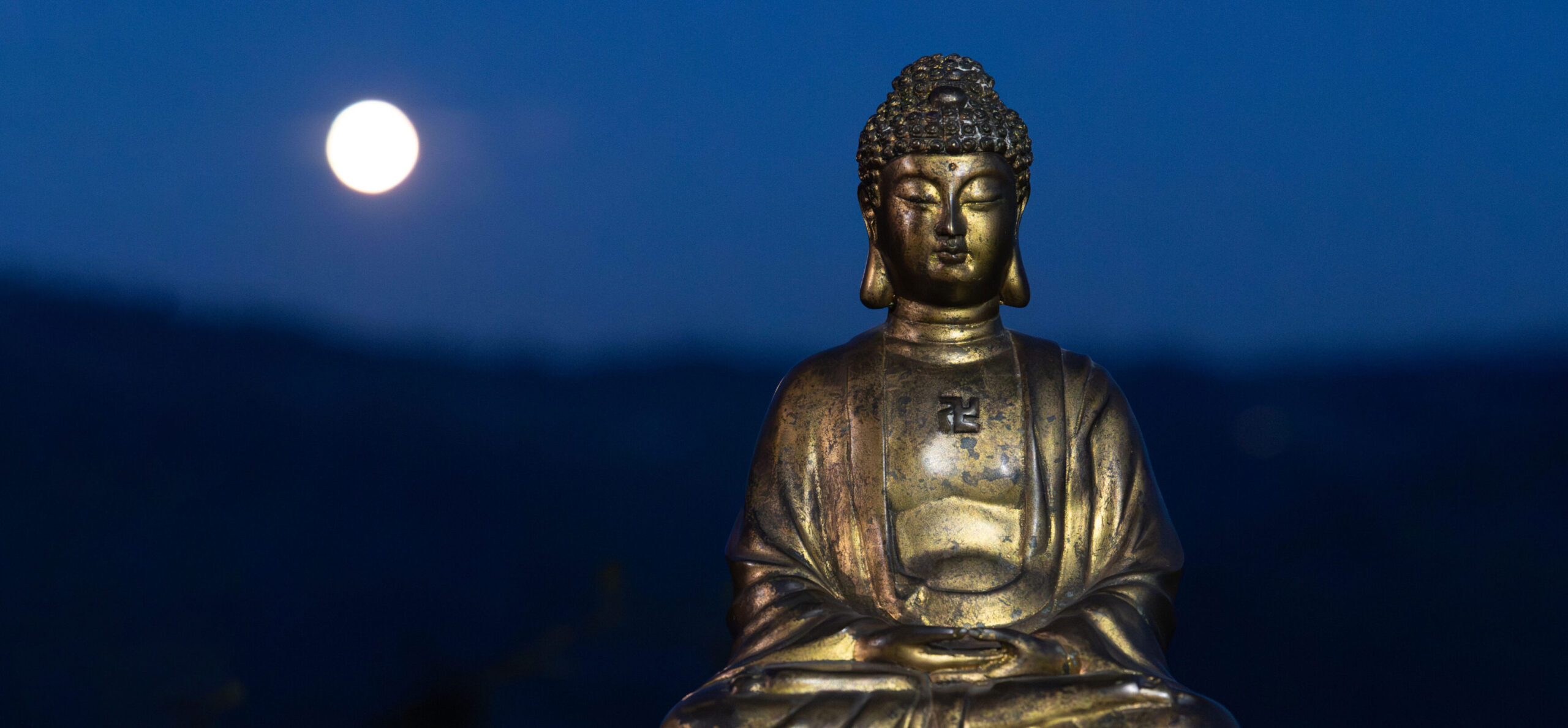
Rohatsu arrives in the Zen world the way winter arrives in the body: not as an idea, but as a change in the air. In the Northern Hemisphere it comes when the days have shortened, when the light is thin and the mornings are cold enough to make the breath visible. For many Zen communities this season carries a particular gravity, because early December is when practice turns toward one of its most concentrated forms. Rohatsu—written in Japanese as 臘八, “the eighth day of the twelfth month”—names the traditional day on which Zen practitioners commemorate the awakening of Śākyamuni Buddha. Around that commemoration, temples and practice centers often hold an extended retreat, a sesshin, in which the schedule is simplified and the act of sitting is repeated with a steadiness meant to mirror the Buddha’s own resolve beneath the Bodhi tree. If other times of year feel like practice braided into ordinary life, Rohatsu can feel like practice brought to a single point, a long night of sitting in which everything unnecessary is allowed to fall away.
Historically, the term Rohatsu points beyond Japan. Its roots reach into the broader East Asian Buddhist calendar, where the eighth day of the twelfth lunar month became associated with the Buddha’s enlightenment. In Chinese it is known as Laba, and across Mahāyāna cultures it came to function as a ritual marker of awakening—less a date to be proved in modern historical terms than a seasonal and liturgical reminder of what the path is for. When Chan Buddhism matured in China, it inherited this calendrical observance along with many other temple rhythms, and when Chan traveled to Japan and became Zen, Rohatsu entered Japanese monastic life as one of the year’s most meaningful periods of intensified practice. The word itself is a kind of compressed history: the Japanese pronunciation of characters already carrying centuries of Buddhist association, a reminder that Zen—often imagined in the modern West as pure minimalism—has always been supported by forms, ceremonies, and a ritual sense of time.
The story Rohatsu commemorates is familiar even to people who have never sat a sesshin. Siddhartha Gautama leaves the security of palace life, undertakes the severe disciplines of ascetic practice, and eventually recognizes that self-mortification is not freedom. He chooses a middle way: neither indulgence nor harm, but a steady, unromantic commitment to wakefulness. Then comes the image that has shaped Buddhist imagination for two millennia—he sits beneath a tree and vows not to rise until he sees clearly. In the long night, the mind’s strategies appear in full costume. Fear arrives. Doubt arrives. Desire arrives. Pride arrives. In later retellings they gather as Māra, the personification of everything that tries to keep awareness asleep. But the central gesture of the story is not supernatural combat. It is the simple refusal to turn away. He sits. He meets what comes. And as dawn breaks—sometimes said to be the moment he sees the morning star—he awakens.
Zen does not ask you to treat this story as a literal transcript. Zen is strangely uninterested in proving the past the way modern minds want to prove it. The story matters because it describes the interior landscape of practice with uncanny accuracy. Anyone who has tried to sit still for a sustained period knows the parade: the itch that becomes an argument, the ache that becomes a story, the boredom that becomes a demand for entertainment, the sudden flood of memory, the flare of irritation, the ache of longing, the wave of sleepiness, the restless urge to do anything other than remain where you are. Even without a mythic adversary, the mind offers endless reasons to get up. Rohatsu takes that familiar human experience and gives it a communal container. It says: for this stretch of days, we will practice as if waking up matters more than comfort, distraction, or self-justification. Not because pain is holy, but because the truth is rarely seen clearly when we are constantly negotiating with ourselves.
That container is often called sesshin, a term that in Japanese can suggest “gathering” or “collecting” the mind and heart. In practical terms, sesshin is a retreat schedule designed to support continuity. Zazen, the seated meditation at the heart of Zen, is done repeatedly through the day, often in periods of sitting followed by walking meditation, meals taken with mindfulness, simple work practice, chanting, and short periods of rest. The forms are spare, and their spareness is not aesthetic—it is functional. When the day is organized around practice, the attention begins to settle. When the attention settles, the usual strategies of avoidance become visible. Sesshin is not a special spiritual theater in which something magical is performed; it is an environment in which you can no longer pretend you do not have a mind, or that your mind is always telling the truth.
Rohatsu sesshin is traditionally one of the most intense sesshin periods of the year. In many places it runs for seven days, culminating on or near December 8. The intent is straightforward: to approximate, in community and within realistic human limits, the spirit of the Buddha’s final night. This is where Rohatsu’s reputation comes from. People speak of long sitting periods, early mornings, a severity in the schedule, and a seriousness in the atmosphere. Yet it is worth saying plainly that the best Rohatsu practice is not brute force. Zen training has never been meant to glorify injury or to confuse endurance with awakening. The body is the vehicle of practice, and harming it is not a spiritual achievement. The intensity of Rohatsu is meant to reveal something, not to break something. When it is held well, the retreat is rigorous and humane at the same time: demanding enough to strip away habits, supportive enough to keep practitioners grounded, fed, and oriented toward what truly matters.
In Sōtō Zen, Rohatsu is also shaped by a distinctive understanding of practice itself. The founder Dōgen Zenji, who brought a mature form of Chinese Chan practice back to Japan in the thirteenth century, is famous for refusing the idea that zazen is merely a technique used to attain enlightenment later. For Dōgen, practice and realization are not two separate stages. Zazen is not a ladder we climb toward some distant spiritual rooftop; it is the enactment of awakening in the posture of the present moment. This is why Sōtō practitioners speak of shikantaza, “just sitting.” The “just” does not mean casualness. It means wholeness. No gaining idea. No spiritual résumé. No attempt to manufacture a certain state of mind. Sit upright, breathe, and let the reality of this moment reveal itself without being forced into the shape you prefer.
Under that view, Rohatsu is not “the week we try to get enlightened.” It is the week we practice with fewer excuses. It is a collective reminder that the heart of Zen is not a philosophy but a discipline of attention. In the quiet repetition of sitting, the mind begins to show how it creates suffering: by clinging to pleasure, rejecting discomfort, insisting on stories, and treating thoughts as orders. Sesshin does not eliminate these patterns; it makes them clear. In doing so it also reveals something steadier than the mind’s weather: awareness that is not improved by praise and not destroyed by doubt, a ground that does not need to be manufactured because it is already present.
Rohatsu has another layer as well: it is not only a commemoration of the Buddha’s awakening, but a way of participating in that awakening as a living possibility. Zen stories often speak about the ordinariness of enlightenment, the way it arrives not as fireworks but as intimacy. In sesshin, moments of clarity can come, and sometimes they come with power. But more often Rohatsu works like water on stone. Its effect is gradual, quiet, and unmistakable over time. Resistance softens. Reactivity becomes easier to see. Attention grows steadier. Compassion arises in places where self-concern used to dominate. You begin to realize you can meet boredom without panic, pain without dramatizing it, and desire without being dragged by it. None of that is glamorous, and that is precisely why it is reliable.
This is why Rohatsu has remained so enduring within Zen culture. It is a yearly re-centering, a return to the source story not as nostalgia but as instruction. Every tradition has its way of renewing itself, of reminding practitioners that the path is real and that it must be walked with the body. Rohatsu does this by gathering people into a shared seriousness. It offers a time when the noise of ordinary life is deliberately reduced and practice is allowed to become the main event. In the West, where Zen often arrives divorced from the temple calendar that shaped it, Rohatsu has become one of the clearest ways communities reconnect with Zen’s traditional rhythm. Even when schedules are adapted to modern lives—shorter retreats, home practice commitments, modified sitting periods—the spirit remains the same: meet the mind honestly, sit through what you would normally avoid, and trust that reality does not require you to embellish it.
In Japanese temples, Rohatsu also sits within a larger ritual world. There are chants, meal forms, bows, bells, and the subtle choreography of monastic life. These forms are sometimes misunderstood as mere cultural trappings. Yet in Zen, forms are not decorations; they are training. They teach attention, humility, and care. They shape the practitioner toward fewer self-centered movements and more responsive presence. Rohatsu, with its intensification of schedule, magnifies this training. It asks practitioners to let their preferences be secondary for a while and to feel what it is like when the self is not the constant narrator of experience.
There is, too, the communal dimension that can be easy to miss if one only imagines Rohatsu as solitary struggle. Sesshin is done together. Even in silence, practitioners support one another simply by holding the schedule, showing up, and returning to the cushion. The room itself becomes a teacher. One person’s steadiness strengthens another person’s wavering resolve. One person’s quiet dignity in discomfort becomes permission for someone else to stop dramatizing their own difficulty. And the collective act of sitting—hour after hour—begins to feel like something larger than individual self-improvement. It becomes an offering, a vow enacted with the body: may this practice benefit all beings, including the ones I do not know and the ones I find difficult to love.
By the end of Rohatsu, when the commemorative day arrives, the emphasis is not on congratulating ourselves for having endured a hard week. It is on remembering what the week pointed toward. The Buddha’s awakening is not a museum piece. It is a statement about what a human being can realize when they stop bargaining with reality. Rohatsu asks the practitioner to taste that directly, even if only for moments: the possibility of a mind that does not have to be coerced into stillness, the possibility of a heart that does not need to be armored, the possibility of living without constantly demanding that the world be different before you consent to be present.
Rohatsu, then, is winter practice in the most honest sense. It is practice stripped of ornament, practice held up against the season’s starkness, practice that does not promise comfort but does promise truth. And the truth it points to is not far away. It is as near as the posture you take, the breath that moves, the sound of the bell, and the simple act of returning—again and again—to this moment. When Rohatsu is held with sincerity, it becomes less a commemoration of something the Buddha did long ago and more a reminder of what we are doing right now: sitting down in the middle of our lives, meeting the long night with open eyes, and discovering that the morning star has never stopped shining.