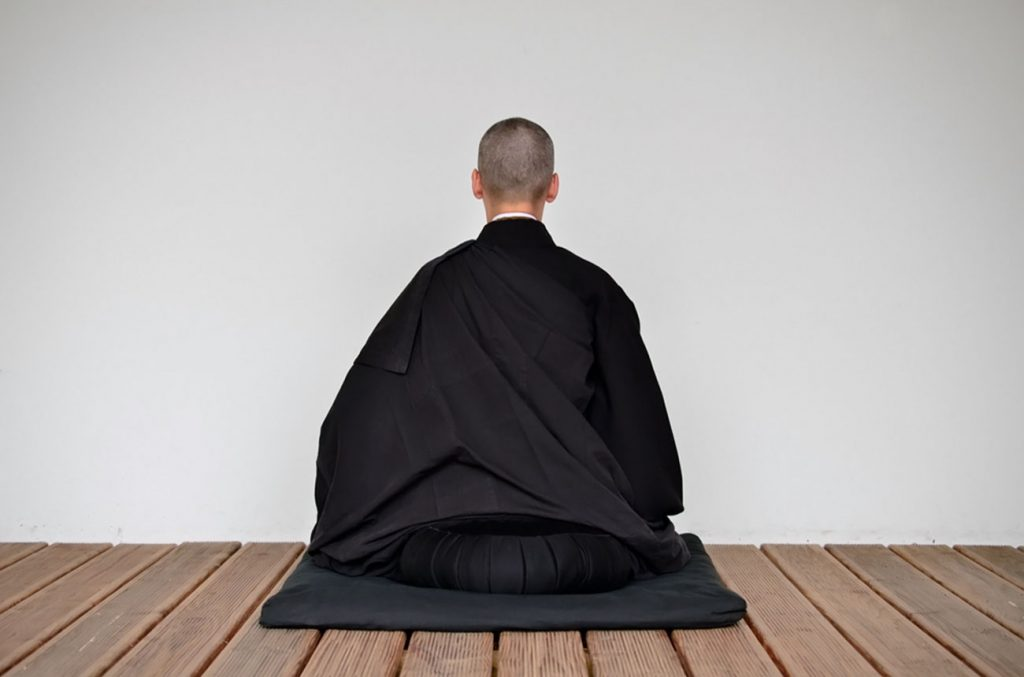
Zazen has never been a hobby for me. It has been closer to a long, quiet marriage with something that doesn’t flatter, doesn’t rush, and doesn’t let me pretend for very long. Over the years I’ve had plenty of ideas about Zen—ideas I could explain, defend, and dress up in respectable language—but the practice itself has always had a way of stripping those ideas down to what they’re worth. In the end, it keeps returning me to one simple thing: the act of sitting still and meeting my life as it is.
One of my first serious Zen teachers liked to call that commitment “sitting hard.” The phrase hit me with a blunt kind of clarity. It wasn’t poetic, and it wasn’t comforting. It sounded like work and that was how he treated it. Despite a great sense of humor and a love of Western movies, he never approached zazen in any way other than sitting hard. It was showing up on days when nothing in me wanted to show up, and staying put when my mind was loud, my body was restless, and my patience was thin. “Sit hard” didn’t mean “be dramatic” or “have a special experience.” It meant practice with spine. It meant being unwilling to bargain with the moment.
And yet, if I’m honest, I have not always sat hard. There were long stretches where I sat only occasionally, as if zazen were something I could keep on a shelf and pull down when life got stressful. In those seasons I told myself the usual stories: I’m too busy, I’m too tired, I’ll come back to it when things settle down. But things don’t settle down. Life rearranges itself, and then rearranges again. If I waited for perfect conditions, the practice would always be postponed into some imaginary future where I finally had time, energy, and a clear mind. Looking back, I can see that what I was avoiding wasn’t only the time commitment. It was the honesty. Zazen is simple, but it is not always comfortable. It is a room you enter and discover you are the one you’ve been avoiding.
Then there were the other seasons, the ones that looked more impressive from the outside but were more dangerous on the inside. I sat too hard. I confused discipline with virtue and intensity with depth. I turned the cushion into a kind of small fortress and made “practice” into an identity I could wear. From the outside I looked like the ideal Zen student. I measured myself by the hours I sat and the way I could endure discomfort, and in subtle ways I began to use zazen to step away from the rough edges of ordinary life. It took time for me to admit it, but that kind of “hard sitting” can be just another strategy of the self. It can be a way to feel pure, controlled, safe—especially when the rest of life is anything but those things. The irony is that the practice meant to loosen the grip of ego can become, if you aren’t careful, one more thing the ego uses to tighten it.
Zazen, thankfully, is patient. It has its own corrective intelligence. When I pushed too hard, the practice started to feel narrow. Not just in my legs and hips, but in my spirit. There was a tightening around everything. I became more brittle. More certain. More tense. Less available. The sitting was happening, but something essential was missing: the opening, the tenderness, the way practice is supposed to flow back into the world and make you more human rather than less. Over time I began to understand that sitting hard is not the same as sitting harsh. Hard isn’t about strain. It isn’t about grinding myself down like I’m trying to win some private contest. Hard, at its best, is about sincerity.
That word—sincerity—has become the truer meaning of “sit hard” for me. It means I sit not to achieve anything, but to be honest. I sit to stop negotiating with my own experience. I sit to see the mind doing what minds do—planning, judging, rehearsing, regretting—and to learn, again and again, that I do not have to chase every thought down its tunnel. I sit to return to the plain reality of breath and body, not as a spiritual performance but as a homecoming. Some days that homecoming feels clear and spacious, and other days it feels like nothing but fidgeting and fatigue. Either way, the practice is still the practice. The sincerity is in the returning.
The longer I’ve practiced, the more I’ve realized that a healthy zazen life is not built on inspiration. Inspiration comes and goes. If practice depends on feeling motivated, it won’t survive adulthood. It won’t survive grief, stress, burnout, parenting, or the months when everything feels ordinary and heavy. What survives is continuity. What survives is a rhythm that can hold you even when you don’t feel particularly spiritual. That rhythm doesn’t require heroic sits. It requires the humility to begin again, and the willingness to let the practice be smaller than your pride would like it to be. Sometimes sitting hard looks like a long sit. Sometimes it looks like fifteen honest minutes when you’re exhausted. Sometimes it means staying with a restless mind without turning that restlessness into a personal failure. Sometimes it means getting up when your body is injured and adjusting your practice to match your reality. The point isn’t punishment. The point is to keep returning without breaking yourself.
I’ve also learned, slowly and sometimes the hard way, that the proof of zazen is not what happens on the cushion. The proof is what happens off it. If sitting makes me more withdrawn, more brittle, more self-important, then something is wrong even if my posture looks perfect. If sitting makes me less kind, less available, less willing to meet the ordinary needs of life, then I’ve turned practice into an escape. But when zazen is alive in me, it does the opposite. It makes me a little less reactive. It gives me a fraction more space before I speak. It softens the instinct to control. It makes it easier to let things be what they are without collapsing into them or fighting them. It doesn’t turn me into a saint. It just returns me to the human scale of things.
That is, in the end, why I do it. I sit because left to its own habits my mind will turn my life into a constant commentary track. It will narrate, evaluate, compare, and rehearse until the day itself disappears beneath the noise. Zazen interrupts that. Not by killing thoughts, but by changing my relationship to them. It reminds me that thoughts are events, not commands. It reminds me that I can witness fear without obeying it, feel sadness without becoming it, experience desire without being dragged by it. It gives me steadiness—not a permanent calm, but a deeper steadiness underneath the weather.
After decades, what I derive from zazen is not a collection of mystical experiences. It is something more ordinary and more precious: clarity, humility, tenderness, and trust. Clarity, in the sense that I can see what’s happening without immediately reacting to it. Humility, because zazen keeps showing me how little control I actually have and how unnecessary it is to pretend otherwise. Tenderness, because the practice has softened places in me that used to be defended. Trust, not that life will go the way I want, but that I can meet what comes without adding unnecessary suffering on top of it.
These days, when I hear “sit hard,” I no longer picture grit or grim determination. I picture showing up. I picture the simple courage of being present without demanding that the moment be different before I’m willing to meet it. I picture taking the posture, letting the breath be the breath, letting the mind be the mind, and staying close to the reality of being alive. Zazen has been a constant thread through decades of change, through seasons of devotion and seasons of drifting. And it keeps offering the same quiet invitation, as steady now as it was at the beginning: sit down, be still, don’t look away. That, to me, is sitting hard.