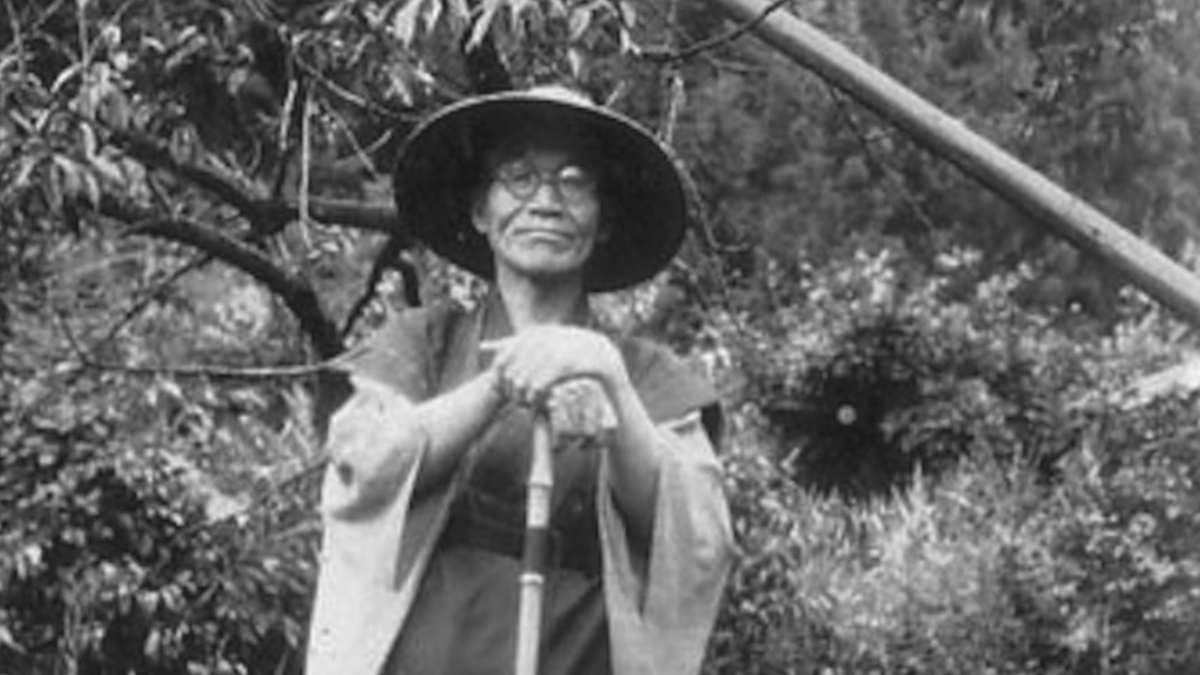
Kodo Sawaki (1880-1965) is one of the names Zen students eventually run into, even if they did not start in a Japanese Soto temple. You may hear him described as blunt, funny, severe, and strangely tender in the way a person can be tender when they refuse to lie to you. He is often called “Homeless Kodo” because he did not build his legacy by settling into comfort and managing a single institution. He traveled, taught sesshin, and kept pointing people back to the same plain center: sit down, do zazen, and do not turn it into a business deal.
Sawaki was born in 1880 in Japan, and his early life was marked by loss. As a child he lost his parents, and the insecurity of those years seems to have burned away any interest in religion as decoration. When you read accounts of him later, you can feel that early brush with impermanence behind the words. This is useful for us to remember: Zen is not an escape into nice ideas. It starts where life actually starts, in the middle of birth and death, gain and loss, clarity and confusion.
He entered monastic training young and became a Soto Zen priest, but he never let priesthood become merely a role. In the Japan of his time, temple life could easily become focused on funerals, parish obligations, and institutional advancement. Sawaki did not deny those realities, but he refused to let them become the point. His presence was a kind of correction. He reminded people, again and again, that Zen is not primarily something we talk about or think about. Zen is something we do with the whole body and mind. The posture matters. The breath matters. The daily conduct matters. Not as moral performance, but as a direct expression of practice.
When students ask what Sawaki taught, the simplest answer is: he taught shikantaza, just sitting, with no gaining idea. This does not mean “do not improve” or “do not learn.” It means do not reduce zazen to a tool for acquiring a special state, a spiritual experience, or a superior identity. If you sit in order to get something, you have already turned practice into a transaction. Sawaki pushed hard against that. He taught that zazen is not a technique we use to obtain awakening later. Zazen is awakening enacted now. We sit as the Buddhas sit, not because it pays, but because it is the Way.
This is also why Sawaki mattered to lay people. He did not teach as if real practice belonged only behind monastery walls. He led sesshin widely and spoke in ordinary language. He taught people who had jobs, families, and complicated lives, and he did not pretend those lives were obstacles that needed to be removed before practice could begin. Instead he treated everyday life as the real training ground, and zazen as the steady anchor that makes that training possible.
In 1949, Sawaki became abbot of Antaiji, then located in Kyoto. Even so, he continued to travel and teach, and much of the day to day stability of Antaiji was carried by his close disciple Kosho Uchiyama. Later, as Sawaki aged and his health declined, he spent more continuous time at Antaiji. He died there in December 1965. Students sometimes imagine that the importance of a teacher is measured by buildings, organizations, or polished systems. Sawaki shows another measure: the power to transmit the marrow of practice so directly that it continues to shape people long after the teacher is gone.
It is also responsible to say this plainly: Sawaki, like other prominent Zen figures of his era, is part of the modern Zen world that has faced criticism for wartime rhetoric and entanglement with Japanese nationalism. As students, we do not need to sanitize history in order to practice. We learn to hold both truths: the value of what a teacher transmitted, and the harm that can arise when spiritual communities are captured by ideology. Maturity in the dharma includes the willingness to look clearly.
Now, if you are learning lineage, do not treat it like a family tree you memorize to sound impressive. Treat it as a way of honoring how practice actually moved through real human lives. Sawaki had many students, but a few became especially important carriers of his style and emphasis.
Kosho Uchiyama (1912-1998) is often named as Sawaki’s successor at Antaiji and the person who clarified Sawaki’s teaching into a form many modern practitioners can grasp. Uchiyama wrote and taught with unusual simplicity. He did not romanticize Zen. He explained practice as returning to reality through sitting, and returning to conduct through careful attention to how we live. If you have been helped by straightforward teachings on zazen that refuse both superstition and self improvement hype, you are feeling Uchiyama’s influence.
Taisen Deshimaru (1914-1982) practiced with Sawaki for many years and later carried Soto style zazen into Europe, where he founded communities and trained teachers. His impact is hard to overstate in the European Zen landscape. Even when later practitioners refine or critique aspects of his style, the simple fact remains: he brought a living practice to people who might never have encountered it otherwise.
Sodo Yokoyama (1907-1980) is another student associated with this stream. He became known for a life that kept returning to the bare essentials, including teaching zazen outside formal settings. He is often remembered as someone who embodied a kind of radical simplicity, as if he kept asking the same question with his whole body: what is left when we stop trying to be special?
Gudo Wafu Nishijima (1919-2014) also studied with Sawaki in his youth and later became influential through teaching and through his work translating and interpreting Dogen. Many modern students who love Dogen’s writing, especially those who want a bridge between rigorous practice and clear explanation, have been shaped by Nishijima’s efforts.
Kobun Chino Otogawa (1938-2002) is another figure often mentioned as someone who studied with Sawaki and later became an important bridge teacher in the West, especially in the United States. His presence influenced a number of communities and practitioners, even when his teaching did not crystallize into a single large institution.
If you want a simple institutional thread associated with Sawaki’s legacy, Antaiji provides it. Sawaki was the fifth abbot. After his death, Uchiyama became the sixth abbot. Later abbots include Watanabe Koho (seventh), Miyaura Shinyu (eighth), Muho Nolke (ninth, 2002-2020), and Nakamura Eko (tenth, current abbess).
And from Uchiyama’s side, several of his dharma heirs became major transmitters of this style internationally. Two names students today often encounter are Shohaku Okumura and Jundo Cohen. Okumura has been especially influential through teaching and translation work that makes the practice centered, Dogen rooted approach available in clear English. Jundo Cohen has also helped many students through accessible teaching and online instruction, bringing a steady emphasis on everyday practice to people who might otherwise never find a sangha. When you hear these modern voices, remember that they are not disconnected teachers floating in the air. They are part of a living stream that runs through Sawaki’s insistence on just sitting, and through Uchiyama’s ability to say it plainly: sit, do not bargain, and let your whole life be the proof.