A personal reflection on sexuality, gender, and meeting one another with love
I keep thinking about the moment before someone tells us something they are afraid we will not accept.
Perhaps they are sitting across from us at the kitchen table. Perhaps they have been carrying the words for weeks, waiting for the right evening, the right mood, some small indication that it is safe to speak. It might be a friend telling us who they love, an adult child sharing something about their gender, or someone close to us explaining that the life they want does not resemble the life we imagined for them.
I imagine the pause before the words, and then the silence afterward. In that silence, they may be watching our face, trying to understand whether anything has changed between us. We may be thinking about definitions, beliefs, or questions we have never had to consider. They may be wondering whether they still have a place at our table.
When I think about that moment, I know the kind of person I want to be.
I want to be someone who stays. Someone who listens. Someone whose first concern is the human being who trusted me enough to speak. Whatever I may need to learn, whatever questions I may have, I want the person across from me to know that my care for them has not disappeared.
“I don’t understand, but I still love you.”
There is something deeply reassuring in those words when we mean them. They leave room for honesty without making love uncertain. They allow us to begin where we actually are, with our knowledge incomplete and our hearts still capable of opening.
I have been thinking about how we speak of sexuality, gender, and the many ways people build their lives. The words we choose matter, as do the meanings we give them, the tone in which we speak, and the assumptions we carry into a conversation. We may intend no unkindness and still use language that leaves someone feeling judged before they have been heard. Even the phrase “alternative lifestyle” gives me pause. Alternative to whose life? Mine? The life most familiar to my family? The one a particular culture has taught us to expect? It can quietly suggest that some lives belong at the center of our shared humanity while others require explanation or permission. Calling someone’s identity a lifestyle can also overlook how deeply it is connected to their sense of self, their relationships, and their belonging. I understand that words and labels can help people express themselves, but I want to let people tell me what those words mean in their own lives. I would rather begin by speaking of human diversity, with enough humility to remember that my experience is one among many. I want my language to make it easier for someone to speak honestly, and my listening to leave room for what I have yet to learn. I do not want my own experience to become the measure of how much room another person is allowed in the world.
Of course, finding better words is only a beginning. We can speak beautifully about inclusion and still become uncomfortable when someone close to us challenges an assumption we have carried for years. We can believe sincerely in compassion, fairness, and freedom, then discover that living by those values asks more of us than agreeing with them.
Many of us inherited ideas about what men and women should be, whom people should love, what families should look like, and which forms of intimacy were respectable. Some of those ideas were taught explicitly. Others arrived through jokes, silences, television, religious instruction, or the reactions of adults we trusted. We may have questioned much of that inheritance while leaving other parts untouched.
I think we need to be gentle enough with one another to admit this. A person trying to learn should have room to ask an awkward question, acknowledge a mistaken assumption, and find better language. I would not want our conversations or communities to become places where people pretend to understand because they are afraid of being exposed as uncertain. An honest question, offered with care, can be the beginning of deeper understanding.
Yet the person we are trying to understand needs gentleness too. Our confusion can be worked through without making their daily life more painful. We can have questions and still be kind. We can take time to reconsider a belief while treating someone fairly today. Their safety and dignity should not have to wait for our comfort to catch up.
I also want to be careful about the word “choice.” Sexual orientation and gender identity are not adequately described as lifestyle decisions. People make choices about relationships, disclosure, and how they express themselves, but those choices do not mean they selected their underlying experience. Most people feel little or no choice about their sexual orientation. When someone shares who they are, I want to take their account seriously rather than assume that my view from the outside tells me more than their own experience does.
Even where a person has freely chosen a way of living, however, I do not believe their freedom should depend on whether I would make the same choice. They do not need to prove that they were incapable of living differently before I recognize their right to live their own life.
When I think about gay and lesbian people, I want to remember how much of love happens in the ordinary hours. Making coffee for someone who is still asleep. Recognizing the tiredness in their voice. Sitting beside them in a waiting room. Learning which small kindness will help after a difficult day. Sexuality matters, but so does the whole life that grows around a relationship. I would hate to look at two people who care for each other and become so preoccupied with their gender that I fail to notice their tenderness.
I want to make room for the many ways we experience attraction, intimacy, and our own sense of self. The closeness that brings one person joy may not be what another person needs, and the words someone uses to describe themselves may be unfamiliar to me. I do not want that unfamiliarity to keep me from hearing them. There is so much of a person’s life that I cannot know from the outside: what makes them feel at home with themselves, what they hope for, what has hurt them, and what helps them feel loved. When someone shares those parts of themselves with me, I want to respond with curiosity and care.
Whatever our differences, I believe each of us deserves the chance to be known on our own terms. I can honor someone’s boundaries, use the name they ask me to use, and respect the place that sexuality, affection, or companionship holds in their life. I may still have questions, but I can carry and ask those questions in a gentle way. I want the people around me to feel at ease in my company, able to speak honestly without wondering whether they must become more like me to remain close to me. Their trust is something I want to care for, even while I am learning.
I want to bring that same openness to the ways people build relationships and make a home. Love, companionship, and commitment can take forms I have never lived or even imagined. A household may look different from the one I grew up around and still hold tenderness, stability, and belonging. I want to notice how people care for one another: whether they listen, share responsibilities, keep their promises, and make room for each other’s needs. Those everyday acts tell me something important about the life they are building together.
I can have my own hopes for love and family while respecting someone else’s freedom to find a different way. What matters to me is that everyone involved can choose freely, speak honestly, and trust that their boundaries will be honored. That care also reaches beyond the people in a relationship to anyone who depends on them. If someone is being pressured, deceived, exploited, or neglected, I want to take that harm seriously. I want to bring the same concern to every relationship, including those most familiar to me, and leave room to recognize love wherever people are caring for one another.
That asks us to pause before treating discomfort as a moral verdict. A feeling can be real and still need examination. I can acknowledge that something unsettles me and then ask why. Is someone being mistreated? Is there a responsibility being abandoned? Or have I encountered a life that challenges an expectation I have never examined? I want to be willing to ask those questions of myself before making another person carry the weight of my reaction.
There is a quiet humility in saying, “I don’t know.” I think we could use more of it. The world contains experiences I will never fully share. Another person’s body, attraction, history, and sense of self cannot be understood simply by consulting my own. Their life may become more understandable when I listen, but it will remain theirs.
I do not believe love requires us to share every belief, approve of every decision, or want the same life. We are allowed our own boundaries. We choose our own partners and the commitments we can honestly make. What troubles me is the moment when a boundary around my life becomes an attempt to control someone else’s.
“I would not choose that” can remain a statement about me. It does not need to become a demand that another person change.
There is also a tenderness we need when discussing acceptance. Saying “I accept you, but I reject your lifestyle” may sound reasonable to the person speaking. To someone hearing their identity or beloved relationship described that way, it may feel like rejection reaching into the center of their life. If I intend to communicate love, I want to care about what my words actually communicate. I want to be willing to hear that I have hurt someone, even when hurting them was never my intention.
Perhaps a more caring beginning is simply: “This is unfamiliar to me. I care about you, and I would love to sit down and talk, if you would like to.”
Then comes the harder part: listening without turning the conversation into a trial.
I want to hear what someone’s life has been like. What brings them happiness? What have they been afraid to say? What do they wish the people who love them understood? And I want to pay attention to my own purpose in asking. Am I willing to discover something, or am I collecting answers so that I can argue more effectively?
No one owes me their story. They may be tired of explaining. They may have been hurt by conversations that began with promises of openness. They may want privacy, or need distance. Meeting people where they are includes respecting that. I can read, reflect, and learn without requiring someone else to become my teacher. If they do choose to share, I hope I will remember the trust involved. I may come away with a clearer understanding. I may still have questions. But I will have been given the chance to know someone more closely, and I do not want to waste that chance by remaining attached to the version of them I had already decided was true.
I also want our conversations to leave room for happiness. People deserve more than our concern about their suffering. They deserve our interest in the person they have fallen in love with, our welcome for a partner, our congratulations when life is going well. Sometimes the most meaningful expression of acceptance is the ease with which we let someone’s good news be good news.
This matters in public life as well. I cannot claim to honor another person’s humanity while supporting efforts to force their consensual adult life into the shape I prefer. We have legitimate responsibilities to protect people from violence, coercion, exploitation, and violations of their rights. My discomfort with someone’s identity or relationships is not sufficient reason to legislate their body and mind. Freedom must have room for lives I would not choose for myself if it is to mean anything beyond permission for people who resemble me.
I think, too, about what rejection can do to someone who is already feeling alone. Research has documented serious mental health and suicide risk disparities among transgender and questioning young people, alongside experiences of violence and disconnection. It has also found associations between supportive environments and lower levels of mental health or suicide risk indicators. These are complicated matters, and a loving conversation cannot resolve every difficulty. Still, we have a responsibility to care about whether our presence adds to someone’s isolation or offers them a place to turn.
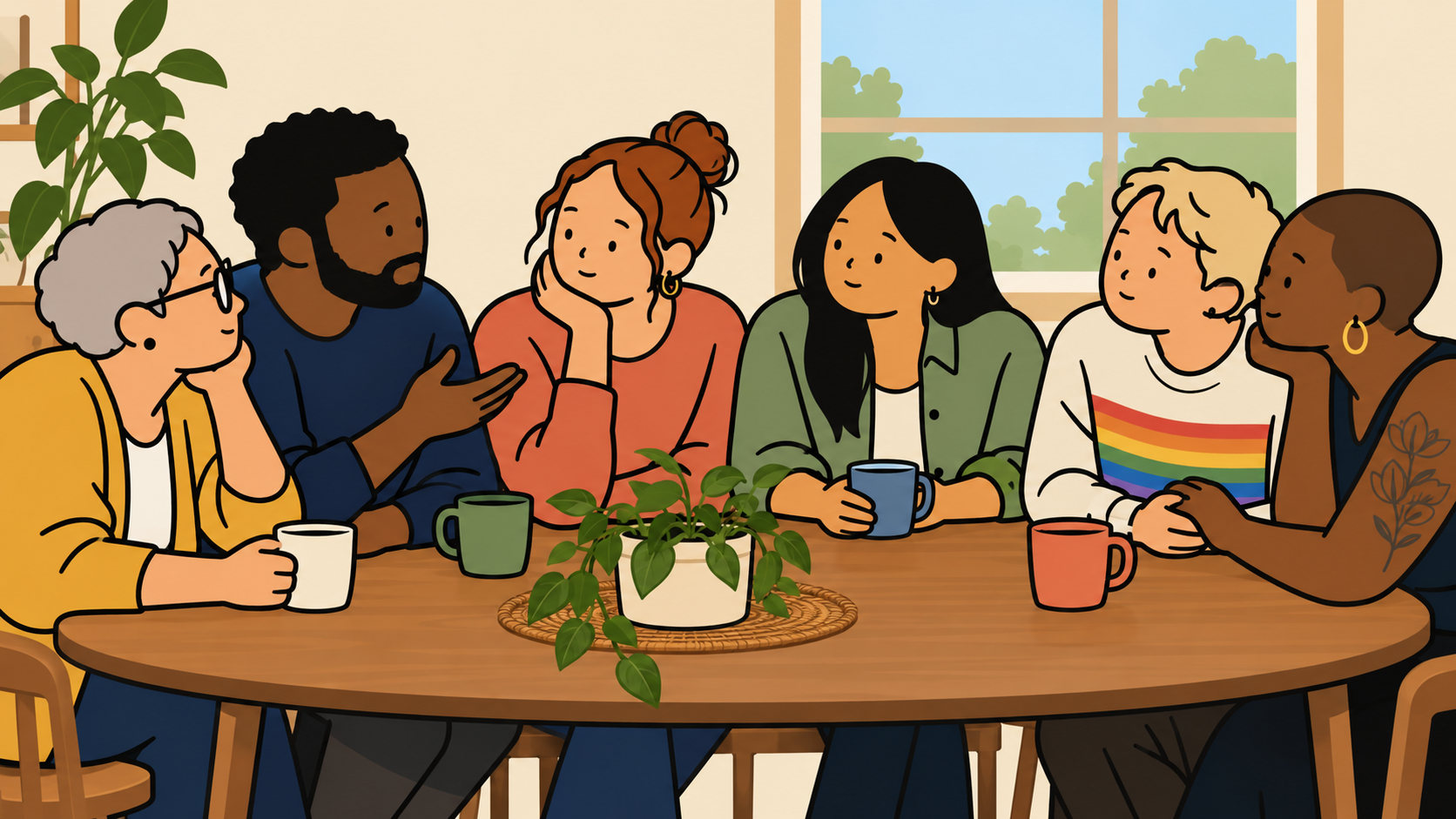
Imagine that kitchen table again. Someone has finally found the courage to speak. We may need time to think. We may have a great deal to learn. But we can offer something steady in that moment: “I’m glad you told me. I love you. You have a place here.”
I cannot help wondering how many relationships might be preserved if those words came before the objections. How many people might feel less alone if they knew that being honest would not cost them every place they had belonged.
For me, compassion begins with a willingness to keep returning to the person in front of us. The person can disappear so easily behind a category, a controversy, or a conviction about how life ought to be. I want to notice when that happens in my own thinking. I want to remember that someone’s life continues after our conversation ends, and that the way I treat them becomes part of what they carry home.
Whatever our beliefs, we can make this a daily practice of attention and care. We make space at a table. We protect a confidence. We correct a careless word. We welcome someone’s partner. We listen long enough to hear something we did not expect. Our love takes shape through these ordinary acts, and through our willingness to keep learning.
I do not expect us to understand everyone. I do hope we can stop making understanding a condition of kindness.
We can meet people where they are, allowing them the freedom to tell us who they are and what their lives mean to them. We can be honest about our questions without surrounding someone with suspicion. We can let love remain steady while our understanding grows.
“I don’t understand, but I still love you.”
I hope, when we say it, the person hearing us can feel that they are welcome to stay. That there is time to talk, and room to be quiet. That they can bring their whole life into the conversation without knowing every answer or finding perfect words.
And I hope we will mean enough by love to let the conversation change us.