Hospitals are among the few modern institutions that must remain both open and controlled at the same time. They are places of healing, grief, emergency, birth, death, family crisis, public access, expensive equipment, controlled substances, sensitive records, and exhausted staff working under pressure. That combination creates a security problem unlike most other environments. A hospital cannot behave like a locked corporate data center, but it also cannot safely operate as an open public building where unknown people may enter, wander, claim authority, approach patients, access workstations, or move through semi-restricted areas without meaningful identity verification.
For that reason, hospitals and healthcare-related organizations should require government-issued photo identification for all adult visitors, vendors, contractors, temporary workers, sales representatives, consultants, clergy, students, observers, and any other non-employee entrants. This should not be treated as a customer-service inconvenience or a symbolic security gesture. It should be understood as a basic layer of physical security, cyber defense, patient safety, workplace violence prevention, privacy protection, and operational resilience.
The central issue is not that every visitor is dangerous. Most are not. The issue is that hospitals need to know who is inside the facility, why they are there, where they are permitted to go, who authorized their presence, and how they can be located or removed if something goes wrong. Identity is the first control. Without it, every other access-control measure is weaker.
The hospital as a hybrid threat environment
Healthcare security used to be discussed mostly in physical terms: workplace violence, infant abduction risk, drug diversion, disruptive visitors, domestic violence spillover, trespassing, theft, unauthorized photography, and access to restricted clinical areas. Those risks remain real. OSHA has long recognized that healthcare and social service workers face significant risks of job-related violence, and its workplace violence guidance specifically covers hospital settings, emergency departments, psychiatric facilities, long-term care, clinics, and other healthcare environments. OSHA’s guidance also emphasizes that workplace setting determines the hazards and the appropriate measures used to reduce them.
But the modern hospital is also a cyber-physical environment. A person who enters the building is not merely a person in a hallway. That person may come within reach of unlocked nursing-station terminals, network ports, badge readers, printers, medication rooms, IT closets, biomedical devices, conference rooms, vendor work areas, and staff-only doors held open out of courtesy. A fake vendor, fake IT worker, fake repair technician, fake consultant, or fake family member may not need to defeat a firewall if they can persuade someone at the front desk, at a unit desk, or in an office suite that they “belong.”
That is why visitor identity management belongs in the same conversation as cybersecurity. The distinction between physical security and cybersecurity is increasingly artificial. A malicious visitor can create a cyber incident. A social engineer can use physical presence to reinforce a phone scam. A fake technician can insert a USB device, photograph workstation labels, observe badge practices, collect names, tailgate through controlled doors, or pressure an employee into granting access.
The FBI’s May 2026 FLASH warning on the Silent Ransom Group illustrates this clearly. The FBI describes Silent Ransom Group, also known as Luna Moth, Chatty Spider, and UNC3753, as using social engineering to impersonate IT personnel. The group uses phone calls and phishing emails to pose as IT support, establish access to victim computers, exfiltrate data through legitimate remote access tools, and, if remote access fails, send an individual in person to the victim company’s location to gain physical access to computers. The FBI also notes that SRG has victimized companies in multiple sectors, including healthcare, even though U.S. law firms have been a consistent focus since 2023.
That warning is highly relevant to hospitals. A hospital is full of people who are trained to be helpful, responsive, and deferential to perceived expertise. If someone appears at a department claiming to be “from IT,” “from the vendor,” “from corporate,” “from the EHR team,” “from biomed,” or “here to image the device,” the environment itself can help the attacker. A strict visitor and vendor identification process creates friction at precisely the point where social engineering depends on smooth passage.
Government-issued photo ID establishes accountability
A government-issued photo ID requirement does not magically make a hospital secure. It does, however, establish a baseline of accountability. It confirms that the person entering is willing to identify themselves using a recognized credential. It gives the hospital a reliable check-in record. It reduces anonymous access. It deters casual trespassers and opportunistic offenders. It supports investigations after incidents. It gives security personnel a starting point when a visitor violates policy, threatens staff, accesses unauthorized areas, or is later associated with a privacy, theft, violence, or cybersecurity event.
The Joint Commission does not impose one universal photo-ID rule for every hospital visitor, but it does require organizations to identify individuals entering their facilities and to control access to security-sensitive areas. It also makes clear that organizations are accountable for their own identification policies once adopted. That is important. If a hospital determines that government-issued visitor identification is necessary for its risk environment, then the organization should treat the policy as a real control, not a lobby preference that can be bypassed whenever someone complains.
A good visitor policy should answer several basic questions: Who is the person? What is the purpose of the visit? Who are they visiting or meeting? What areas are they authorized to access? When did they enter? When did they leave? Are they a visitor, vendor, contractor, student, clergy member, law enforcement officer, delivery driver, or temporary worker? Are there limits on their movement? Are they required to be escorted? Is their badge time-limited? Is the visit tied to a specific patient, work order, department, or appointment?
The IAHSS Foundation’s research on visitor management in hospitals highlights the complexity of hospital environments, including large campuses, multiple buildings, many public entrances, and diverse facility layouts. In its study sample, respondents reported an average of 12.5 public entrances, with a wide range across facilities. That matters because the more doors a hospital has, the more important it becomes to standardize who may enter, how they are identified, and how access is documented.
Visitor ID is a workplace violence prevention tool
Healthcare workplace violence prevention is not only about responding to assaults after they occur. It is about recognizing risk, reducing anonymity, controlling access, setting behavioral expectations, and ensuring staff know how to report and respond to concerning conduct. The Joint Commission describes workplace violence prevention programs as a way to help leaders and staff understand potential violence, recognize early warning signs, respond to actual or potential incidents, and ensure that claims are investigated and addressed. It also expects workplace violence prevention programs to include policies and procedures, incident reporting, trend analysis, follow-up support, and governance reporting.
Government-issued visitor ID supports that framework. It gives hospitals better data about who was present during an incident. It helps identify repeat problem visitors. It allows restrictions to be documented and enforced. It helps security officers distinguish between authorized visitors and people who should not be on the unit. It can support domestic violence precautions, custody-related restrictions, behavioral contracts, and high-risk patient alerts. It also sends a clear message to visitors that the hospital is not an unmonitored public space.
This is especially important in emergency departments, labor and delivery, behavioral health, pediatrics, intensive care, pharmacy areas, and units caring for vulnerable patients. A person wandering without identification may be a lost family member, but they may also be a threat, a privacy risk, a disruptive visitor, a person attempting to remove a patient, a person seeking drugs, or someone trying to reach a staff member or patient despite restrictions. Staff should not have to guess. A visible visitor badge tied to verified identification makes it easier for every employee to recognize when someone is out of place.
Vendor identity is a cybersecurity control
Hospitals often focus on family visitors when discussing visitor management, but vendors and contractors may present a greater cyber-physical risk. Vendors frequently have plausible reasons to access equipment, workstations, supply rooms, clinical departments, loading docks, IT areas, and administrative offices. Some may be onsite for medical devices, imaging equipment, networked systems, food services, facilities maintenance, linen, pharmacy automation, EHR support, revenue cycle systems, security systems, or construction. Many vendors are legitimate and essential. That is exactly why impersonating one can be effective.
A vendor check-in process should therefore be stricter than ordinary visitor check-in, not looser. Government-issued photo ID should be matched against company identification, appointment records, work orders, purchase orders, vendor management records, and departmental authorization. Vendors should not be permitted to self-deploy into clinical or technical areas merely because they are wearing a polo shirt with a logo. They should be badged, time-limited, destination-limited, and escorted when appropriate. High-risk vendor activity—especially anything involving computers, networked devices, medical equipment, storage media, software installation, remote access tools, or data-bearing systems—should require confirmation through a known internal contact, not a phone number provided by the visitor.
The FBI’s Silent Ransom Group warning makes this more than theoretical. The FBI states that SRG actors may send someone in person to gain access and insert a storage device into a victim’s computer, using a pretext such as imaging the device or creating a backup file. The warning also identifies the use of legitimate remote administration tools, valid accounts, WinSCP, Rclone, and cloud file-sharing platforms for exfiltration. In a hospital, a person who can reach a workstation, biomedical device support computer, shared office machine, or departmental file share may create a serious data-loss event without ever deploying traditional ransomware.
This is why “verify the vendor” should be part of healthcare cybersecurity training. Staff should be trained to challenge unescorted vendors, unknown IT personnel, and anyone attempting to plug in a device, access a workstation, install remote access tools, image a machine, or “fix” a system without a verified internal ticket. Visitor ID alone is not enough, but it is the front door of that control chain.
Healthcare is already under social-engineering pressure
Healthcare organizations are frequent targets because they hold valuable data, operate under time pressure, depend on continuous availability, and often have complex vendor ecosystems. The American Hospital Association described the 2024 Change Healthcare cyberattack as an unprecedented national disruption that affected healthcare operations, patient access, clinical and eligibility functions, and provider finances. HHS has also highlighted social engineering as a healthcare threat, noting that phishing remains one of the most effective social engineering attacks against healthcare organizations and that technical and non-technical mitigations are both necessary.
The phrase “non-technical mitigations” is crucial. Hospitals often respond to cyber risk by buying cybersecurity tools, but the attack path may begin with a phone call, a front desk interaction, a badge that looks convincing, a person carrying a laptop bag, or a request that sounds urgent. Identity verification at the door is a non-technical mitigation that reinforces the technical program. It helps ensure that cyber hygiene is not confined to the IT department.
A hospital that requires government-issued photo ID for every adult visitor and vendor is making a cultural statement: access is not based on confidence, costume, urgency, or social pressure. Access is based on verification.
The policy should be compassionate but firm
Hospitals serve people in crisis. Any visitor ID policy must be implemented with compassion, good judgment, and exceptions for true emergencies. A parent rushing in after a child’s accident, a spouse arriving during a code, a patient without identification, or a vulnerable person seeking emergency care should not be treated as a criminal. Emergency medical care must never be delayed because of a visitor-management procedure.
But compassion does not require uncontrolled access. The policy can allow emergency exceptions while still documenting identity as soon as practical. It can provide a supervised process for visitors who lack ID. It can allow alternative identity verification when appropriate. It can distinguish between patients seeking care and visitors seeking access to the facility. It can train staff to avoid confrontational language. It can provide signage that explains the purpose: “For the safety of patients, visitors, and staff, adult visitors and vendors are required to present government-issued photo identification.”
The point is not to create a hostile environment. The point is to create a safe one.
Recommended policy elements
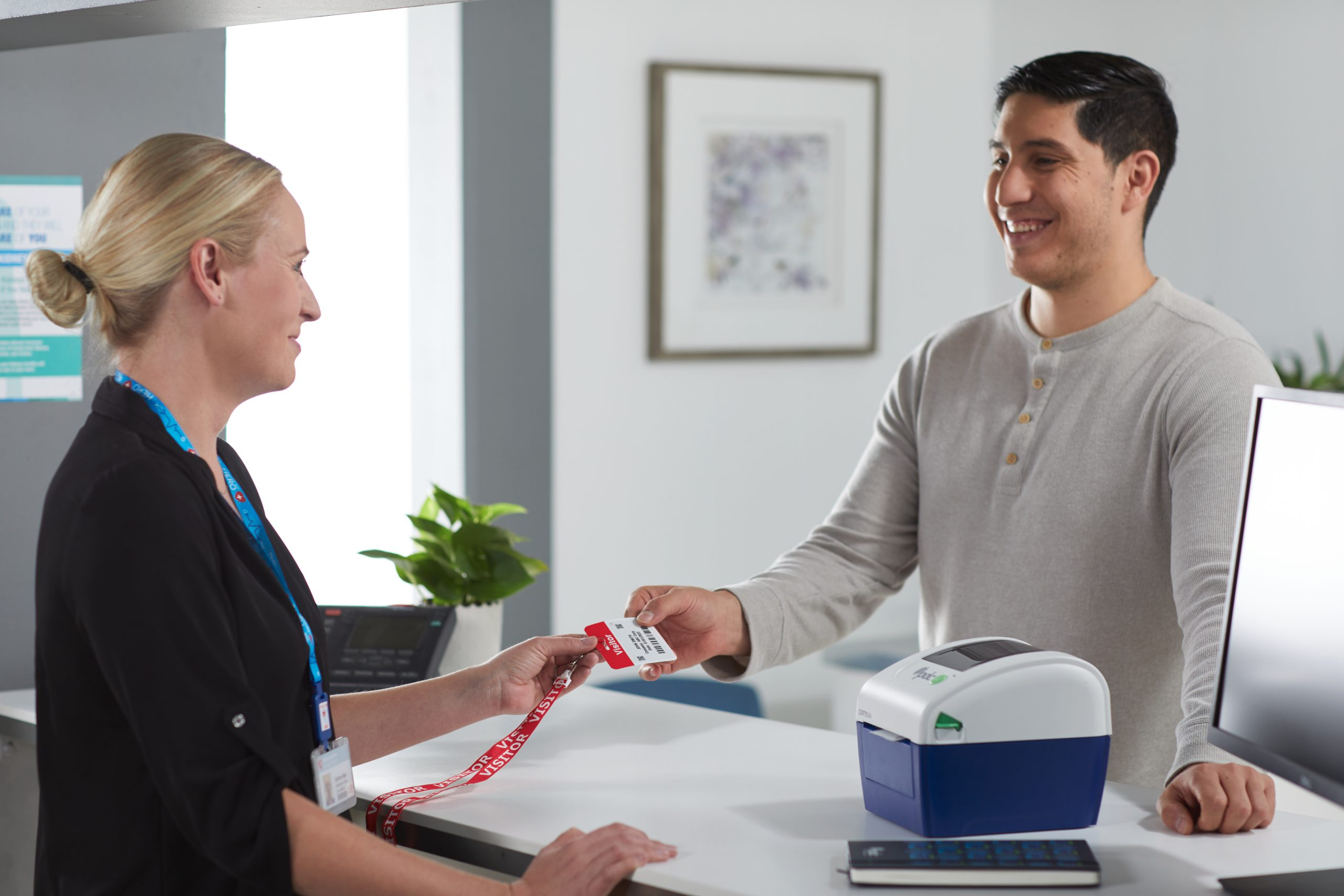
A strong hospital visitor and vendor ID policy should include government-issued photo identification for all adult non-patient entrants, including visitors, vendors, contractors, clergy, consultants, observers, delivery personnel who move beyond public drop-off points, and temporary workers. The ID should be checked at entry, and the visitor should be issued a visible badge that includes the visitor type, date, expiration time, destination or authorized area, and whether escort is required.
The hospital should use a visitor management system where feasible rather than relying only on paper logs. The system should record entry and exit, support watchlists or internal restrictions where legally and ethically appropriate, and allow security to know who is in the facility during emergencies. Visitor data should be protected as sensitive information, retained only as long as necessary under policy and law, and accessed only for legitimate security, compliance, or investigative reasons.
Vendor access should require additional validation. The vendor’s government ID should be matched to company ID and a verified appointment, work order, service ticket, or departmental sponsor. Any vendor seeking access to IT systems, biomedical devices, network closets, server rooms, medication systems, or data-bearing equipment should be verified through a known internal process. Staff should be trained never to accept a visitor’s own phone number, email, or paperwork as the sole proof of authorization.
The policy should also include visible badge enforcement. A badge that no one checks is theater. Employees should be empowered to politely challenge unbadged individuals: “Can I help you find where you’re going?” or “For everyone’s safety, I need to help you get a visitor badge.” Security should support staff who challenge unknown individuals, rather than treating such reports as annoyances.
Addressing common objections
The most common objection is that requiring ID is inconvenient. That is true. Security controls often add friction. But the question is whether the friction is reasonable compared with the risk. In a hospital, the answer is yes. The environment contains vulnerable patients, stressed families, controlled substances, sensitive records, expensive devices, and life-critical systems. A short identity check is a proportionate measure.
Another objection is that “bad people can have real IDs.” Also true. Government-issued ID does not prove good intent. But security is layered. Metal detectors do not prove good intent either. Neither do cameras, badges, access cards, sign-in logs, locked doors, or employee training. Each control reduces a different part of the risk. Government ID reduces anonymity, strengthens accountability, supports investigation, and makes impersonation harder.
A third objection is that hospitals should feel welcoming. They should. But welcoming does not mean unprotected. A well-run ID process can be courteous, fast, and respectful. It can reassure patients and families that the hospital takes safety seriously. Many visitors already expect ID checks in schools, government buildings, corporate offices, airports, and even some residential facilities. Hospitals have at least as strong a reason.
Conclusion
Hospitals should require government-issued photo identification for all adult visitors, vendors, contractors, and other non-employee entrants because identity is the foundation of safe access. This is not merely a front-desk administrative practice. It is a patient safety control, a workplace violence prevention control, a privacy control, a vendor-risk control, and a cybersecurity control.
The FBI’s warning about Silent Ransom Group impersonating IT personnel shows how modern social engineering can cross from phone and email into physical presence. OSHA and The Joint Commission both emphasize structured workplace violence prevention, risk assessment, policies, reporting, and access control. Healthcare cyber incidents show that attacks on healthcare systems can disrupt care far beyond ordinary business inconvenience. Taken together, the lesson is clear: hospitals cannot afford anonymous access.
A hospital does not need to become cold or fortress-like to become safer. It needs to become disciplined. Requiring government-issued photo ID, issuing visible visitor and vendor badges, verifying access purpose, limiting movement, documenting entry, and training staff to challenge unknown individuals are practical steps that protect patients, staff, visitors, and the organization itself. In today’s threat environment, knowing who is in the building is not optional. It is one of the most basic duties of care.