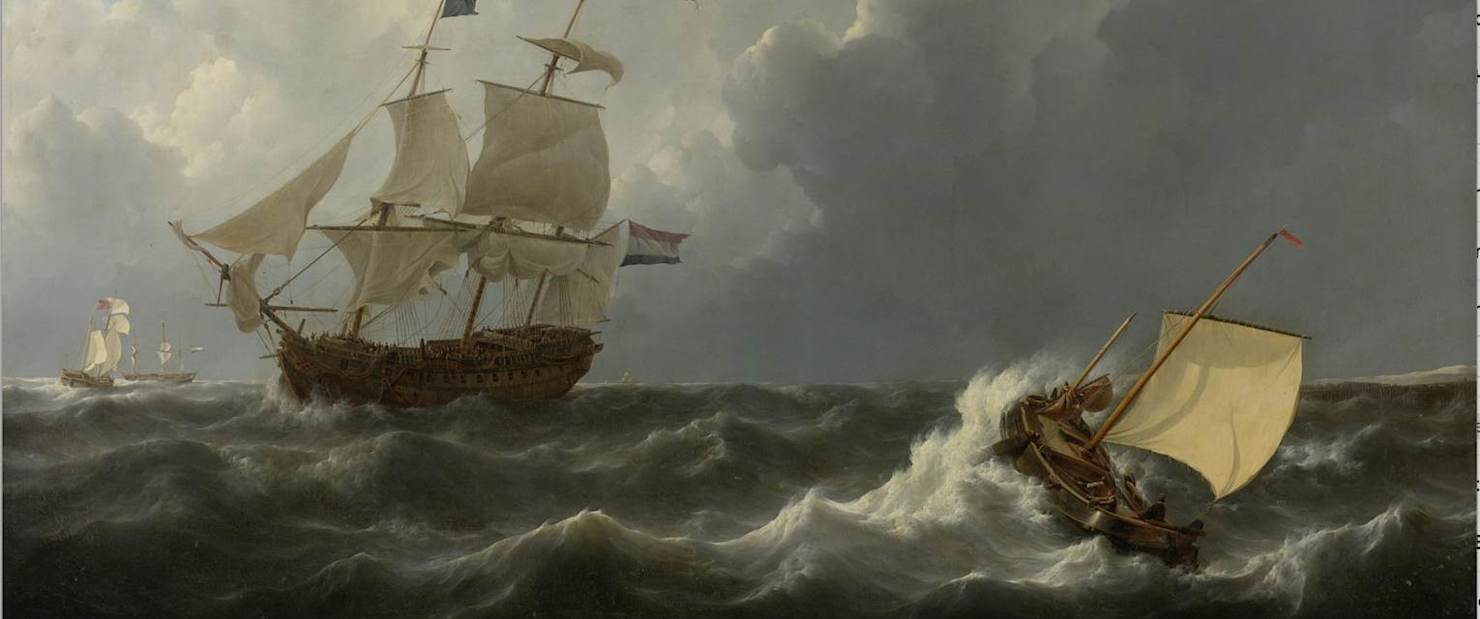
Nautical fiction is one of the great adventure traditions of modern literature. At its simplest, it is fiction in which the sea is not merely scenery, but a shaping force. A nautical novel is not just a story that happens to include a ship. It is a story in which ships, storms, navigation, naval discipline, trade, war, piracy, exploration, isolation, command, seamanship, and the vast moral pressure of the sea become central to the drama. The sea tests character. It strips away comfort. It puts human beings under command, danger, boredom, confinement, superstition, and sudden violence. That is why the best nautical fiction is rarely only “adventure fiction.” It is also fiction about duty, hierarchy, courage, survival, exile, masculinity, empire, conscience, and the thin line between order and chaos.
The genre has deep roots. Long before the modern novel, Western literature had sea epics: The Odyssey, the voyage of the Argonauts, medieval pilgrimage tales, shipwreck narratives, pirate ballads, exploration accounts, and sailors’ memoirs. But nautical fiction as a recognizable novelistic genre emerged much later. It required the rise of the modern novel, the expansion of maritime empires, the growth of professional navies, and a reading public fascinated by ships, war, trade, and faraway places.
The Earliest Nautical Novels
The first works that can reasonably be considered ancestors of nautical fiction include Daniel Defoe’s Robinson Crusoe in 1719 and Tobias Smollett’s The Adventures of Roderick Random in 1748. Robinson Crusoe is not a naval novel in the later sense, but it is foundational to maritime adventure: shipwreck, survival, trade, colonial encounter, and the psychological drama of isolation. Smollett’s Roderick Random is closer to true nautical fiction because it drew on Smollett’s own experience as a naval surgeon’s mate and contains a vivid account of eighteenth-century Royal Navy life, including brutality, disease, class conflict, and battle. Britannica notes that Roderick Random was published in 1748 and includes a “graphic account of British naval life” of the period.
Still, most scholars and readers usually identify James Fenimore Cooper and Frederick Marryat as the real founders of nautical fiction as a distinct genre. Cooper’s The Pilot: A Tale of the Sea, first published in 1824, is often described as the first fully developed sea novel, especially in American literature. It centers on a mysterious American sea pilot modeled on John Paul Jones and places naval action, seamanship, weather, loyalty, and maritime danger at the center of the narrative.
Frederick Marryat, a former Royal Navy officer, then gave the genre much of its popular form. His novels, including Frank Mildmay in 1829, Peter Simple in 1834, and Mr Midshipman Easy in 1836, helped establish the conventions of the naval adventure novel: the young officer, the shipboard hierarchy, the testing of courage, the comic and cruel life of the mess, the sudden violence of combat, and the rough humor of sailors. If Cooper helped prove that the sea could sustain a serious novel, Marryat helped prove that readers would eagerly follow a series of maritime adventures.
The Nineteenth-Century Expansion of the Genre
Once nautical fiction took shape, the nineteenth century became its great age of expansion. The sea was central to the century’s imagination. Britain’s empire rested on naval power and merchant shipping. America’s literary imagination was shaped by whaling, trade, naval conflict, and coastal expansion. France, Spain, the Netherlands, and other maritime powers had their own sea traditions. To read nineteenth-century nautical fiction is to enter a world where the ship was both machine and society, both weapon and home.
The towering literary figure of this period is Herman Melville. Moby-Dick in 1851 is not simply a whaling novel. It is one of the great symbolic and philosophical novels in English. Melville had gone to sea himself, and his fiction draws from hard experience: shipboard labor, whaling practice, Pacific travel, religious obsession, and the strangeness of men confined together under extreme conditions. With Moby-Dick, nautical fiction became metaphysical. The sea was no longer merely a place of adventure; it became an image of God, fate, nature, madness, and the unknowable.
Other nineteenth-century writers broadened the field. Victor Hugo’s Toilers of the Sea explored human struggle against the forces of nature. Jules Verne brought maritime adventure into speculative fiction with works such as Twenty Thousand Leagues Under the Seas. R. M. Ballantyne wrote popular adventure fiction for younger readers. W. H. G. Kingston and other Victorian writers helped turn sea adventure into a major boys’ literature tradition. These works could be imperial, moralistic, nationalistic, or romantic, but they helped preserve the sea story as one of the most popular forms of adventure fiction.
Joseph Conrad and the Psychological Sea Novel
By the late nineteenth and early twentieth centuries, nautical fiction matured into something darker and more psychologically complex. The key figure here is Joseph Conrad, who had served for years in the merchant marine before becoming a novelist. Conrad’s sea fiction includes The Nigger of the “Narcissus”, Lord Jim, Typhoon, Youth, The Shadow-Line, and parts of Heart of Darkness. In Conrad, the sea becomes a moral testing ground. His captains, officers, and sailors are not merely heroic adventurers; they are men under pressure, forced to confront cowardice, guilt, command, loyalty, and the collapse of certainty.
Conrad is one reason nautical fiction should never be dismissed as a mere subgenre of adventure. At its best, it has produced some of the most profound explorations of character in modern literature. The ship is an ideal literary device because it compresses society into a small, dangerous space. There is no easy escape. A weak captain cannot hide. A cowardly officer cannot avoid consequence. A mutinous crew becomes an existential threat. The sea intensifies everything.
The Age of the Naval Series
In the twentieth century, nautical fiction found one of its most beloved forms: the long historical naval series. Here the great name is C. S. Forester, creator of Horatio Hornblower. Beginning with Beat to Quarters in 1937, Forester’s Hornblower novels followed a Royal Navy officer through the Napoleonic Wars. Hornblower is brilliant, anxious, disciplined, lonely, and deeply human. He is not the swaggering hero of simpler adventure fiction. He doubts himself, calculates constantly, fears failure, and yet acts with extraordinary competence. Forester helped define the modern naval historical novel.
After Forester came Patrick O’Brian, whose Aubrey–Maturin series is often considered the summit of the form. Beginning with Master and Commander, first published in the United States in 1969 and in Britain in 1970, O’Brian created a twenty-novel sequence centered on Captain Jack Aubrey and Dr. Stephen Maturin. The novels are set largely during the Napoleonic Wars and combine naval action, espionage, natural history, medicine, music, friendship, politics, and domestic life. The first book was published by J. B. Lippincott in the United States and Collins in the United Kingdom; W. W. Norton’s 1990 reissue later helped bring the series to a large American readership.
O’Brian’s genius was not only accuracy, though his command of period language and naval practice is famous. His deeper achievement was the creation of one of the great friendships in modern fiction. Aubrey and Maturin are opposites: sailor and scientist, extrovert and introvert, Tory and radical, man of action and man of thought. Their friendship gives the series emotional depth beyond battle and seamanship.
Major Writers in the Field
A serious introduction to nautical fiction should include at least the following major authors:
James Fenimore Cooper — one of the founders of the sea novel, especially with The Pilot.
Frederick Marryat — former Royal Navy officer and early master of the naval adventure novel.
Tobias Smollett — an important precursor whose naval scenes drew from lived experience.
Herman Melville — author of Moby-Dick, White-Jacket, Billy Budd, and other sea-related works.
Joseph Conrad — master of the psychological and moral sea novel.
C. S. Forester — creator of Horatio Hornblower and one of the most influential modern naval novelists.
Patrick O’Brian — author of the Aubrey–Maturin series, perhaps the most admired historical nautical series in English.
Alexander Kent, the pen name of Douglas Reeman — creator of the Richard Bolitho novels.
Dudley Pope — creator of the Lord Ramage series.
Richard Woodman — author of the Nathaniel Drinkwater series.
Dewey Lambdin — author of the Alan Lewrie naval adventures.
Julian Stockwin — author of the Thomas Kydd series, which follows a pressed man’s rise through the Royal Navy. His official site describes the Kydd series as “one man’s journey from pressed man to Admiral” and lists twenty-seven titles, with Admiral as the final title.
James L. Nelson — known for American Revolutionary War naval fiction, including the Isaac Biddlecomb novels.
Seth Hunter — author of the Nathan Peake series, published in the United States by McBooks Press. Publishers Weekly described The Time of Terror as Hunter’s American debut and identified it as the beginning of a naval adventure series featuring Royal Navy officer Nathan Peake.
Antoine Vanner — a more recent writer whose Dawlish Chronicles move beyond the usual Age of Sail setting into the late nineteenth-century world of steam, ironclads, heavy guns, torpedoes, and imperial crisis. His site describes the series as naval adventures set in the late Victorian period as the “Age of Sail” gives way to steam and modern naval warfare.
Popular Publishers of Nautical Fiction
Several publishers have played important roles in keeping nautical fiction alive.
W. W. Norton is especially important because of its reissue of Patrick O’Brian’s Aubrey–Maturin series in the United States. That reissue helped transform O’Brian from a respected but relatively under-read author into a major literary figure among American readers.
McBooks Press has been one of the most important specialty publishers for nautical and naval historical fiction. Its own imprint description says it publishes “the foremost British and American authors in nautical fiction,” including classics by Frederick Marryat and Douglas Reeman, and series by Seth Hunter, David Donachie, Julian Stockwin, Alexander Kent, Richard Woodman, Dudley Pope, Dewey Lambdin, and James L. Nelson.
Naval Institute Press is better known for military and naval nonfiction, but it has also published fiction and remains important to readers interested in naval history and sea power.
Penguin Classics, Oxford World’s Classics, Everyman’s Library, Folio Society, and Library of America have helped preserve the literary end of the genre: Melville, Conrad, Cooper, Defoe, and related classics.
Simon & Schuster, HarperCollins, Random House, Globe Pequot, and other large or mid-sized houses have published or distributed many modern nautical titles, especially historical naval series.
Collectible Authors, Books, and Editions
Collecting nautical fiction can become a field of its own. The most collectible works tend to fall into several categories: early foundational novels, major literary sea novels, beloved series first editions, illustrated editions, and fine press or limited editions.
Among the most collectible authors and books are:
Herman Melville — Moby-Dick. True first editions of Moby-Dick are major high-end literary collectibles. The first American edition, published in 1851 by Harper & Brothers, and the earlier British edition, published as The Whale, are especially desirable. Condition, binding, completeness, and provenance matter enormously.
Joseph Conrad first editions. Conrad collectors often seek early editions of Lord Jim, Typhoon, Youth, The Shadow-Line, and The Nigger of the “Narcissus.” Dust jackets, when present for later titles, dramatically affect value.
C. S. Forester’s Hornblower books. Early British and American first editions of the Hornblower novels are collectible, particularly in dust jacket. Beat to Quarters, the first Hornblower novel published, is especially significant.
Patrick O’Brian’s Aubrey–Maturin series. First editions and first printings of Master and Commander and the early Aubrey–Maturin novels are highly collectible, especially in excellent dust jackets. Because the series became far more famous after the W. W. Norton reissues, earlier Lippincott and Collins editions are especially attractive to collectors. Listings for first editions and full sets appear regularly through specialist and antiquarian booksellers, though prices vary greatly by condition and edition.
Frederick Marryat first editions. Marryat’s early nineteenth-century naval novels are important to the history of the genre. Collectors prize clean early editions, though these are often scarce in fine condition.
James Fenimore Cooper — The Pilot. Because The Pilot is frequently identified as one of the first true sea novels, early editions have both literary and genre-historical importance.
Fine press and illustrated editions. Folio Society, Easton Press, Heritage Press, Limited Editions Club, and other fine or illustrated editions of Melville, Conrad, Defoe, and O’Brian are often sought by readers who want handsome shelf copies rather than only investment-grade firsts.
For collectors, the hierarchy is usually: true first edition, first printing, original dust jacket, excellent condition, no library markings, no major repairs, and strong provenance. With nautical fiction, series completion also matters. A complete matched set of O’Brian, Forester, Kent, Pope, Woodman, or Lambdin can be more desirable than scattered individual volumes, especially when condition is consistent.
Current Writers and the Modern Field
Nautical fiction today is smaller than it was in the heyday of Forester and O’Brian, but it is still alive. The core readership remains loyal, especially among readers of historical fiction, naval history, military fiction, and maritime adventure.
The most active modern field has been historical naval fiction, especially novels set during the American Revolution, the Napoleonic Wars, the War of 1812, and the late Victorian transition from sail to steam. Julian Stockwin’s completed Thomas Kydd series, Antoine Vanner’s Dawlish Chronicles, James L. Nelson’s American naval fiction, Seth Hunter’s Nathan Peake novels, and other series continue this tradition. Stockwin’s Kydd books, for example, have remained prominent enough to sustain a long twenty-seven-book sequence.
There is also a broader modern maritime fiction field that includes literary novels, climate fiction, pirate fantasy, naval thrillers, survival stories, and retellings of classics. Recent literary attention to sea fiction includes works such as Xiaolu Guo’s Call Me Ishmaelle, a modern reimagining of Moby-Dick from a female perspective, discussed in 2025 coverage of Guo’s work.
The field has also expanded beyond the old pattern of British male officers in the Napoleonic Royal Navy. Modern maritime fiction may focus on women at sea, enslaved or colonized peoples, merchant crews, immigrants, fishermen, pirates, environmental catastrophe, submarine warfare, or speculative ocean worlds. The old naval adventure remains central, but nautical fiction no longer belongs only to the quarterdeck.
Stories and Legends Around the Genre
One of the great stories of nautical fiction is the delayed fame of Patrick O’Brian. Master and Commander was not an immediate American sensation. Its language was dense, its naval terminology challenging, and its pleasures subtle. Yet W. W. Norton’s reissue in 1990 found the right readership, and the series became a phenomenon among serious readers, sailors, historians, and lovers of literary friendship. O’Brian’s rise is a reminder that some books need time to find their harbor.
Another story concerns the relationship between fiction and real naval history. Many of the greatest nautical novels borrow directly from historical events. O’Brian’s Jack Aubrey is partly inspired by Lord Cochrane, one of the most daring and controversial naval officers of the Napoleonic era. The capture of the Spanish frigate El Gamo by Cochrane’s much smaller HMS Speedy became one of the models for Aubrey’s exploits in Master and Commander.
The genre also has a long relationship with professional sailors. Many major nautical writers had real maritime experience: Smollett as a naval surgeon’s mate, Marryat as a naval officer, Melville as a sailor and whaleman, Conrad as a merchant marine officer. This gives the genre one of its defining tensions. Readers want technical authenticity, but they also want story. Too much jargon and the novel becomes a manual; too little and sailors will not believe it. The finest nautical novelists solve this by making seamanship part of the drama. A reefed sail, a change in wind, a shoal, a badly timed order, or a damaged spar is not decorative detail. It is plot.
Why Nautical Fiction Still Matters
Nautical fiction endures because the sea remains one of the few settings that can still make modern readers feel small. It resists human control. It is beautiful, useful, violent, and indifferent. A ship at sea is a world unto itself, but it is also fragile. Everyone aboard depends on everyone else. Rank matters. Skill matters. Courage matters. Folly kills.
The genre’s great themes are timeless: command, loyalty, isolation, temptation, fear, endurance, friendship, ambition, and the struggle between human order and natural force. Whether one begins with Cooper and Marryat, Melville and Conrad, Forester and O’Brian, or modern writers like Stockwin and Vanner, nautical fiction offers one of literature’s richest traditions of adventure joined to moral seriousness.
At its best, nautical fiction is not simply about ships. It is about the human soul under sail.